Get Full Government Meeting Transcripts, Videos, & Alerts Forever!
Get email alerts on the Economic Development topic
No spam. Unsubscribe anytime.
Organogenesis pitches $100 million Smithfield investment, seeks tax-stabilization agreement and 100 jobs
Summary
Organogenesis told Smithfield officials it plans to occupy the vacant Hundred Technology Way/Hunter Tech facility, commit roughly $100 million in investment and an initial hiring target of about 100 jobs, and seeks a long-term tax-stabilization agreement; the council scheduled a Jan. 7 public hearing and tabled the company's application pending application revisions.
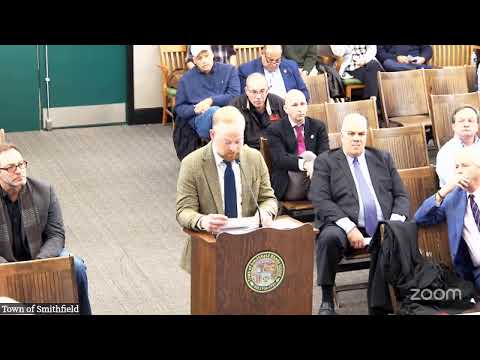
Organogenesis officials presented plans to the Smithfield Town Council to convert the vacant Hundred Technology Way (Hunter Tech) facility into a manufacturing site and asked the town to consider a tax-stabilization agreement to support the project.
Patrick Bilbo, chief operating officer for Organogenesis, said the company has signed a lease and intends to bring manufacturing back to the facility, citing both FDA-approved products and a multiyear plan to reestablish production. “Our hiring commitment, you know, at a minimum is, a hundred jobs,” Bilbo said, and he described a project he estimated would involve about a $100 million investment to ready the site.
The company said several products to be manufactured at the facility already hold FDA approval and that the facility work will include clean-room upgrades, validation, tech transfer and subsequent FDA inspection. Bilbo said the project will be staged and could begin limited commercial operations earlier in the program, while full construction and regulatory work will take multiple years.
Why it matters: Organogenesis is a publicly traded biotechnology manufacturer (NASDAQ: ORGO) with reported revenues in the hundreds of millions of dollars that promised higher-than-average wages and direct local economic activity. The company and state economic development partners said incentives and tax credits already under discussion are contingent on a local tax-stabilization agreement.
The town manager announced a public hearing for Jan. 7 to consider amendments to the town’s tax-stabilization ordinance (chapter 3.2.1, article 6) that would accommodate longer agreements. Matt Hambanke of PricewaterhouseCoopers, working with the company, said the draft tax-stabilization agreement discussed with staff is structured as a 15-year term with a five-year extender (20 years total) to match the lease term. “The current draft agreement that we've discussed with the town manager and the assessor is 20 years,” Hambanke said.
State-level context: Rhode Island state Senator David Takoy told the council he sponsored enabling legislation that the General Assembly passed earlier in 2024 and said it allows Smithfield to adopt 20-year tax-stabilization agreements. “At the request of the town council in 2024, I was asked to submit a piece of enabling legislation… it was subsequently passed by the Rhode Island General Assembly,” he said.
Public and procedural concerns surfaced over the application process and confidentiality. Resident Tom Hodgkins asked whether a confidential draft payment schedule should be withheld from the public and whether a tenant (lessee) is eligible for an agreement under the existing ordinance; town staff and council members said the ordinance currently contemplates agreements with property owners and that the application submitted lacked attachments and owner signatures.
Council action and next steps: After discussion, council members agreed to table the company's application until required paperwork and a revised application are submitted, and to proceed with the advertised Jan. 7 public hearing on proposed ordinance amendments. The council and budget/financial-review board will review the application and any final draft agreement in a public process once the application materials are complete.