Get Full Government Meeting Transcripts, Videos, & Alerts Forever!
Get email alerts on the Budget Projections topic
No spam. Unsubscribe anytime.
Coventry and school leaders outline five‑year budget projections, project a roughly $4.7M school deficit and press for CTE, transportation fixes
Summary
At a joint work session, town and school finance staff presented five‑year revenue/expenditure projections showing rising budgets and a school-side structural deficit estimated at about $4.7M; the meeting highlighted contested CTE tuition outflows, transportation costs, audit timing, and an RFP for employee benefits.
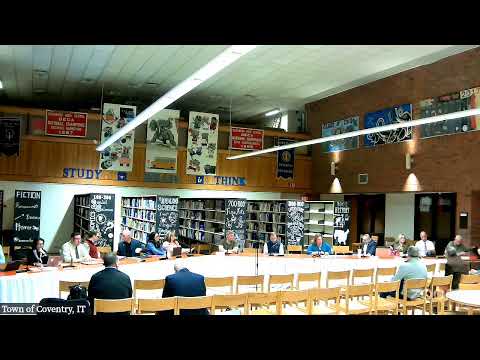
Coventry town and school officials presented a joint five‑year revenue and expenditure forecast during a work session that highlighted projected budget growth, audit timing and an estimated school operating shortfall.
Finance presenter Mister Civetti told the joint meeting that the town-wide budget is projected to grow over the five-year period modeled and that the property tax levy projections include year-to-year increases (examples cited in the presentation included roughly 3.25% in the first projected year). He noted the town expects additional revenue from a local solar farm "in the next couple of months," estimating "about a hundred 30,000 annually" from that source. Civetti also emphasized uncertainty in state education aid: the FY2025 state aid outperformed budget expectations by about $640,000 but future state support remains uncertain.
School-side presenters described their five‑year outlook showing the district's operating costs rising from roughly $80.6 million in the current year and noted staffing and compensation assumptions (for example, early years modeled at a 3% compensation increase, with smaller adjustments later). Both town and school teams said late entries and reconciliations reduced an initial $5 million shortfall estimate to a working figure of about $4.7 million to $4.8 million in cumulative structural deficit estimates; staff said they plan continued, biweekly reconciliation meetings to refine that number before the FY26 budget deadline.
Officials identified several drivers of high costs: purchased services (the transcript cites a purchased‑services line of roughly $11 million, driven primarily by out‑of‑district special‑education placements and associated transportation), rising health and dental expenses (projected increases cited near 6% annually), and the teacher salary line where prior lumped accounting created an underbudgeting for longevity and step increases that contributed to the shortfall.
School officials described actions taken to reduce risk and improve transparency: monthly principal budget reporting, a new employee salary schedule to capture step and longevity calculations, and steps to finalize outstanding audit work (the audit firm CLA was described as making final changes to the FY2023 draft with the goal of issuing FY2024 audit results by February, contingent on staff availability).
A prominent theme was CTE (career and technical education) tuition and transportation. Speakers said Coventry pays more than $2 million in tuition to other districts while receiving a little over $1 million in tuition from non‑resident students; transportation and unplanned student transfers create unbudgeted costs. School and council members discussed policy responses: tightening deadlines for CTE applications, improving notification/documentation processes for students accepted to out‑of‑district programs, and challenging or amending the "substantially similar" list used to determine program eligibility. Several members urged the school committee and council to coordinate on drafting legislative language and municipal resolutions and to enlist the League of Cities & Towns and local legislators to pursue statutory changes.
Staff also reported administrative next steps: posting the forecast and supporting documents on the school finance web pages, circulating a benefits RFP (to evaluate self‑insurance and trust options), and continuing joint budget meetings so council and school committee can reconcile assumptions ahead of formal FY26 budget submissions. Officials said some items — particularly state funding outcomes and final audit numbers — remain uncertain and will influence the final levy request.
The joint session closed with officials agreeing to continue meetings, provide requested documentation (detailed purchase‑services breakdowns and enrollment/FTE projections), and produce materials that would allow the council to evaluate policy and legislative options to reduce future outflows and stabilize the district's budget.