Get Full Government Meeting Transcripts, Videos, & Alerts Forever!
Get email alerts on the Board Self Evaluation topic
No spam. Unsubscribe anytime.
RSU 40 board reviews first baseline self-evaluation, agrees to unpack survey ahead of July 18
Summary
Facilitator Steve Bailey led a workshop reviewing a 26-question board self-evaluation completed by 14 respondents, highlighting gaps in orientation, mixed responses on student-learning focus, and media-relations concerns; members agreed to compile suggestions for follow-up on July 18.
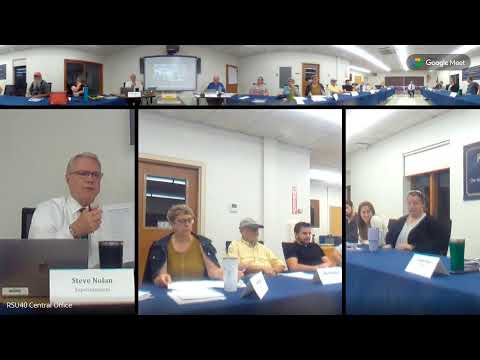
Facilitator Steve Bailey opened an RSU 40 board workshop and led members through the results of a board self-evaluation completed by 14 respondents, saying the data were presented as a baseline for future board development and alignment with the district's comprehensive education plan.
The board examined three district goals—student learning, personnel development and support, and financial and facilities oversight—and Bailey urged the group to consider whether the board's own goals and actions are aligned to support those priorities. "This is an overview based on the 14 people who filled this information out," Bailey said, describing the responses as a collective rather than an individual assessment.
Members flagged several recurring themes. Several said survey wording left room for divergent interpretations—most notably question 3 about annual goals, which some members thought should have elicited more consistent answers. Bailey suggested a two-step approach: first agree on how the board interprets core survey questions, then revise unclear items before the next administration.
On onboarding and orientation, board members described uneven experiences. Newer members said they lacked a clear mentor and struggled with meeting acronyms and procedures; more experienced members recommended a formal orientation and a designated resource person for procedural questions. The group identified the superintendent's job description and the evaluation tool as misaligned and recommended that alignment be a follow-up topic.
The workshop also included a sustained discussion about relations with the media and the tone of public meetings. Bailey said the board chair and superintendent typically serve as spokespersons and suggested the board could more actively promote positive district stories to counter negative coverage. Several participants criticized harsh public rhetoric at a recent meeting and on social media as damaging to students and community trust.
Bailey and the members agreed on next steps: board members will email suggested priorities and topics to a colleague who will compile the list and forward it to Bailey; Bailey offered to return for a follow-up session at the July 18 meeting to work through priority questions and recommended that the board use its policy and committees (policy committee was suggested) to carry forward any substantive policy or question changes.
The workshop did not produce formal votes or policy changes. Instead, members left with a set of suggested priorities for follow-up: revising unclear survey questions, developing a formal orientation/mentoring plan for new board members, aligning the superintendent job description with the evaluation, and adopting a coordinated approach to media relations. The board closed the session with agreement to reconvene on July 18 to continue the work.