Get Full Government Meeting Transcripts, Videos, & Alerts Forever!
Get email alerts on the Board Governance topic
No spam. Unsubscribe anytime.
RSU 40 workshop stresses duty to vote, public‑comment limits and social‑media guidance
Summary
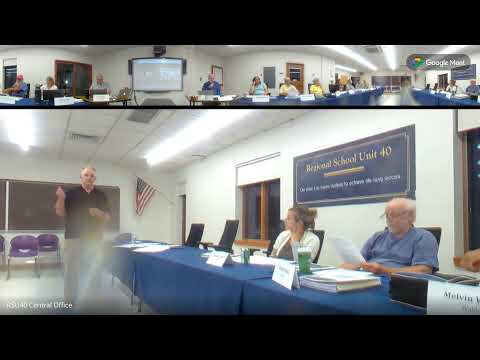
At a board workshop following its meeting, RSU 40 hosted Steve Bailey (MSMA) for orientation covering the board self‑evaluation, Maine Freedom of Access Act requirements, abstention policy, committee rules, confidentiality and new social‑media guidance.
The RSU 40 board held a governance workshop after its regular meeting, where Steve Bailey, executive director of the Maine School Management Association (MSMA), led an orientation on board practice and district policies.
Bailey reviewed results of a recent board self‑evaluation and offered concrete changes: clarify the survey response scale, reword questions so members evaluate the board’s performance (not their individual performance), and add a question asking how the board visibly supports the RSU 40 comprehensive education plan. "Please assess from your viewpoint the governing performance of the full board, not your individual performance," Bailey said while walking through the recommended survey revisions.
He emphasized rules and statutes that shape board behavior. Citing state law the presentation noted that the board must provide a public comment period at full meetings and that boards may set reasonable standards and time limits. Regarding abstentions, Bailey said, "Each member of a public body has the duty to express a choice or preference by voting on the issues, but can legally abstain when there is a statutory or ethical conflict of interest." Board member Emily raised a concern: "I think sometimes... abstention is used to hide someone's true feelings about a vote taker," which prompted discussion about norms and when abstentions are appropriate.
On public comment, Bailey summarized sample MSMA policy language and recent case law guidance: personnel matters should generally not be aired in public comment because of privacy and due‑process concerns; boards can prioritize in‑district speakers when time is limited but cannot bar non‑residents from speaking on education matters. He also advised that subcommittees should be publicized like regular meetings and that administrators invited to committee meetings may inform discussion but do not vote.
Bailey reviewed the board code of ethics, confidentiality for executive‑session business, and electronic‑communication rules under the Maine Freedom of Access Act. He recommended that board members avoid group decision‑making via email or text and suggested adding clear disclaimers on social media profiles distinguishing personal posts from official board positions. "Posting 'The views expressed on this page are my own and do not represent RSU 40' helps avoid confusion following recent court decisions," Bailey said.
Why it matters: the session covered governance fundamentals that shape how the board conducts public business, manages complaints, and preserves confidentiality. Members were encouraged to use the self‑evaluation results to set annual goals and align resources to the district’s comprehensive education plan.
What’s next: the board will take these recommendations under advisement, and policy committee work was suggested to draft any formal changes to the district policy manual.