Get Full Government Meeting Transcripts, Videos, & Alerts Forever!
Get email alerts on the Beach Management Plan topic
No spam. Unsubscribe anytime.
Flagler County commissioners direct staff to begin drafting beach management plan after workshop on sand sources, costs and permits
Summary
County consultants presented a beach management study and a planning 'Option 7' that would focus maintenance on the northern 11.6 miles; consultants reported offshore coring found potentially large sand resources but warned hard‑bottom rock could raise mitigation costs and permitting complexity. Commissioners asked staff to start the plan, funding study and permit work.
Flagler County commissioners on Wednesday directed staff to begin drafting a long‑term beach management plan after a workshop where consultants described offshore sand resources, construction options and significant permitting and funding hurdles.
Chris Creed, a coastal engineering consultant with Olson Associates, told the Board the county needs a programmatic plan to move beyond piecemeal, post‑storm repairs and to guide project scope, phasing and funding. "We believe now that we have possibly up to ... 20,000,000 cubic yards of sand suitable for placement on the beach available to Flagler County," Creed said, describing recent coring in an offshore area he called Area 3A.
Why it matters: consultants said the county faces a multi‑decade maintenance commitment and large up‑front costs. Creed presented a planning scenario he called "Option 7," which would build an initial project and then focus routine maintenance on the northern 11.6 miles over a 50‑year planning horizon. He estimated an initial project on the order of $100 million and annualized future maintenance in the rough range of $3 million to $4.5 million per year, depending on construction approach and renourishment interval.
The plan will need federal and state permits. Creed warned hard‑bottom (coquina rock) in the northern reaches could force construction methods that avoid direct hydraulic placement or, alternatively, require mitigation under fisheries and habitat laws. "If you're gonna impact hard bottom, there's going to have to be mitigation," he said, noting mitigation reefs and other compensatory measures can be complex and expensive.
Construction trade‑offs: the presentation described two primary approaches. Hydraulic dredging pumps sand ashore directly and is the most cost‑effective method but risks impacts to nearshore rock and associated mitigation. Stockpiling and mechanical rehandling—dredging to an on‑beach stockpile and using trucks and excavators to redistribute sand—can avoid hard‑bottom impacts but raises per‑yard costs (Creed cited example rehandling costs near $50 per cubic yard and added monitoring contingencies of roughly $500,000 per year).
Funding picture: Creed said the county already has some external funding identified — roughly $18 million from the Army Corps and $14 million in a DOT grant to support the federal Flagler Beach project, as well as approximately $41 million in DEP supplemental and eligible FEMA assistance — but that a substantial funding gap remains for the assumed Option 7 scope. Amy Lukaszczuk, the county's tourism development director, told commissioners the upcoming fiscal year projection for bed‑tax contributions to the renourishment bucket is about $850,000 before fees and encumbrances.
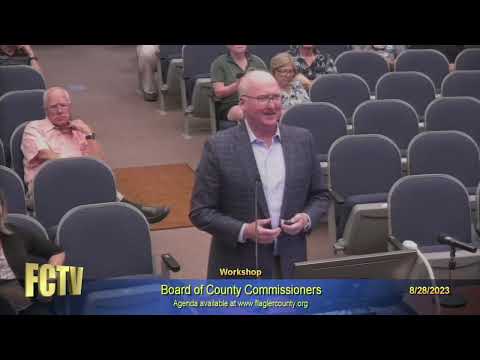
Public input and next steps: during public comment, shoreline residents and property‑owner association representatives urged swift action. John Gass of the Hammock Dunes Shoreline Management Committee said, "We need to get on with a long term comprehensive beach management plan," and asked the county to move quickly on a joint coastal permit (JCP) application and a local funding study. Other residents urged careful prioritization to protect homes and infrastructure and recommended starting a hard‑bottom characterization as soon as possible.
Board direction: commissioners discussed phasing, prioritization and whether the county or the city of Flagler Beach should administer future maintenance. Multiple commissioners expressed a desire to start drafting a plan and to initiate the funding study and permitting work. One commissioner summarized the board's posture: "Let's write the **** thing," after which members signaled agreement to begin plan development, pursue the JCP and commission the recommended studies.
What's next: staff said the county will complete the offshore coring report, move forward with a funding study and survey, and begin permitting steps (DEP and Army Corps) and any required biological/hard‑bottom characterization. The schedule and final project scope will depend on permit outcomes, final engineering and new funding commitments.
No formal vote was recorded at the workshop; commissioners provided direction to staff to proceed with drafting the plan and advancing the funding and permitting efforts.