Get Full Government Meeting Transcripts, Videos, & Alerts Forever!
Get email alerts on the Local Taxes topic
No spam. Unsubscribe anytime.
Peachtree City town hall explains HB 581’s homestead cap and countywide sales‑tax option ahead of March opt‑out deadline
Summary
City officials laid out how House Bill 581 would cap annual assessment growth for homesteads at inflation and allow a countywide flexible sales tax (FLOST) to offset revenue losses; residents pressed officials on long‑term millage pressure, distribution and whether the schools will opt out.
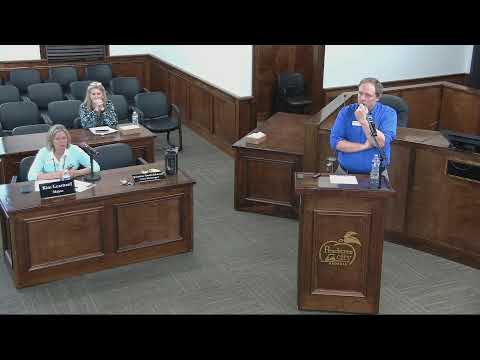
Peachtree City officials held a town hall to explain House Bill 581 and to gather residents’ questions on how the measure would affect local property taxes and services.
Mayor Kim Leonard opened the session by telling residents the meeting’s purpose: “Our goal tonight is to discuss and review a new law, House Bill 581, that, as it turns out, will be very impactful on our property taxes.” She and City Manager Justin Strickland said the meeting was informational and that council would not vote tonight.
Justin Strickland, the city manager, summarized the bill’s two central features. First, HB 581 creates a statewide floating homestead exemption that limits the annual increase in taxable value for an owner‑occupied homestead to the rate of inflation — typically the Consumer Price Index — rather than the full change in fair market value. “Basically if we opt into this, your rate for 2025 … based on the rate of inflation … your value cannot go higher than that,” Strickland said. He added that the exemption resets when a home is sold and does not transfer to a new owner.
Second, HB 581 authorizes a countywide flexible local option sales tax (FLOST) of between 0.5¢ and 1¢ to be placed before voters to replace property‑tax revenue lost from the exemption. Strickland described the FLOST as a revenue‑neutral mechanism: “Whatever you bring in, in this new sales tax, if approved, you have to reduce your property tax by that much.” He said any FLOST revenue that exceeds the amount needed for property‑tax relief must be offset by a commensurate millage rollback that applies to all property classes, including commercial and rental property.
Officials warned of tradeoffs and timing. Mayor Leonard and Strickland noted that opting out is a local decision that requires specific procedures — advertising, three public hearings and a letter to the Secretary of State — to be completed before March 1, 2025; failure to complete those steps means the jurisdiction remains in the exemption by default. Strickland said Peachtree City’s millage rate is currently 5.983 mills and the city collects roughly $24 million a year in property tax revenue, with about half of that amount coming from homesteaded property. He estimated the city’s exposure from the homestead exemption could be in the range of $3–4 million over time but emphasized the figures are preliminary.
Residents raised questions about the size and distribution of a potential FLOST, whether all jurisdictions in Fayette County must opt into the exemption to run the FLOST, and how sales tax receipts would be shared. Strickland said the FLOST runs countywide and that municipalities and the county would negotiate an intergovernmental distribution, similar to how LOST or SPLOST distributions are handled. He said a full penny was the likeliest FLOST discussion point but that the statute allows between half a penny and a penny.
Leanne Bartlett, the Fayette County chief appraiser, addressed technical questions about assessment notices and existing school exemptions, saying the Fayette County Board of Education already uses a floating homestead structure and that taxpayers receive whichever exemption is better for them. “On your assessment notice it’s still gonna show as the fair market value of your property. The difference is gonna be the difference between that fair market value and your adjusted base value,” Bartlett said.
Multiple residents urged caution about long‑term effects on city services and public safety, warning that slower revenue growth could force the city to delay hires or reduce service expansions. Strickland replied that slower revenue growth would mean the city must plan within a more constrained revenue path and that officials would try to avoid raising the millage rate if possible.
Mayor Leonard closed by thanking attendees and noting the city will continue countywide conversations with Fayetteville, Tyrone, Brooks, Woolsey and the county before any final decision on opting out.
Next steps: local governments must complete the opt‑out procedures before March 1, 2025; residents who want more information were directed to the city’s website for follow‑up and to upcoming public hearings.