Get Full Government Meeting Transcripts, Videos, & Alerts Forever!
Get email alerts on the Unified Development Ordinance topic
No spam. Unsubscribe anytime.
Peachtree City planning commissioners map UDO rewrite, set November presentation to Council
Summary
At a Sept. 9 Planning Commission workshop, commissioners reviewed a compiled list of UDO questions, agreed to emphasize performance standards over prescriptive specs, discussed committee membership and consultant budgeting, and directed staff to prepare a late-November presentation to City Council.
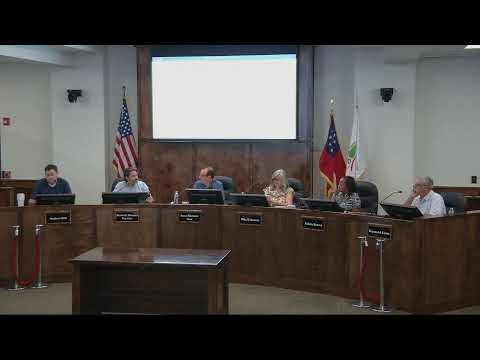
Peachtree City’s Planning Commission used its Sept. 9 workshop to refine questions and process steps for a long-planned rewrite of the city’s Unified Development Ordinance, instruct staff to prepare a presentation for City Council in November, and discuss committee membership, funding and consultant needs.
Commissioners heard that the rewrite is intended as a reorganization and clarification of existing ordinances rather than a wholesale recreation. A staff member said the compiled document before the commission collects questions raised by commissioners and Council and will help frame the November presentation. “Allow for creativity while promoting cohesiveness,” a staff member said, summarizing the approach the commission agreed to recommend.
Several commissioners told staff that City Council members they had spoken with are concerned about overly prescriptive design rules that could make new buildings look identical. Commissioners responded that the UDO draft will emphasize performance standards and district themes rather than mandating a single manufacturer, material or fixture. As one commissioner put it, the UDO should set “goal posts” while leaving room for design flexibility.
Practical items the commission asked staff to consider include golf-cart parking and how such parking connects to cart paths, and the future inclusion of electric-vehicle charging infrastructure in applicable sections. Staff also flagged technical housekeeping fixes: consolidating duplicative sections, moving provisions out of definitions and into ordinance text, and clarifying terms (for example, distinguishing an “overstory tree” from a “canopy tree”).
The commission discussed committee composition, concluding not to appoint a sitting City Council member to the UDO working group but to update Council regularly and loop in subject-matter experts when needed. Commissioners emphasized managing public input to avoid “analysis paralysis” by controlling meeting topics and using targeted agendas or checklists.
On funding and procurement, staff said a consultant will likely be needed and estimated the professional cost would be “more than $40,000,” which would require a competitive RFP; commissioners recalled prior UDO work in which budget estimates exceeded $100,000. Staff noted there is a remaining CIP allocation from prior work that could be tapped pending Council approval, and described other local funding pots (SPLOST, general fund contingency) that Council controls.
Staff also advised that most regional planning grants (for example, through the metropolitan planning organization or the Atlanta Regional Commission) are targeted to specific infrastructure projects rather than a general UDO rewrite; implementation grants may be available later if the UDO identifies specific projects (for example EV infrastructure or an affordable-housing initiative).
Other topics covered included collecting comparables from Metro Atlanta UDOs and providing a project library (SharePoint) for documents, clarifying remote participation rules (discussion-only virtual meetings allowed; formal hearings or votes likely require in-person presence), and considering additional checklist items for concept plans such as limits of disturbance and identified retained trees.
The commission directed staff to continue refining the draft, to identify gaps for the presentation, and to return with a presentation for City Council in November. Commissioners voted to approve the Aug. 26 minutes earlier in the meeting and later moved to adjourn.
Votes at a glance - Motion to approve Aug. 26 minutes: moved by Speaker 2, seconded by Speaker 1; voice vote, outcome: approved (verbal 'ayes' recorded). (SEG 057–069) - Motion to adjourn: moved by Speaker 1, seconded by Speaker 7; voice vote, outcome: approved. (SEG 1340–1347)
What happens next Staff (Speaker 4) will prepare the Council presentation, flag any gaps, and circulate materials to commissioners. The commission expects to keep Council updated during the multi-phase project and to use consultants and outside experts as needed.