Get Full Government Meeting Transcripts, Videos, & Alerts Forever!
Get email alerts on the Administrative Variance Ordinance topic
No spam. Unsubscribe anytime.
Commission opens public hearing on administrative-variance ordinance, tables decision to July 22 for more work
Summary
Commissioners opened a council-initiated public hearing on proposed changes to Peachtree City—s Administrative Variance Ordinance — including proposals to reduce allowed rear-setback and parking reductions and to change decision-makers — and directed staff to return with additional ordinance text, comparative ordinances, and approval-rate data before resuming deliberations July 22.
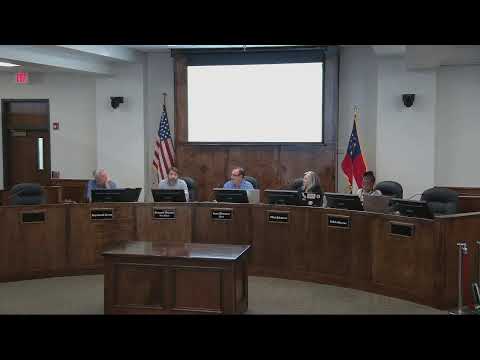
The Peachtree City Planning Commission on June 24 opened a public hearing and lengthy discussion on a council-initiated zoning text amendment proposing revisions to the city—s Administrative Variance Ordinance and then voted to table further deliberations to the commission—s July 22 meeting to allow staff to provide more information.
Staff framed the hearing as council-initiated and explained that the commission was asked for review and comment, not for a time-bound recommendation. The presentation summarized three decision categories — ministerial, quasi-judicial and legislative — and described the five types of requests currently eligible for the administrative-variance process: existing setback encroachments created by a prior owner; rear-setback encroachments up to 50%; setbacks adjacent to public land up to 25%; parking reductions up to 25%; and fence-height increases up to 25.
Staff also described the administrative-variance committee (zoning administrator/planning director/city manager/a council member), review criteria (no substantial detriment to surrounding properties; not impair the zoning ordinance—s purpose), and a short history of ordinance changes. Staff said most administrative requests in recent years appeared residential and flagged that the 50% rear-setback category is larger than similar provisions in peer jurisdictions.
Council members had proposed alternatives ranging from sequential single-person approvals to reducing maximums (examples included lowering a 50% rear setback allowance to 2 feet or 25%), eliminating written-neighbor-consent requirements, or converting the process to a single administrative decision maker. Staff summarized those council comments but noted members were divided.
Only one public commenter attended: Council member Suzanne Brown spoke as a citizen and urged the commission to clarify the ordinance—s intent (residential vs. commercial) and reiterated her sequential-review idea to ease scheduling and minute-taking. Commissioners asked for and staff committed to provide the full ordinance texts from peer jurisdictions, the approval-rate data (how many applications were approved vs. received), and clarifications on public-notice and the proposed timeframes.
In discussion commissioners expressed split views: some favored keeping a multi-person committee to avoid concentrating controversial decisions on one staff member, while others supported moving to a single decision maker but narrowing the types of requests that qualify administratively (with several commissioners calling the 50% rear-setback limit too large for ministerial action). Several commissioners suggested certified notice with a passive objection window as an alternative to requiring neighbors to actively sign written consent.
After debate the commission voted to table the item to July 22 so staff can return with the requested ordinance language, comparative ordinances, and approval-rate statistics. Staff said it will provide those materials in a format intended to help commissioners focus on policy choices rather than raw summaries.