Get Full Government Meeting Transcripts, Videos, & Alerts Forever!
Get email alerts on the Elections topic
No spam. Unsubscribe anytime.
Peachtree City council declines motion to start feasibility study on running its own municipal elections
Summary
Council debated whether Peachtree City should commission a third‑party feasibility study or form a committee to assess running its own municipal elections; after extensive questions about cost, staffing and liability, a motion to begin a committee/study failed on a 3‑2 vote.
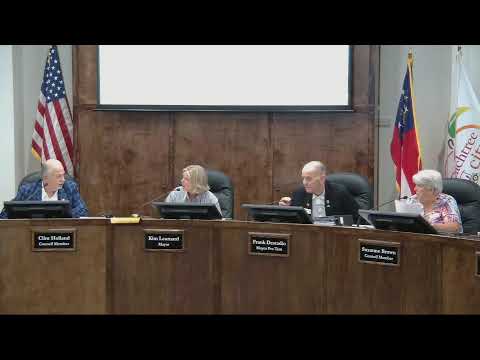
Peachtree City — The City Council debated a proposal July 24 to study whether the city should run its own municipal elections instead of paying Fayette County to do so, but a motion to authorize a feasibility study using a council‑appointed committee failed.
City staffer Stacy Collins told the council the clerk’s office had solicited proposals and received two bids: Gaither & Company at $30,000 with a three‑month timeline and Crumby Consulting Solutions at $27,000 with a two‑month timeline. Collins outlined statutory requirements for a municipal‑run election (citing OCGA 21‑2‑385(d)(1)), including required early‑voting hours, minimum staff at polling locations and options for ballot and tabulation methods.
Councilwoman Brown urged the council to proceed, proposing a seven‑member feasibility committee (one council member, two citizen members, two subject‑matter experts and two non‑voting city staff) and argued that hand‑marked, hand‑counted paper ballots can increase voter confidence. Brown cited recent litigation (Curling v. Raffensperger) and criticized existing voting equipment, saying a move away from machine‑counted ballots could be both more transparent and cost‑effective in the long run.
Other council members pushed back, citing Milton’s experience — where projected savings did not materialize and total costs proved higher than early forecasts — and raising concerns about staffing, year‑round administrative burden, legal liabilities and potential conflicts of interest if the city ran its own elections. Several councilors noted that Fayette County currently charges about $1.35 per registered voter for general elections and that county invoices have sometimes been negotiated down after they were issued.
After discussion, a motion to authorize the proposed feasibility committee and study was seconded and put to a vote; the motion failed on a recorded voice vote, with the mayor announcing “2 to vote. The motion does not carry.” Council did not adopt any study or committee at the meeting.
What happens next: Council members noted they still want better cost data and a fuller accounting of what municipal administration would require, but no new action was approved at this meeting. Any further study or a future formal request to the legislative delegation on charter changes would require later council action.
Quotes: "We must get it done before the MOU is required...we're already behind the power curve," Councilman (unnamed) said during the discussion, urging timely study.
"Running our own municipal elections is a choice that we can make," Councilwoman Brown said, urging a committee approach and emphasizing citizen confidence in hand‑counted paper ballots.
Ending: The council left open the possibility of revisiting the question, but at this meeting it declined to authorize the proposed feasibility study or committee.