Get Full Government Meeting Transcripts, Videos, & Alerts Forever!
Get email alerts on the Ambulance Service topic
No spam. Unsubscribe anytime.
Orland council agrees to short-term aid, seeks county partner to shore up Westside Ambulance
Summary
Facing steep reimbursement shortfalls and rising costs, Westside Ambulance asked Orland for immediate monthly support; council moved to split a $17,000 monthly subsidy between Measure A and Measure J for a limited period and to form an ad-hoc city–county committee to pursue longer-term solutions.
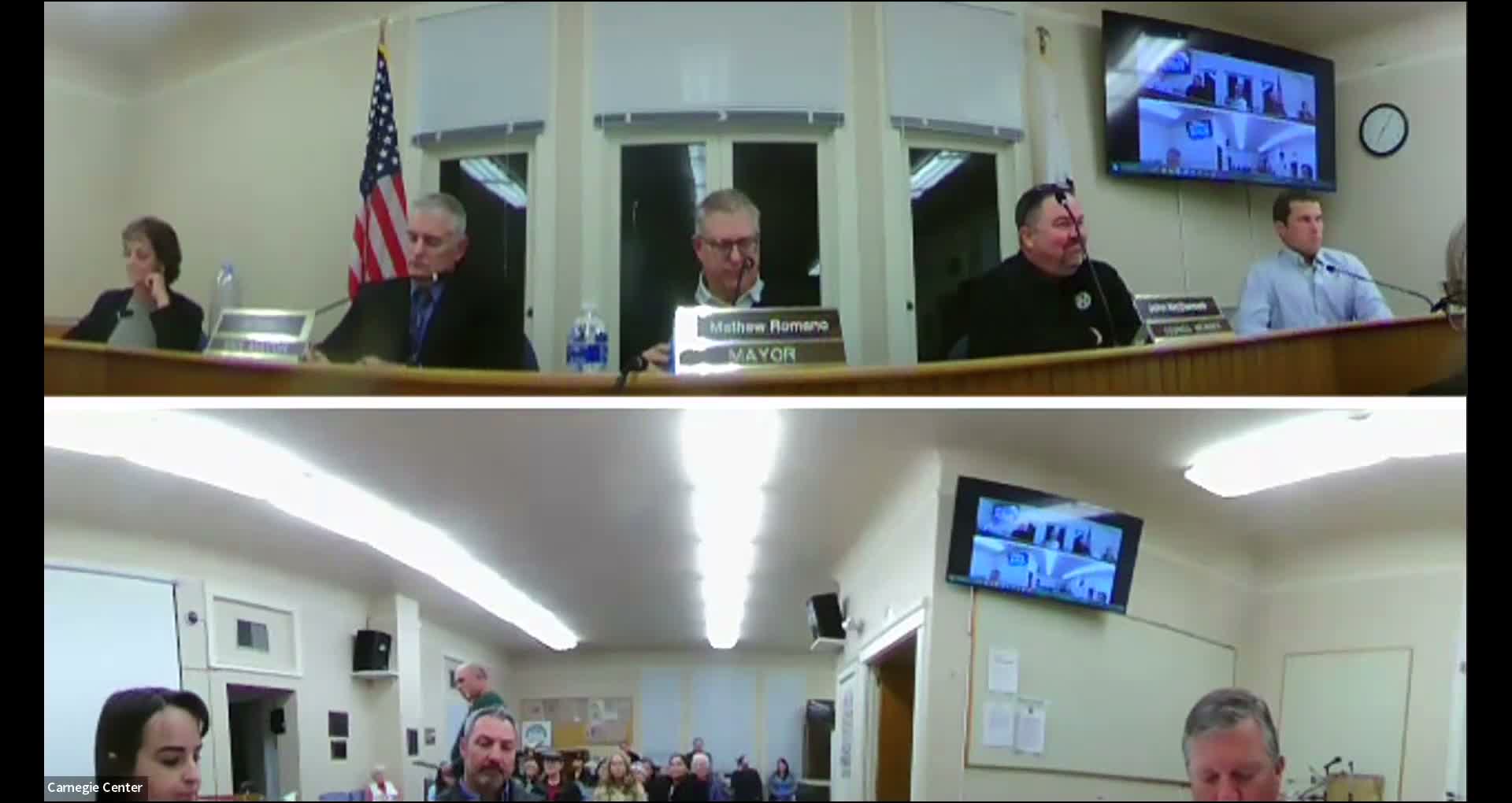
The Orland City Council voted to provide short-term financial support to Westside Ambulance and asked staff to pursue a joint city–county approach for a lasting fix. The council’s motion, made by a council member and seconded by the mayor, proposed splitting a $17,000 monthly support package 50/50 between Measure A and Measure J and extending that support while the parties pursue county participation and structural reforms.
The request followed a detailed presentation from Scott Schmidmaker, a Westside board member, who told the council the nonprofit ambulance provider has been losing money and is at risk of becoming insolvent. "We're afloat, but our bank account was like $184,000 lost in the last 18 months," Schmidmaker said, explaining that low Medicaid/Medi-Cal and Medicare reimbursements — sometimes as little as about $150 per transport while actual costs approach $900 — are the core challenge. He described aging vehicles, rising supply and labor costs, and an operational model that relies heavily on non-reimbursed calls.
John Paul, regional executive director of the Sierra Sacramento Valley Emergency Medical Services Agency, told the council rural EMS providers around the region face similar pressures and that even modest increases in reimbursements are unlikely alone to restore long-term sustainability. "Rural EMS is really struggling right now," Paul said, noting that several neighboring systems have shuttered in recent years and that state reimbursement programs have uncertain futures.
Council members debated short- and long-term options. Some members pointed to the sales-tax funding model used by nearby counties to subsidize ambulance service; others urged options to improve provider pay and recruitment to retain medics. At least one council member said Measure J (a more recent local tax) and older Measure A funds could be tapped together for the temporary assistance. Several council members called for an ad-hoc committee with county participation to codify shared funding, pursue grant opportunities (including GEMT/GMT-related reimbursements), and study whether a nonprofit or contracted private model best suits the region.
The motion recorded in the meeting moved the funding proposal to a roll-call vote; council proceeded with implementation steps and directed staff to return with details on accounting, fund availability, and the ad-hoc committee structure. The motion text on the record: "I move that we fund Westside 50% from Measure A, 50% from Measure J at $17,000 a month, with hopes that the county will come on board to share that cost."
Council asked staff to detail where the Measure A and J balances sit, to account for other promised uses of those funds, and to return to the council with a formal agreement and timeline. Staff and council did not set a final long-term model at the meeting; the ad-hoc committee was the next procedural step.
Next steps: staff will prepare the formal funding allocation and a proposal for a city–county ad-hoc committee to pursue durable funding, regulatory options, and recruitment/retention incentives for EMS personnel.