Get Full Government Meeting Transcripts, Videos, & Alerts Forever!
Get email alerts on the Homelessness Services topic
No spam. Unsubscribe anytime.
Consultant presents Lakes Region homelessness study, recommends one-stop service hub and site analysis
Summary
A consultant to Cumberland County presented the final Lakes Region Homeless Study, estimating at least 30 people experiencing homelessness, recommending a one-stop service hub (about 30 beds) and identifying 17'18 candidate sites; construction costs were estimated at roughly $6.5'$8 million with operating costs near $1 million annually.
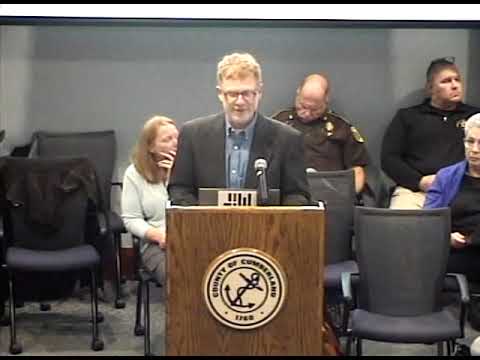
A consultant from Levine Planning Strategies LLC presented the final Lakes Region Homeless Study to the Cumberland County commissioners, summarizing interviews, listening sessions and focus groups and recommending a centralized service hub that could include overnight beds and day services.
The consultant said the study found at least "30 people experiencing homelessness in this area" as a conservative minimum and that figures are likely higher given the rural context and many people who couch-surf or sleep in woods and barns. He identified transportation and housing prices as the primary drivers, and said many people who are homeless in the Lakes Region prefer to stay in the area rather than seek shelter in Portland.
To address the needs, the report recommends a one-stop service center or service hub located near Lakes Region Explorer transit routes where possible, with longer-term-stay design features that could include separate spaces for individuals and families, pet accommodations, locked storage, showers, day space, access to computers, beds with charging stations, laundry and on-site food-prep areas. The consultant said a useful model is the new homeless service center in Portland, while noting the region is unlikely to support a facility at that scale.
On siting, the consultant said an initial screening identified roughly 17'18 larger parcels that could accommodate a center and several smaller properties that might serve a scaled-down facility. Candidate sites were discussed by town (Bridgeton, Naples, Windham, Standish) and include hospital-owned land, community centers, a school-district property, privately owned tracts (including a parcel listed in the report as held by Norway Savings Bank), and town-owned parcels. The presentation repeatedly cautioned many sites are privately held, may require zoning changes and that no site is without complications.
Cost estimates were presented as order-of-magnitude. Under baseline assumptions (new construction, minimal site-prep, roughly 15,000 sq ft to accommodate about 30 beds), construction was estimated in the range of $6.5 million to $8 million. Operating costs were presented as an "order of magnitude" estimate of about $1 million per year, with the caveat that some operating functions could be carried by existing services consolidated at the center.
The consultant emphasized next steps would be for county staff and commissioners to decide whether to pursue land control, refine the program and identify partners. He recommended a community advisory board to coordinate providers and neighbors, mobile outreach to address transportation barriers, improved data collection to better estimate need, and landlord engagement strategies to increase voucher acceptance.
County staff said limited ARPA funds have been allocated to begin implementation work and that a community presentation in the Lakes Region will be scheduled to share findings and seek partnerships. The consultant noted all figures and site identifications are preliminary and would change if the county selects a program with different scope or site-control conditions.