Get Full Government Meeting Transcripts, Videos, & Alerts Forever!
Get email alerts on the Environment Climate Ccs topic
No spam. Unsubscribe anytime.
Railroad Commission outlines Class 6 CO2 storage permitting; says Galveston County project is in early review
Summary
At a March 3 Galveston County workshop, Railroad Commission staff described Class 6 wells for deep geologic CO2 storage, explained technical and safety safeguards, and said an application for a Galveston County project has been submitted and is still in initial permit review.
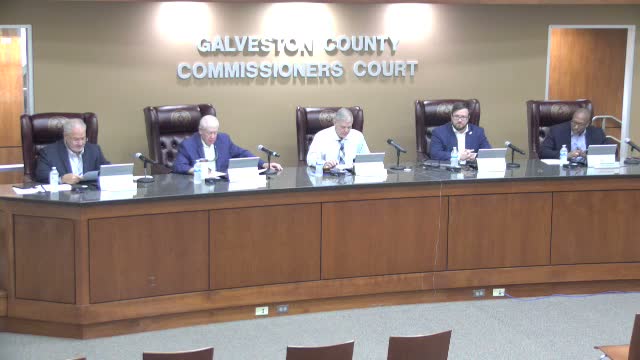
Leslie Savage, identified as chief geologist with the Railroad Commission of Texas’ oil and gas division, told the Galveston County Commissioners Court on March 3 that the commission is providing information about Class 6 wells — deep geologic storage of carbon dioxide — and that a project application referencing Galveston County is in the early stages of the permitting process.
"I'm Leslie Savage. I've been with Railroad Commission for 41 years. I'm the chief geologist of the oil and gas division and, the, the point of contact for the class 6 primacy," Savage said during the workshop presentation. The session was framed as outreach and information-sharing rather than a project hearing.
The Railroad Commission presenter said Class 6 wells are used for permanent, deep storage of CO2, typically about 5,000 to 10,000 feet below ground. "Typically, it's anywhere like 5,000 foot down to like 10,000 foot," the presenter said, adding that site selection relies on detailed geological modeling, 3D seismic and fault analyses to identify suitable confining layers and reduce upward migration risk.
Commission staff outlined the technical and administrative safeguards required of applicants: pre-injection testing to confirm rock suitability, detailed reservoir modeling and plume prediction, ongoing monitoring during injection and for decades after closure, emergency-response plans, and financial assurance in the form of bonds or letters of credit that must be maintained and adjusted annually to cover closure and remediation costs.
The commission emphasized engineering controls to address CO2-related corrosion and potential carbonic-acid effects in the presence of water, including specialized cementing and metallurgical measures for well construction. Staff also noted pipeline safety is handled through a related division; CO2 is transported as a high-pressure liquid in pipelines (the presenter cited pressure ranges of roughly 1,200 to 2,000 psi) and owners must file emergency-response plans and coordinate with regional emergency officials.
In response to questions, staff said they were not aware of instances where subsurface water supplies had been contaminated by geologic CO2 storage, but acknowledged past pipeline releases have occurred and informed updated rules and notification practices. Leslie Savage noted examples in other states and said the commission has incorporated lessons from those incidents into its rules.
The Railroad Commission also discussed the federal-state relationship for regulation. Staff said Texas has applied for primacy — authority delegated by the U.S. Environmental Protection Agency — but at present applicants must secure both an EPA permit and a Railroad Commission permit while the state coordinates with EPA. The presenters stated they currently have about 15 Class 6 applications in the system and that some proposed sites are along the Gulf Coast; the Galveston County application is in early, pre-draft stages.
The workshop concluded with staff encouraging early community outreach by project proponents and explaining that draft permits will include formal public comment opportunities and, if contested, protest hearings conducted under the commission's processes. The County workshop adjourned at 10:11 a.m.
Next steps: Railroad Commission staff said they expect to share updates with local officials as individual applications progress toward draft-permit stages and formal public-notice periods.