Get Full Government Meeting Transcripts, Videos, & Alerts Forever!
Get email alerts on the Climate Commitment Act topic
No spam. Unsubscribe anytime.
Bill to adjust Climate Commitment Act auctions and add market analysis draws mixed views on liquidity and timing
Summary
HB 1975 would change the Climate Commitment Act's auction mechanics to boost near‑term liquidity, cap price ceilings for 2026–27, and require additional economic modeling. Proponents say the bill reduces price spikes; Ecology cautioned about shifting allowances and potential delays in emissions reductions.
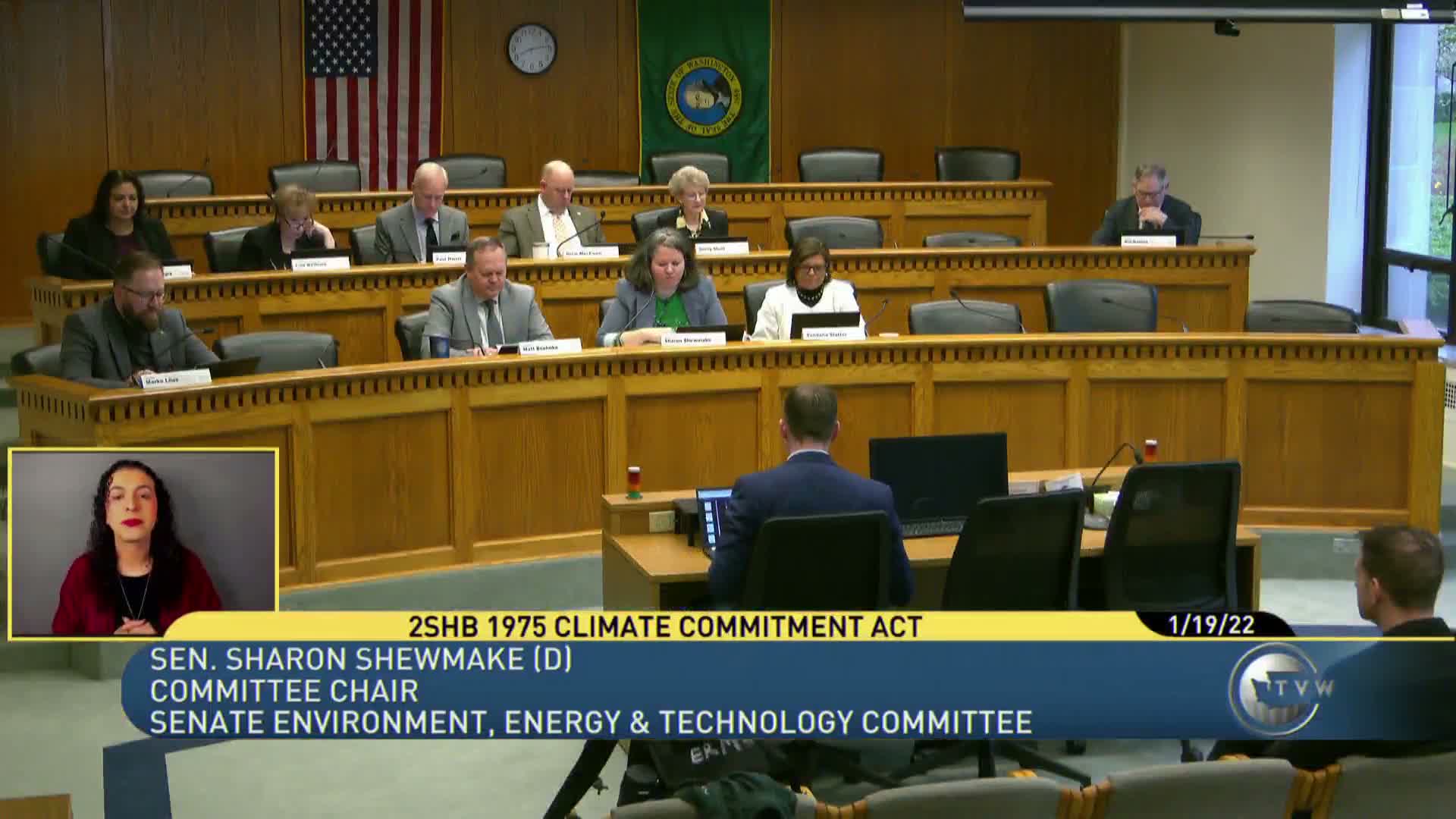
The Senate Environment, Energy & Technology Committee heard HB 1975, a measure that would amend the Climate Commitment Act's market design to add near‑term liquidity and require enhanced economic modeling by the Department of Ecology.
Staff explained core changes: the bill shifts some allowances from future years into the allowance price containment reserve (APCR) for earlier use, caps the auction price ceiling at $80 in 2026 and 2027 unless linkage requires otherwise, and mandates Ecology provide periodic market and economic modeling, including linkage scenarios. A fiscal note estimated roughly $4.5 million in operating costs over the four‑year outlook from the climate investment account.
Support and rationale Proponents including Isaac Castellaw (Clean and Prosperous Washington) and the Association of Washington Business argued the changes would reduce the risk of price spikes as the program approaches potential linkage with California and Quebec, improve market liquidity and create more predictable conditions for covered entities.
Technical concerns and tradeoffs Department of Ecology staff said the bill's shift could ease near‑term compliance but might complicate the state's ability to allocate allowances for emissions‑intensive, trade‑exposed industries in later years and could delay some transitions for frontline communities. Ecology and other witnesses urged that the additional economic modeling required by the bill would be useful to understand net effects.
Consumer price questions Members questioned whether allowance or credit prices map directly to pump prices. Witnesses noted multiple drivers of retail fuel prices (crude oil, supply chain, taxes/fees) and that pass‑through from allowance/credit prices is often partial; several participants recommended further modeling to quantify consumer impacts.
Procedural status: The committee closed the public hearing after extensive testimony and indicated further work and modeling will inform any amendments and votes.