Get Full Government Meeting Transcripts, Videos, & Alerts Forever!
Get email alerts on the Clean Buildings topic
No spam. Unsubscribe anytime.
Senate committee considers HB 1543 to expand compliance options for the Clean Buildings standard, with K–12 and historic building provisions
Summary
HB 1543 would authorize alternative compliance metrics, allow extensions and exemptions for financial hardship, and clarify rules for historic and K–12 school buildings. School districts and building owners urged flexibility; unions and building advocates sought narrower exemption language to ensure retrofit jobs proceed.
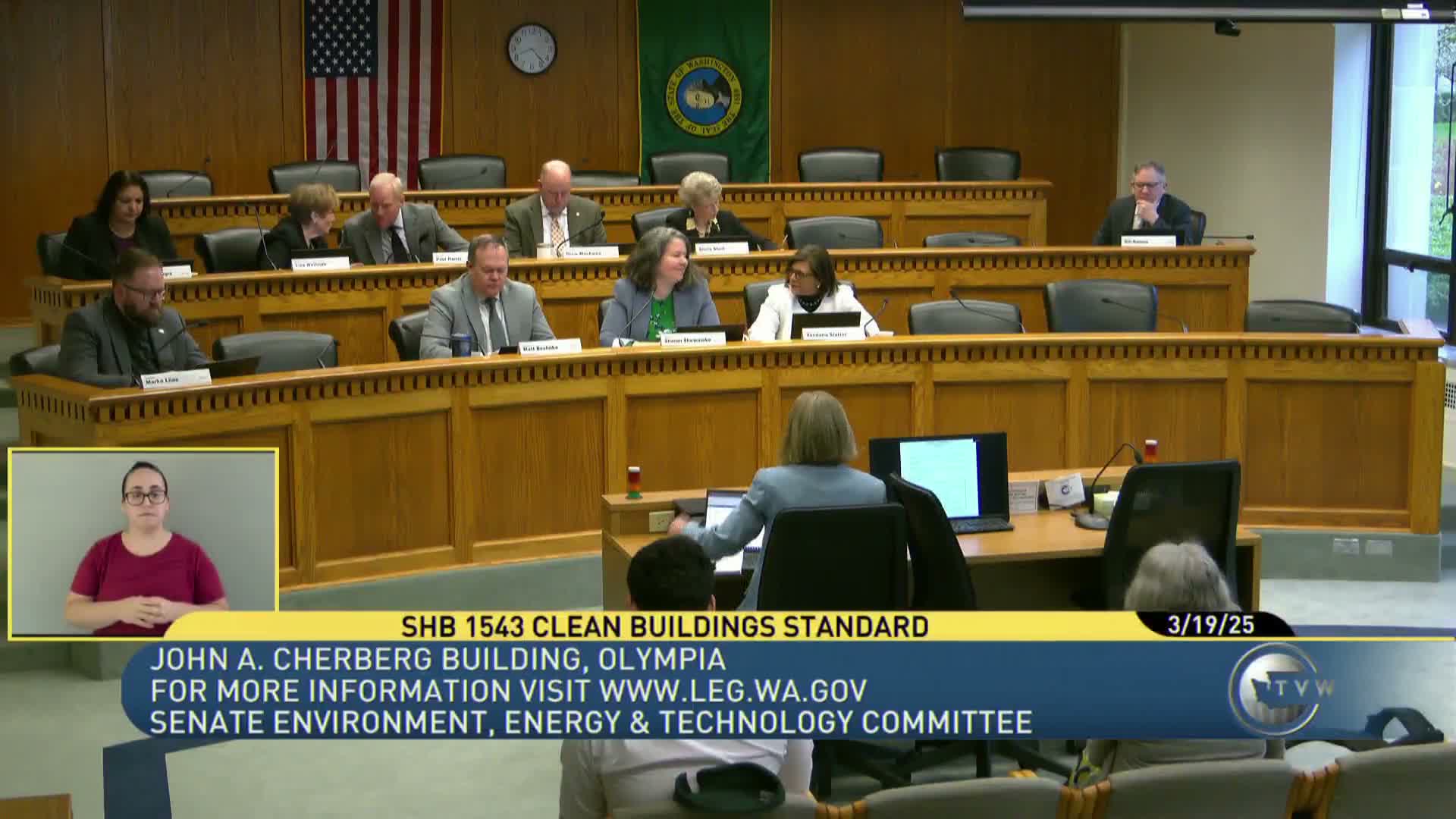
The Senate Environment, Energy & Technology Committee heard testimony on HB 1543, a striker bill that would expand compliance pathways and allow extensions under Washington's Clean Buildings performance standard.
Kim Cushing, staff to the committee, said the bill authorizes Commerce to approve alternative metrics in place of energy‑use‑intensity targets, permits extensions up to two years (with renewal options), clarifies exemptions for manufacturing or industrial buildings and for buildings with financial hardship, and directs utilities to provide building energy consumption data to covered buildings.
Sponsor remarks and rationale Representative Beth Dolio (appearing as the bill sponsor in testimony) said the measure reflects extensive stakeholder work and recognizes that existing buildings account for roughly 30% of greenhouse gas emissions from the built environment. She told the committee the measure is intended to give building owners, including school districts, more flexibility and to avoid forcing unsafe or fiscally impossible changes.
Public testimony highlights - School district witnesses (Jason Morris and Martin Tierney, Issaquah School District and Puget Sound Schools Coalition) described funding challenges: Tierney said his district placed a $130,000,000 bond on the November 2024 ballot that failed, leaving the district without funds to comply and arguing for a broader definition of financial hardship. - Independent schools and education associations asked for clarified priority language so health and safety repairs (for example from wildfire smoke or water damage) would be prioritized over energy projects when necessary. Emily Salzberg of Commerce said the striking amendment adds clarity for public and private schools and refines handling of historic buildings. - Developers and downtown business groups urged consideration of five‑year exemptions or tailored standards for historic properties to encourage redevelopment for housing and retail. - Unions and electricians (IBW Local 46, WAMOA) supported the bill's goals but urged that exemptions be narrow to ensure retrofit work creates jobs.
Concerns and unresolved points Witnesses and some advocates urged narrower wording on K–12 exemptions so that bond failures directly tied to compliance funding—not any failed bond—would qualify. Tenant/owner penalty pass‑through rules and documentation standards for financial hardship were also raised.
Procedural status: The committee concluded the public hearing on HB 1543; no vote was taken during this session.
Next steps: Committee members and staff indicated further refinement and possible amendments will follow, including more detailed language to limit the scope of exemptions and clarify documentation requirements.