Get Full Government Meeting Transcripts, Videos, & Alerts Forever!
Get email alerts on the Supply Chain Infrastructure topic
No spam. Unsubscribe anytime.
Committee hears testimony supporting Senate Bill 5649 to fund port and supply-chain projects
Summary
Lawmakers and port, seaport-alliance and tribal representatives urged support for Senate Bill 5649, which would create a state program to provide grants and loans for projects listed in freight development plans; witnesses said the bill establishes a framework but includes no immediate funding commitments.
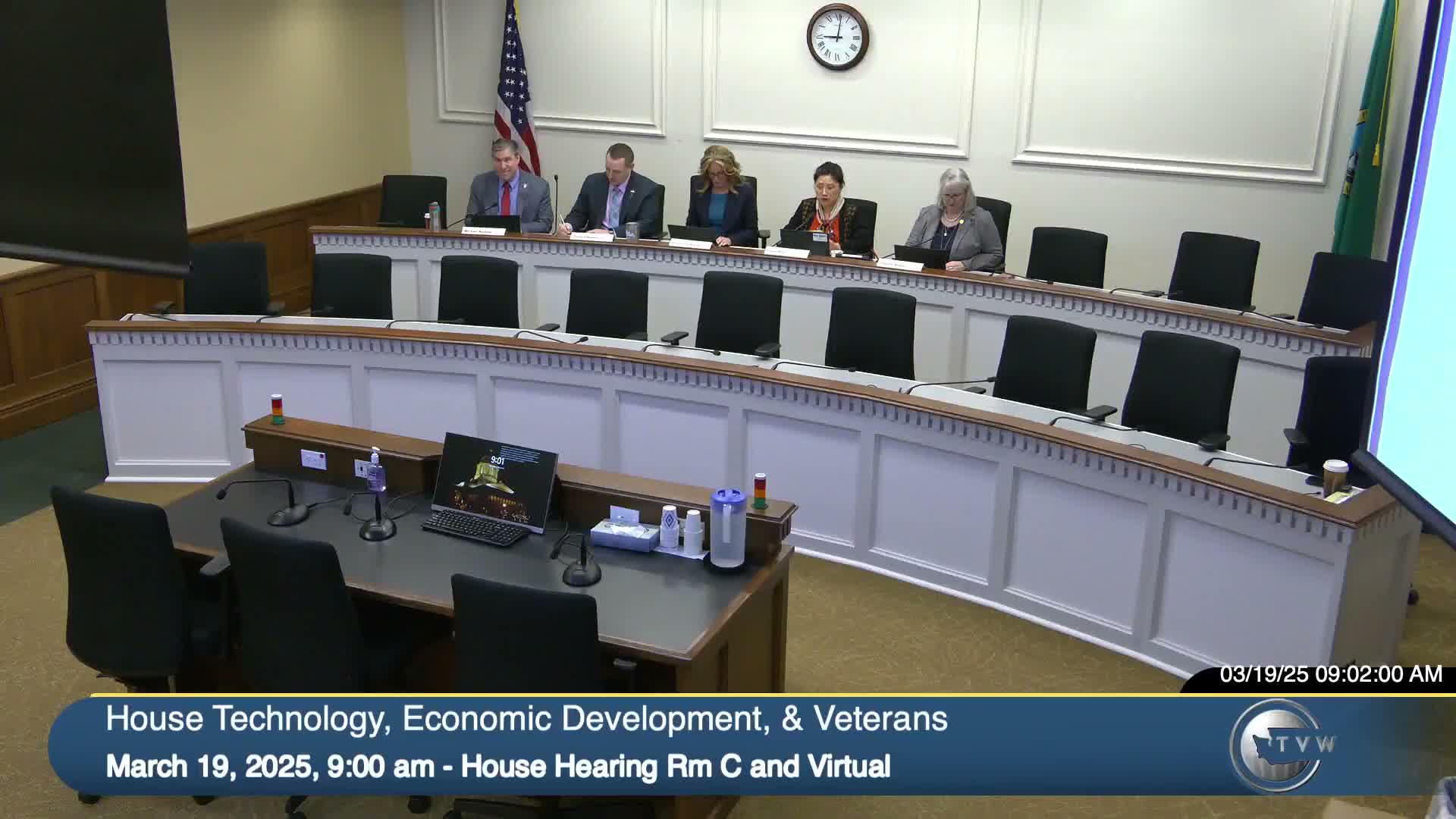
Senators, community and port officials urged the Technology, Economic Development and Veterans Committee on March 19, 2025, to advance Senate Bill 5649, which would create a State Supply Chain Competitiveness Infrastructure Program to provide grants and loans for public and tribal port projects.
Martha Whaling, staff to the committee, told members the bill (companion to House Bill 1860) would require the Department of Transportation to set program priorities, collaborate with supply-chain stakeholders, develop performance metrics and publish the project types eligible for funding. Eligible projects must be included in a port’s freight development plan and align with six programmatic goals, including operations, efficiency, market access and mitigation for impacted communities. The measure also creates a dedicated account in the state treasury for the program.
Senator Marco Lias, who identified himself as chair of the Senate Transportation Committee, said the pandemic showed how brittle supply chains can be and argued Washington needs targeted tools beyond existing rail programs to improve resilience, preserve access to goods and support family-wage jobs statewide. "The bill in front of us, is relevant to you if you wear clothes, eat food, or take medicine in Washington State," he said, arguing the program would help ports and airports address critical gaps.
Port representatives told the committee the bill provides useful flexibility even if initial appropriations are modest. Chris Herman, representing the 75 port districts through the Washington Public Ports Association, said the bill would allow ports to pursue projects that align economic development with transportation objectives and help local governments partner on near-port investments.
"This bill gives us the opportunity to pursue projects that make a real meaningful impact on the local economy," Herman said.
Sean Egan of the Northwest Seaport Alliance highlighted language in the bill allowing support for tribal investments and pointed to a newly announced partnership with Puyallup tribal partners to expand a marine cargo terminal as an example of a project that might benefit from the program.
Lawmakers pressed witnesses about the fiscal note and how much funding — if any — might be available in the current or next biennium. Witnesses repeatedly said the measure establishes a policy framework rather than guaranteeing immediate funding. As one proponent put it, legislators would be creating an "empty bucket" that could be filled later; the Department of Transportation could nevertheless begin convening stakeholders and drafting program rules so the state could move quickly if appropriations follow.
Adam Lemieux of the Port of Everett described how smaller ports might use the program to invest outside district boundaries to support manufacturing supply chains, citing an example of moving 25-foot-diameter components that require corridor improvements (removing low-hanging lines and signals) to reach Interstate 5. TJ Green, chairman for the Macaw Tribal Council, said his council recently completed about $15,000,000 in harbor improvements and is planning a multipurpose barging facility that the bill could help support; he also noted annual timber harvest volumes of about 8,000,000 board feet that underpin regional contracting.
No amendments were offered during the hearing, and the chair closed the session, indicating the committee could execute the bill out on Friday for further consideration.
The hearing produced several open questions for budget writers: the bill defines program scope and administrative responsibilities but does not specify an appropriation, and proponents emphasized the need for later legislative action to fund the account and activate sizable project support.