Get Full Government Meeting Transcripts, Videos, & Alerts Forever!
Get email alerts on the Prison Riot Reform topic
No spam. Unsubscribe anytime.
Washington bill would bar prison‑riot charges for juvenile facility incidents, seek resentencing and curb disparities at Green Hill
Summary
HB 1815 would stop use of the prison‑riot statute for conduct that occurs in DCYF or county juvenile facilities, create internal infraction rules at DCYF, and allow vacating and resentencing of related convictions; sponsors and analysts say the change could reduce racial disproportionality and Green Hill overcrowding.
Representative Strom Peterson, the bill sponsor, and the committee’s public safety analysts presented HB 1815 as a targeted fix to a statutory change that has led to lengthy adult felony consequences for young people held at juvenile rehabilitation facilities.
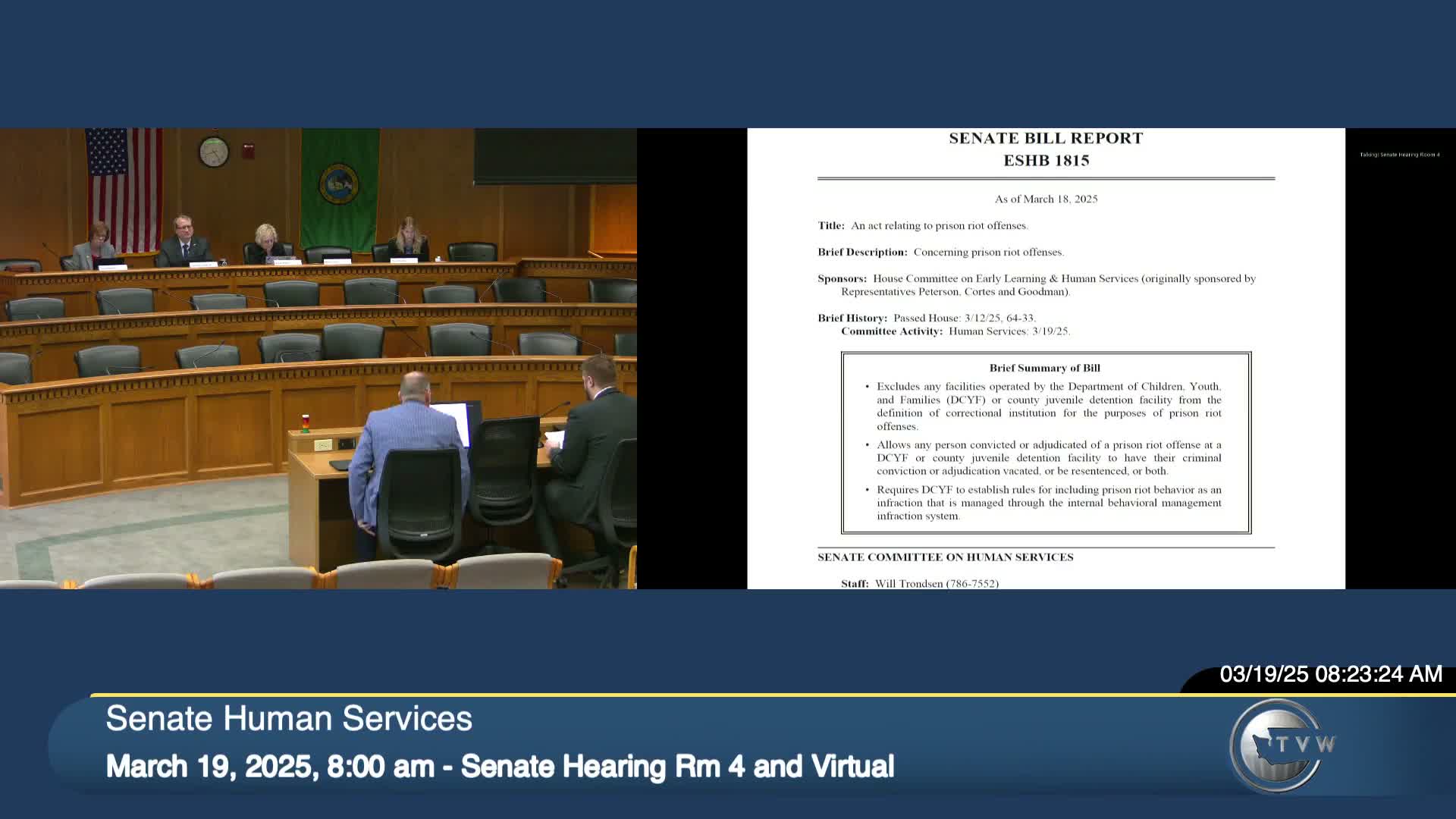
"This is a charge that is rarely, if ever, used in DOC facilities," Peterson told the Senate Human Services Committee, urging members that reducing that exposure could restore hope and reduce transfers to the Department of Corrections. Committee staff described the bill as excluding facilities operated by DCYF and county juvenile detention centers from the definition of "correctional institution" for the prison‑riot offense, allowing courts to vacate or resentence convictions that occurred at those facilities and requiring DCYF to manage prison‑riot behavior through its internal infraction system by 08/01/2025.
The Public Safety Policy and Research Center presented a rapid racial and ethnic impact analysis for HB 1815, noting that in fiscal year 2024 there were 28 juvenile adjudications and 58 adult convictions where prison‑riot was the most serious offense and that 75% of Green Hill residents were over age 18 — making them subject to adult sentencing provisions. Analysts reported an average adult prison‑riot sentence of about 23 months and found Black and Hispanic individuals were substantially overrepresented among prison‑riot adjudications and convictions in the available records.
"This bill does have the potential to reduce racial disproportionality in confinement," said Lauren Peterson of the Public Safety Policy and Research Center, summarizing the analysis that focused in particular on Lewis County and Green Hill School.
Advocates and witnesses who testified — including young people incarcerated at Green Hill and lawyers from TeamChild and the Washington Defender Association — described case examples in which relatively short fights or incidents were charged as prison riot, producing multi‑year adult sentences or transfers to DOC that advocates called disproportionate and harmful to rehabilitation. A Green Hill resident described the effect as a loss of hope: "This prison riot has held over his head and not allowed him to go into any community facility," one witness testified.
Law‑enforcement groups and prosecutors asked the committee to refine statutory language and warned that some incidents have organized or aggravated dynamics that merit serious criminal response. James McMahon of the Association of Sheriffs and Police Chiefs said, "The infraction language in this bill is not appropriate or a sufficient response for that kind of behavior," while expressing willingness to consider statutory changes that preserve accountability for truly egregious incidents.
Committee members and staff discussed implementation mechanics: the bill would allow prosecutors to file motions for resentencing and require courts to set expedited dates; the Administrative Office of the Courts and the Office of Public Defense flagged fiscal and operational costs for resentencing and defense work. Witnesses urged expedited implementation and clarity about retroactivity so youth are not transferred or resentenced unnecessarily while related transfer or juvenile reforms are considered.
The committee closed the hearing after extended testimony and asked for additional written materials; two panels were not heard because of time. No formal committee vote was recorded during the hearing.
Next procedural step: the committee closed public testimony on HB 1815 for the day and solicited written testimony and follow‑up data; further committee action and any amendments will be scheduled at a future meeting.