Get Full Government Meeting Transcripts, Videos, & Alerts Forever!
Get email alerts on the Clean Fuels Program topic
No spam. Unsubscribe anytime.
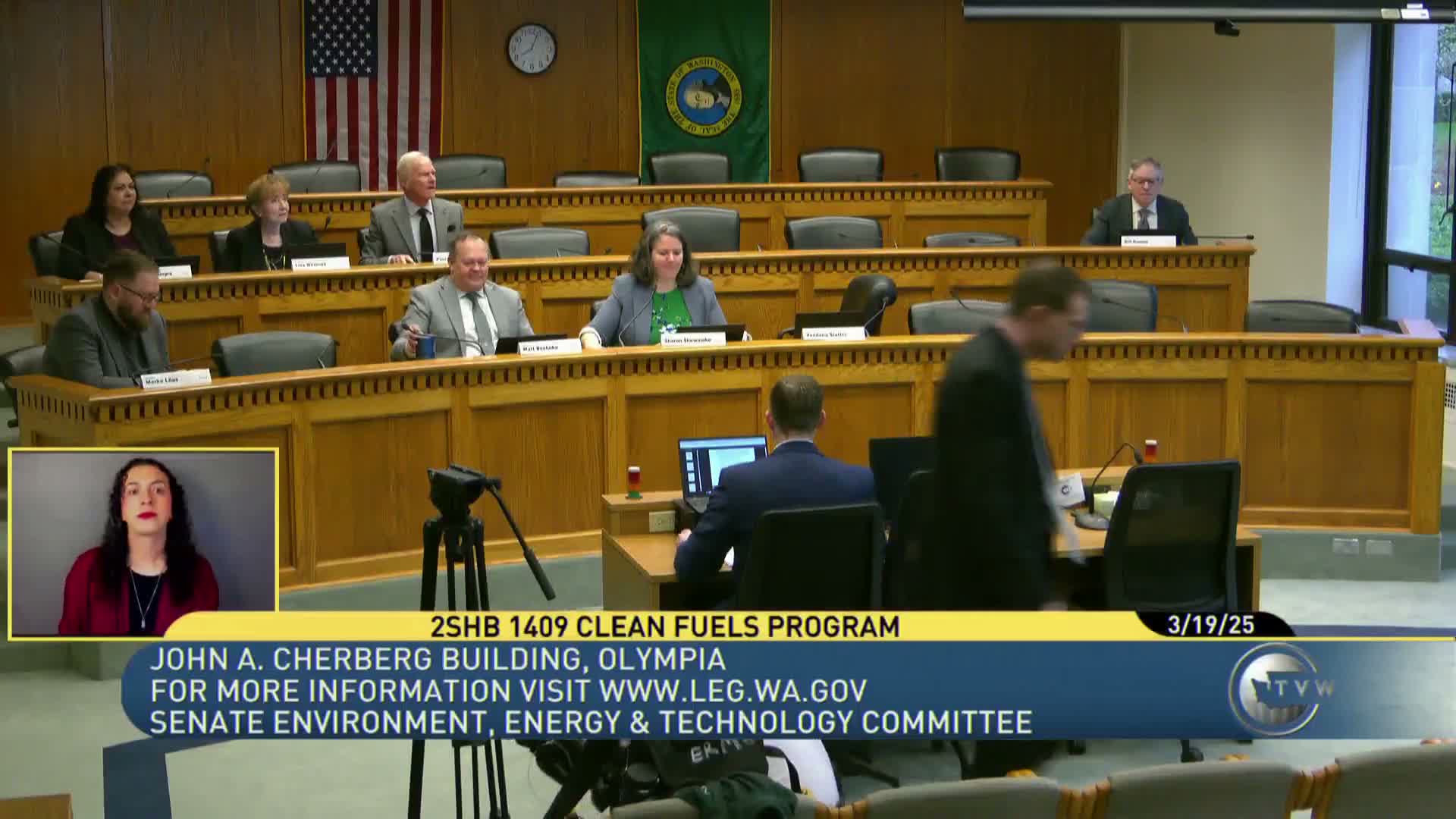
Senate committee hears proposal to tighten Washington's Clean Fuels standard and bolster market oversight
Summary
A bill to increase the Clean Fuels Program's carbon‑intensity target and create program‑specific penalties drew both support and opposition. Sponsors say higher targets and clearer enforcement will spur in‑state investment; critics say changes could raise pump prices for consumers.
A Washington State Senate Environment, Energy & Technology Committee public hearing on HB 1409 focused on strengthening the state's Clean Fuels Program by increasing carbon‑intensity reduction targets and adding new market and enforcement requirements.
Sponsor Representative Fitzgibbon told the panel the bill aims to make enforcement more tailored and predictable, removing the risk of criminal penalties and clarifying intermediate targets. "We, with this bill create a more tailored approach," she said, adding that the bill would raise the program's long‑term reduction goal — requiring Ecology to reduce carbon intensity by roughly 45% below 2017 levels by 2038, or to 55% under certain conditions — and to publish market analyses and price comparisons on Ecology's website.
Why it matters: The Clean Fuels Program requires fuel suppliers to reduce life‑cycle greenhouse‑gas emissions per unit of transportation fuel. Supporters say the bill will restore healthy credit prices, attract clean‑fuel investment and align Washington with other West Coast jurisdictions. Opponents say the changes risk increasing fuel costs for consumers and businesses.
What supporters said - Leah Misick of Climate Solutions and Scott Richards of Clean Fuels Alliance America testified in favor, saying the proposal would align Washington with peer programs and spur clean‑fuel production. Richards noted the program has already reduced millions of tons of greenhouse gases and that improving demand signals will encourage more in‑state investment. - Utility and transit witnesses, including Logan Barr of Tacoma Public Utilities and Justin Layton of the Washington State Transit Association, said a stronger program and more stable credit prices would enable investments in charging infrastructure and fleet transitions.
What opponents said - Jeff Pack of Washington Citizens Against Unfair Taxes and Todd Myers of the Washington Policy Center warned the bill could increase pump prices and impose costs on farmers and consumers. Pack said diesel costs have already risen and blamed program changes for higher prices. Myers argued the program duplicates broader CO2 caps and could increase costs without additional climate benefits.
Technical perspective and committee questions - Joel Creswell of the Department of Ecology explained the market imbalance caused by rapid growth in renewable diesel and other alternative fuels; an oversupply of credits has pushed prices low and reduced incentives. Ecology staff described the bill's changes as tools to restore price signals, while preserving reporting and modeling to evaluate impacts. - Committee members asked how the bill would interact with other jurisdictions and whether consumers would see price increases at the pump. Witnesses and staff said crude oil prices and other supply factors also affect pump prices, that pass‑through is often partial, and that modeling and additional analysis are needed to quantify effects.
Procedural status: The committee heard staff and sponsor presentations and an extended panel of witnesses pro and con. The public hearing was held; no final vote was taken at this session.
Next steps: The bill will return to committee work and any sponsor or staff amendments will be considered at subsequent meetings.