Get Full Government Meeting Transcripts, Videos, & Alerts Forever!
Get email alerts on the Technology Plan topic
No spam. Unsubscribe anytime.
Flagstaff Unified approves five-year technology plan emphasizing digital citizenship and AI guidance
Summary
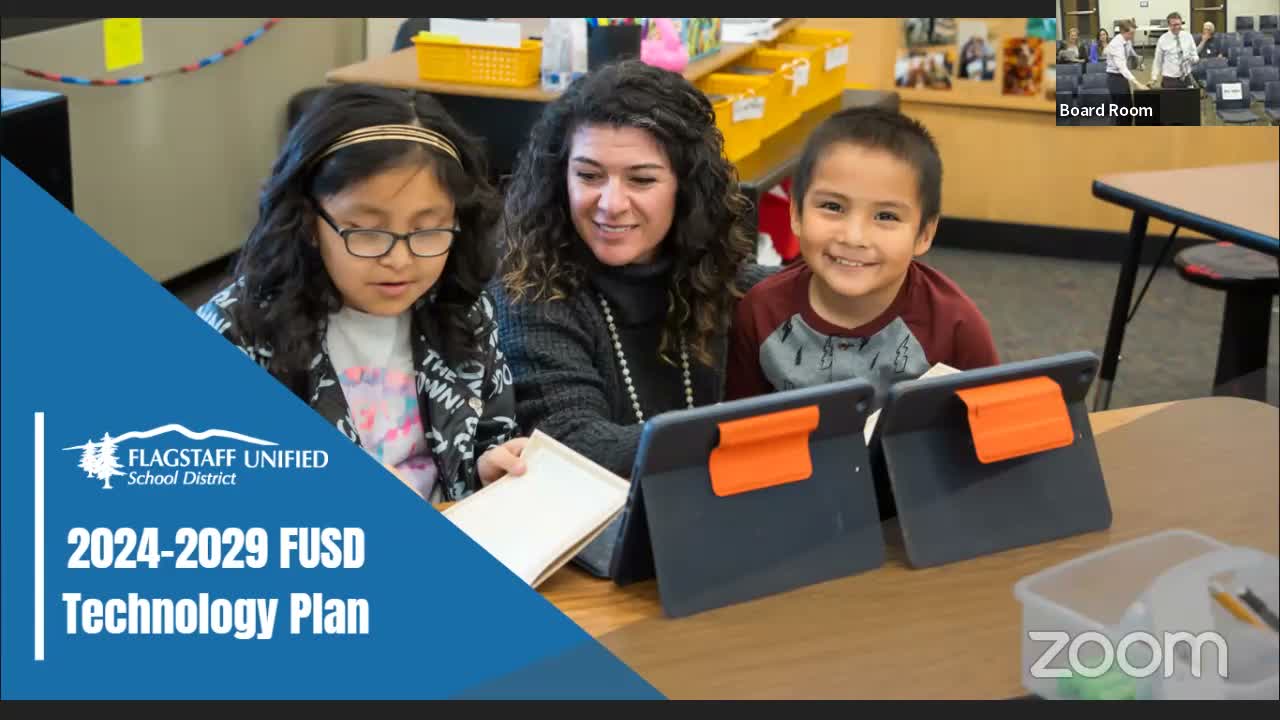
The Flagstaff Unified School District board unanimously approved a five-year technology plan on Oct. 8 that emphasizes digital citizenship, expanded teacher professional development, continued iPad deployment, cybersecurity upgrades and district AI guidance.
The Flagstaff Unified School District board unanimously approved a five-year technology plan on Oct. 8 that lays out goals for learning, infrastructure, data governance and staff training.
Director of Learning Technology and Innovation Troy Harris introduced the plan as a successor to the district’s prior four-year plan and summarized its vision of “wild success,” in which technology “seamlessly integrates with teaching and learning.” Harris said the plan covers learning, environment, data privacy and security, leadership, systems administration, technical services and infrastructure and cited the need to teach students to discern misinformation and limit unproductive screen time.
Harris told the board the district drew on national and state guidance in drafting the plan, including the 2024 U.S. Department of Education National Educational Technology plan and the International Society for Technology in Education standards. He said FUSD developed an AI guidance document last spring after an AI task force began work in 2023 and that the district has joined Northern Arizona University’s professional-development “3 and 3” challenge to expand staff PD on AI tools and practices.
Technical staff outlined system-level work needed to support the plan. Technical services staff reported the district supports approximately 12,000 iPads and is planning an elementary refresh of up to 6,000 devices; they also described recent cybersecurity investments, including a major firewall upgrade and a move to a redundant 20 Gbps internet connection via Sun Corridor to reduce single-point outages.
Matthew Kovacs, systems administrator, said the plan includes improved documentation, a Kanban-based project management approach to balance capacity and demand, and a district-wide data governance effort to improve accuracy and safeguard access to key systems.
Teachers who participate in the district’s iPad cohort described classroom benefits. Emily Leahy, a second-grade teacher, said the cohort helped her integrate apps and design lessons that center technology on learning goals. Other teachers highlighted student engagement, creativity and collaborative projects enabled by iPads.
Board members raised questions about funding; Harris noted that state education funding does not directly fund device purchases and that FUSD has relied on bonds and federal E-rate discounts (which cover a portion of network connection costs). The board voted to approve the plan by voice vote.
Next steps noted by presenters include phased device refreshes, continued rollout of the district’s AI guidance to staff, and quarterly meetings of district committees to track milestones and PD completion.