Get Full Government Meeting Transcripts, Videos, & Alerts Forever!
Get email alerts on the Tax Collection topic
No spam. Unsubscribe anytime.
Linebarger reports 2024 delinquent-tax collections, outlines process for Smith County
Summary
Linebarger presented a year-end delinquent-tax collection report to Smith County commissioners, citing $2.1 million collected in 2024, a 29% increase in the 2023 turnover, and an emphasis on payment agreements and targeted mailings to recover small-balance accounts.
Jim Lambeth of Linebarger, a law firm contracted by Smith County to collect delinquent property taxes, told the commission’s court on Jan. 21 that the firm collected about $2.1 million in delinquent taxes in calendar year 2024 and that the 2023 turnover to the firm totaled $2,230,677 — a 29% increase from 2022.
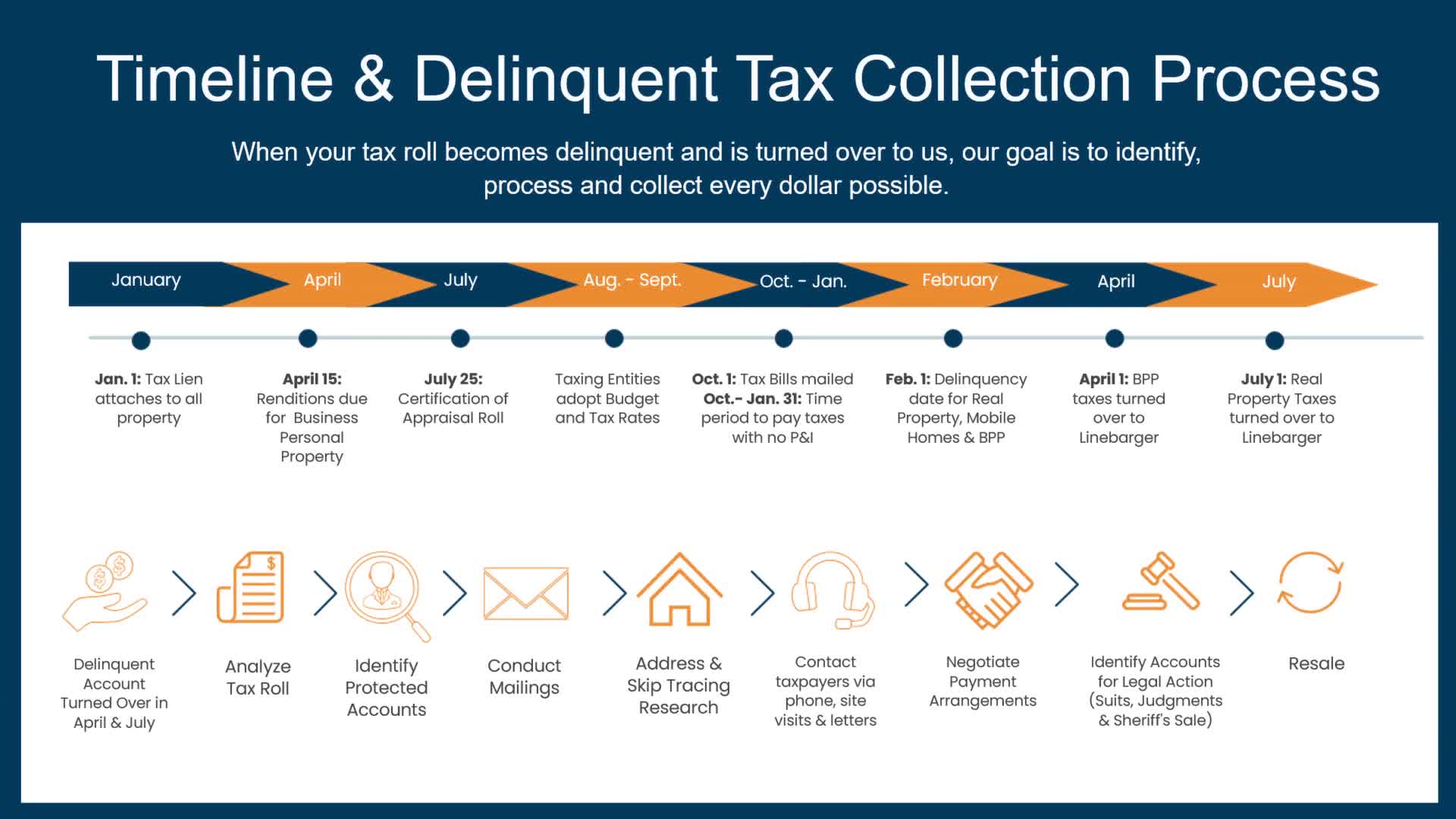
Lambeth said the firm begins collection work before formal turnover dates by monitoring potential business personal property delinquencies early in the year, and that the office combines data purchases, skip-tracing and repeated mailings to locate and notify taxpayers. “We want to know where they moved to, where they’re connecting their utilities, where their driver’s license moved to,” Lambeth said, describing the data-driven approach.
Why it matters: County officials said collection rates affect budget projections and bond ratings. Lambeth told the court Smith County’s combined collection rate (current collections plus delinquent recoveries) averaged roughly 100.93 percent over the past eight years, a figure the county uses in revenue forecasts.
Accounts and exemptions: Lambeth broke down the delinquent roll by account type: 78% of accounts were real property, about 10% mobile-home only, 7% business personal property and 5% minerals. He said approximately 31% of accounts were under $250, and that 20.5% of the roll involved deferrals or taxpayers over age 65. Lambeth explained that accounts in bankruptcy or deferral cannot be pursued immediately and usually result in slower collection timelines.
Enforcement tools and outcomes: The firm uses a progression of outreach: repeated mailings and walk-and-talks, negotiated payment agreements, suit filings and, when necessary, sheriff’s sales. Lambeth said the office filed 4,583 suits on accounts reporting roughly $378,000 in base tax in the reporting period and listed 4,748 accounts disposed through collection activity. He also reported 113 properties sold in tax sales yielding about $1.99 million in taxes due.
Successes and community work: Lambeth highlighted several recovery stories, including collection on a large out‑of‑town oil-and-gas account and a tax-sale outcome that enabled redevelopment of vacant lots in coordination with the city of Tyler. He told the court his office provides training to appraisal districts and offers some services to the county at no additional cost, including bankruptcy-claim filings and legislative support.
What’s next: The presentation was received by the court with thanks; no formal action was required. Lambeth said the office will continue targeted outreach and payment-agreement efforts and noted that a growing share of the delinquent roll is in deferral categories tied to aging homeowners, which tends to shift collections into later periods.