Get Full Government Meeting Transcripts, Videos, & Alerts Forever!
Get email alerts on the Human Trafficking topic
No spam. Unsubscribe anytime.
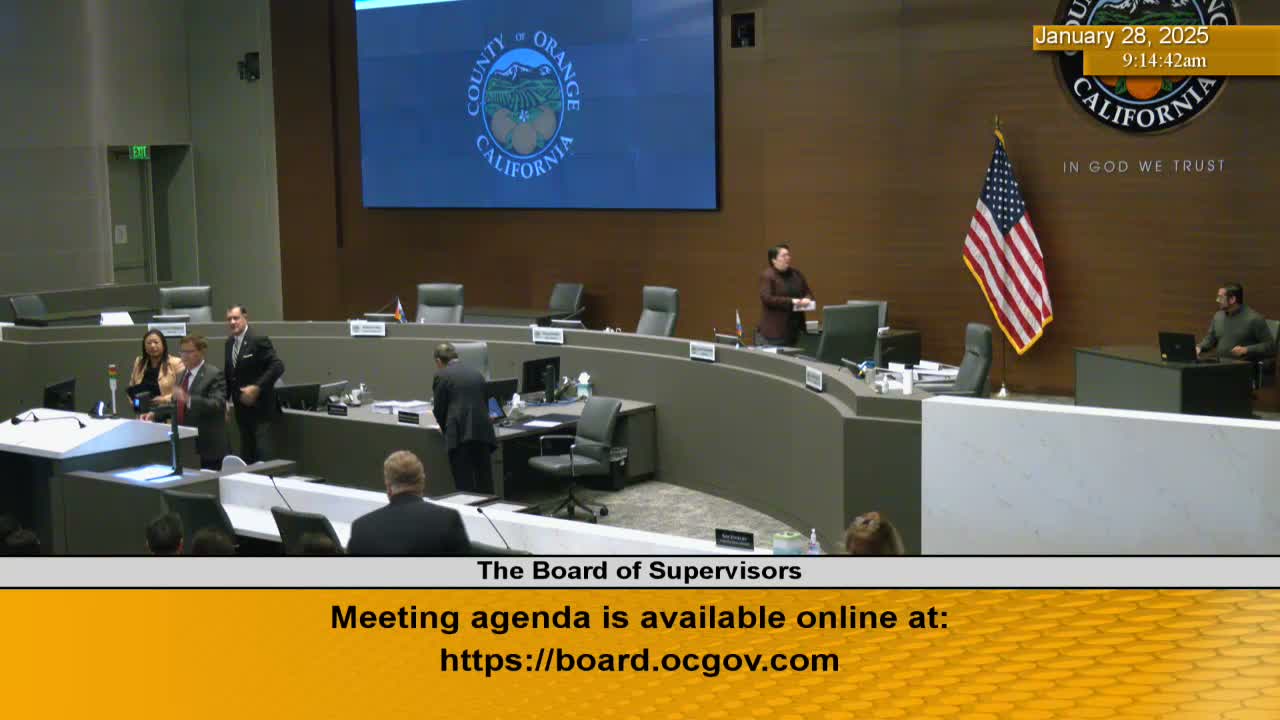
Orange County supervisors mark Human Trafficking Prevention Month, DA urges resources for prosecution
Summary
The Orange County Board of Supervisors on Jan. 28 recognized January as National Human Trafficking and Modern Slavery Prevention Month, highlighted victim services and prevention programs, and heard the district attorney call for sustained resources to prosecute traffickers and support survivors.
The Orange County Board of Supervisors on Jan. 28 formally recognized January as National Human Trafficking and Modern Slavery Prevention Month and heard a series of presentations from county leaders and nonprofit partners on identification, prosecution and prevention efforts.
Chair Doug Chaffee opened the presentation by describing the Orange County Human Trafficking Task Force — which the board said includes local police departments, the Orange County District Attorney’s Office, Probation, Social Services, federal partners and nonprofits — and urged residents who suspect trafficking to contact law enforcement rather than attempt a rescue.
Vice Chair Katrina Foley said the county’s victim advocacy team has served roughly 1,490 victims over the past decade and highlighted a partnership with University of California, Irvine researchers to integrate court, social services, sheriff’s and district attorney data to identify victims earlier.
"This is a domestic problem," Foley said, urging parents to talk to children about online grooming and describing prevention work in schools.
District Attorney Todd Spitzer told the board his office has filed more than 400 criminal cases related to trafficking since he became DA and said traffickers often brand and psychologically manipulate victims, which makes prosecution and witness cooperation difficult. "They are literally owned by others," Spitzer said, arguing that prosecutions require sustained resources.
Social Services Agency representatives described an increase in child exploitation investigations and previewed county prevention events, including a school program for seventh and eighth graders and a parent training session scheduled for Feb. 6. Global Hope 365, a local nonprofit, described its school‑based prevention and ambassador programs and healthcare provider training for identifying victims.
The presentations emphasized a trauma‑informed, victim‑first approach, cross‑agency coordination and the continued need for funding to support prosecution, victim services and prevention programs. Board members applauded the task force and urged community vigilance and use of the National Human Trafficking Hotline.