Get Full Government Meeting Transcripts, Videos, & Alerts Forever!
Get email alerts on the Bhsa Implementation Housing Audit topic
No spam. Unsubscribe anytime.
Plumas County staff warn BHSA rule changes, audits and housing plans will challenge small counties
Summary
Staff briefed commissioners on new Behavioral Health Services Act guidance, a combined CalAIMS audit scheduled for May, and early-stage plans with RCHDC to identify sites for supportive housing—flagging complexity for small 'frontier' counties like Plumas.
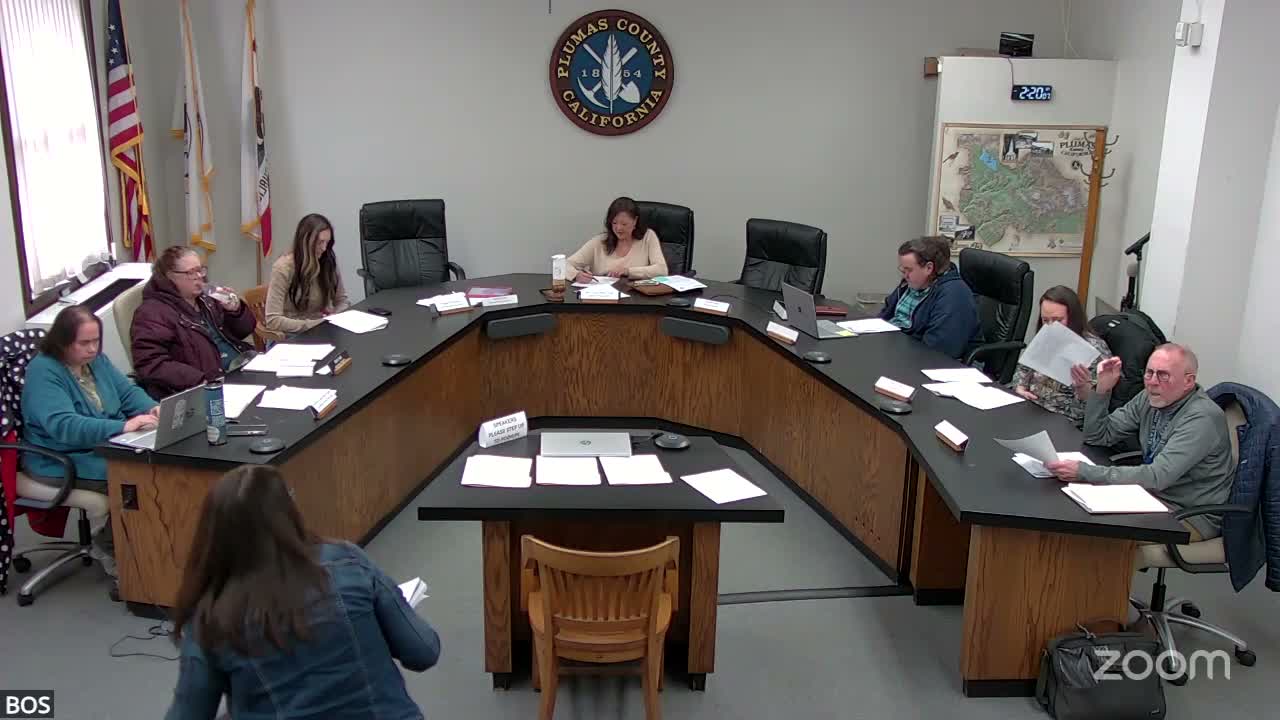
Plumas County behavioral health staff used the March 5 meeting to flag several looming state-level changes and local projects that could reshape services and budgets.
Staff described a recently released BHSA (Behavioral Health Services Act) Module 1 guidance and said the new BHSA funding model will divide money across multiple priorities — staff quoted breakdowns such as roughly 30% for housing and 35% for full-service partnerships (FSP) while the remainder falls into other categories with further sub-allocations for early intervention. County staff and commissioners warned those layered percentages, coupled with new rules and Prop 1 bond components, make compliance and implementation especially hard for small, frontier counties.
A combined audit under CalAIMS covering specialty mental health, substance use services and block grant services is scheduled for May 12–23, 2025 and will review the county’s fiscal year July 1, 2023–June 30, 2024 service universe. Staff emphasized the audit is the first combined review of its kind for Plumas County and said county fiscal staff are preparing documentation.
On housing, staff said a local partnership with the Rural Community Housing Development Corporation (RCHDC) has identified five or six potentially viable parcels for supportive housing and that the immediate next steps are to assemble a spreadsheet, reach out to property owners and, if interest exists, have RCHDC do deeper feasibility and negotiation. Staff noted the preference for sites sized to accommodate roughly a 30-unit building (about 1.5 acres) and that some sites previously considered (near the fairgrounds, behind Safeway) had been evaluated and failed previous feasibility checks.
Officials also warned that institutional placements are expensive: staff reported seven clients in IMD facilities and one in a state hospital with average monthly costs for out-of-county placements cited around $25,000–$27,000 per person, a substantial ongoing pressure on local behavioral health budgets.
Commissioners discussed advocacy avenues, including small-county coordination through CBHDA and possible formal requests for state exceptions. Staff said they will return with more filtered guidance on BHSA rules and a presentation for stakeholders once module guidance stabilizes.