Get Full Government Meeting Transcripts, Videos, & Alerts Forever!
Get email alerts on the Public Safety topic
No spam. Unsubscribe anytime.
Plumas County authorizes sheriff agreements, recruitment and Portola policing contract
Summary
The Board approved the sheriff’s application for OHV grant funds, authorized agreements for radio/vault space with CHP and approved a Portola policing contract that will bring roughly $130,000 in FY24‑25 revenue; the board also approved recruitment for a funded sergeant FTE.
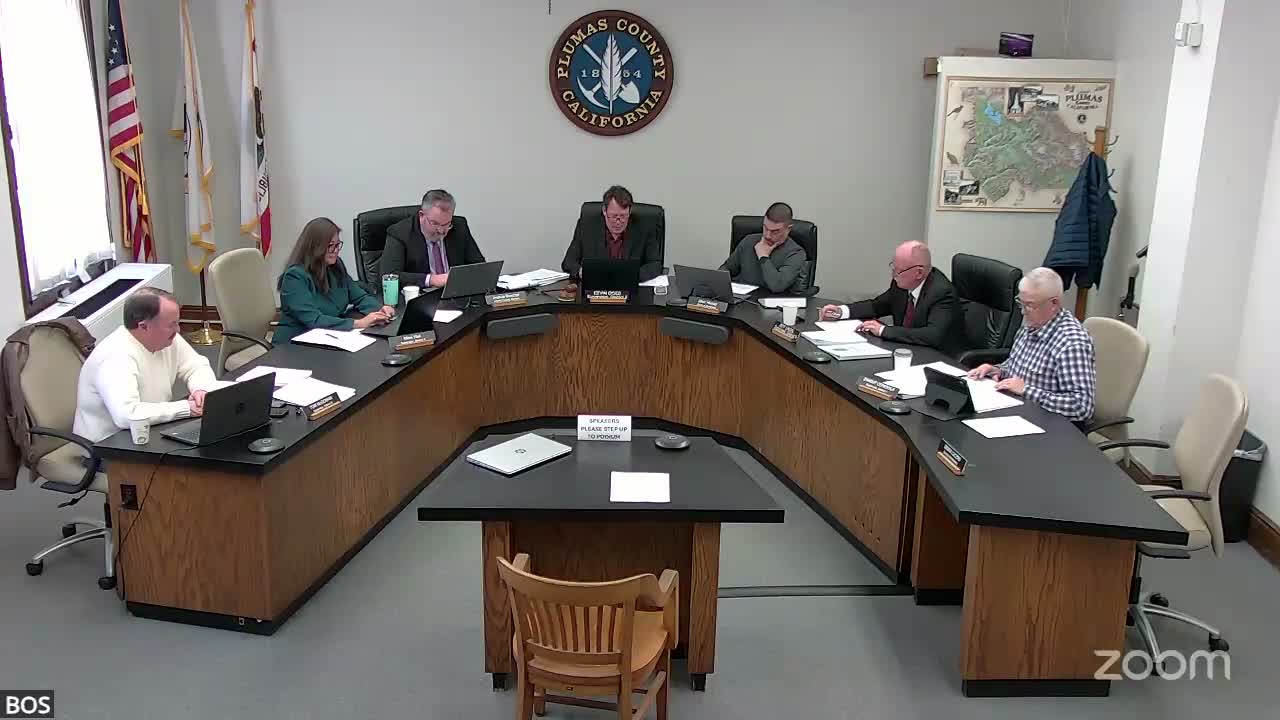
The Plumas County Board of Supervisors on Feb. 11 approved a package of sheriff’s office items including grant applications, interagency agreements and staffing actions.
The board authorized the sheriff’s office to apply for and administer off‑highway vehicle (OHV) grant funds through the California Department of Parks and Recreation’s Off‑Highway Motor Vehicle Division. The board also approved agreements with the California Highway Patrol and the Department of General Services for vault/radio equipment space (effective Oct. 1, 2024; an initial not‑to‑exceed cost of $5,040 was noted for the first year). County counsel flagged indemnity and contract language that required negotiation; staff said those concerns were addressed as far as was possible and recommended approval to preserve communications infrastructure.
The board approved recruitment and filling of a funded sheriff sergeant FTE as included in the FY24‑25 recommended budget, and authorized the chair to ratify and sign an agreement with the City of Portola for law‑enforcement services, effective July 1, 2024, with incoming revenue of approximately $130,000 for the first year as shown in the agenda. During discussion supervisors pressed the sheriff’s office on whether the Portola contract covers all COPS funds and whether the county is fully recovering the cost of providing city policing services; the sheriff acknowledged the contract has been renegotiated over time and noted complexities in comparing per‑call burdens versus flat contract revenue.
Board members approved the motions by voice vote. County staff noted the importance of the agreements for radio and communications infrastructure, and that ongoing agreements with regional partners are sometimes necessary even when indemnity language is imperfect.
No additional staffing or contract amendments were adopted beyond the recruitment authorization and contract ratification votes recorded at the meeting.