Get Full Government Meeting Transcripts, Videos, & Alerts Forever!
Get email alerts on the Housing Inspections topic
No spam. Unsubscribe anytime.
Rockville to stagger multifamily renewals, raise inspection rates and implement enhanced inspection program
Summary
After a staff presentation, council backed immediate steps to stagger multifamily rental-license renewal dates, raise baseline multifamily inspections from 20% to 25%, and implement an enhanced inspection program that raises inspections to 40% for flagged properties; staff said the changes will be put into practice starting Jan. 1 and an annual report will follow in December 2026.
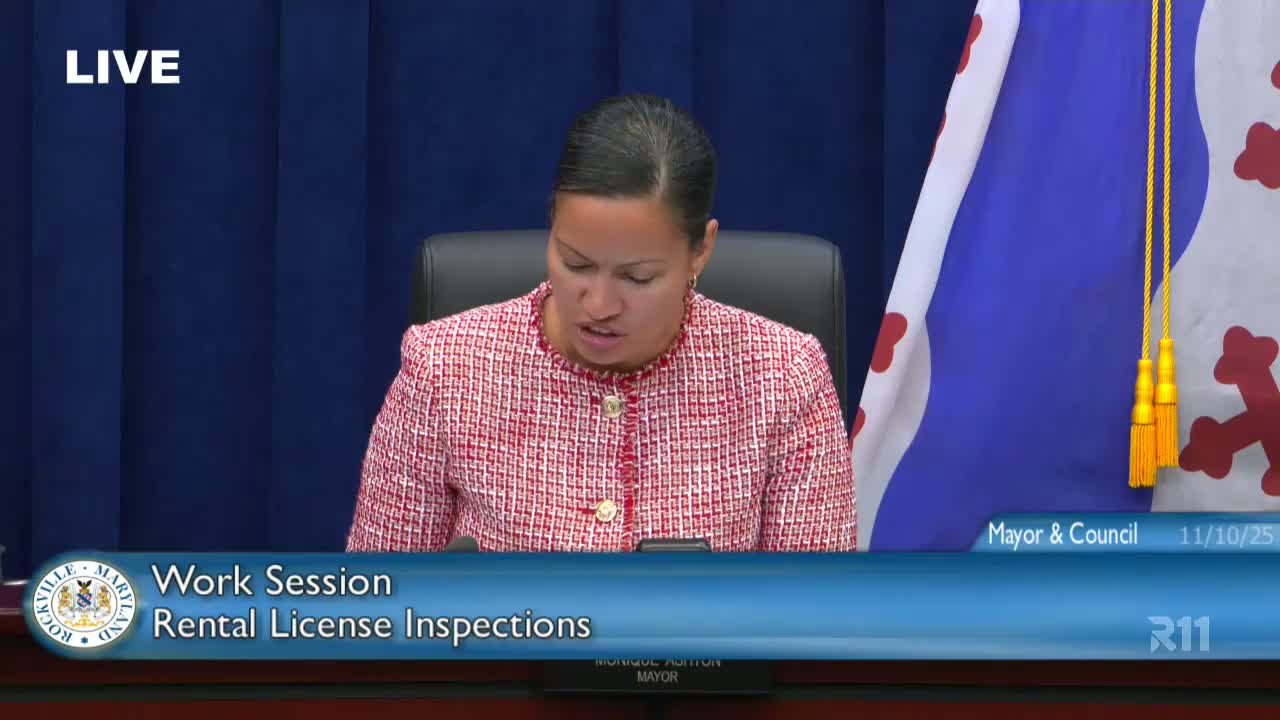
Rockville staff presented a set of changes to the city's rental-license inspection program and the council broadly supported immediate implementation of those practices.
Kina Campbell, chief of inspection services, told the council there are roughly 2,500 single-family rental units in the city and approximately 9,135 multifamily units. For calendar year 2024, staff reported a 74% first-pass inspection rate for single-family rentals and an 87% first-pass rate for multifamily units.
To address workload and improve oversight, staff proposed three primary changes: stagger multifamily license renewal dates (instead of a single March 31 cluster); raise the multifamily inspection baseline from 20% to 25% of units at each complex; and implement an enhanced inspection program that increases inspection coverage to 40% (or higher) at properties that meet defined health-and-safety thresholds. Campbell said the enhanced program will use an escalation system and assign a senior code inspector to properties that trigger the thresholds.
On mold, staff described the new Maryland tenant mold protection law signed in July 2025: landlords must perform a mold assessment within 15 days of notification and remediate confirmed mold within 45 days. Staff said Rockville will adopt the 15/45 timeline in practice, require air-quality testing where a suspicious black substance is seen, and add a mandatory acknowledgement of the state mold law on rental-license forms. To support implementation, staff are formalizing a contract with an air-quality consultant.
Council reaction: members widely supported staggering renewal dates, continuing the current suite of enforcement tools (inspection at renewal, reasonable-suspicion inspections, complaint-driven inspections, denial/suspension/revocation, citations), raising the multifamily baseline to 25% and establishing the enhanced inspection program. Several members urged more parity between single-family and multifamily inspection frequency and asked staff to consider higher inspection rates for problematic properties; staff said the code already allows more extensive inspections when justified.
Implementation and next steps: staff said they could begin the staggered schedule and enhanced inspections as practice immediately, with the staggered renewals starting Jan. 1 and an annual report on outcomes due by December 2026. The council encouraged stronger tenant outreach, clearer guidance for landlords, and consideration of public transparency about troubled buildings; staff said those topics will be part of ongoing code-review work and reporting.