Airport panel denies Verizon rooftop 5G installation near March Air Reserve Base
Loading...
Summary
The Riverside County Airport Land Use Commission voted 4–2 on Feb. 13 to find a proposed Verizon rooftop 5G facility inconsistent with the March Air Reserve Base Airport Land Use Compatibility Plan, citing unresolved safety concerns and proximity to military runways despite conditioned FAA review.
The Riverside County Airport Land Use Commission voted on Feb. 13 to deny a conditional use permit for a proposed Verizon Wireless rooftop 5G installation near March Air Reserve Base, finding the project inconsistent with the airport land use compatibility plan.
Staff planner Jackie Vega told the commission the application (ZAP16‑34MA24) sought to locate an 8‑foot wireless antenna on the roof of an existing manufacturing building and an approximately 360–362 square‑foot equipment enclosure on 2.35 acres at 22440 Van Buren Boulevard within March Air Reserve Base Airport Influence Area Zone B2. Because the proposed structure exceeded FAA height thresholds, staff said the FAA’s Office of Airspace and Evaluation Services (FAA OES) reviewed the project and issued a conditional “no hazard” determination, and the Air Force later provided concurrence, both subject to mitigation requirements.
The staff report and subsequent discussion referenced a 2020 RTCA report (Assessment of C‑Band Mobile Telecommunication Interference Impact on Low‑Range Radar Altimeter Operations) and the March compatibility study, which identify potential harmful interference to radar altimeters from mobile operations in the 3.7–3.98 GHz band unless coordinated mitigations are applied. Jackie Vega summarized the FAA‑conditioned mitigation steps, including requirements that the licensee reduce power, cease operation, or implement immediate corrective actions if the Federal Communications Commission notifies the licensee that harmful interference is occurring.
Simon Hausman, who assisted with the March compatibility study, told commissioners the RTCA work and the compatibility analysis informed staff recommendations and emphasized interagency coordination. "If there is interference, they have to reduce the power to eliminate the interference or shut it down," Hausman said, summarizing the conditions that accompany the FAA’s determination.
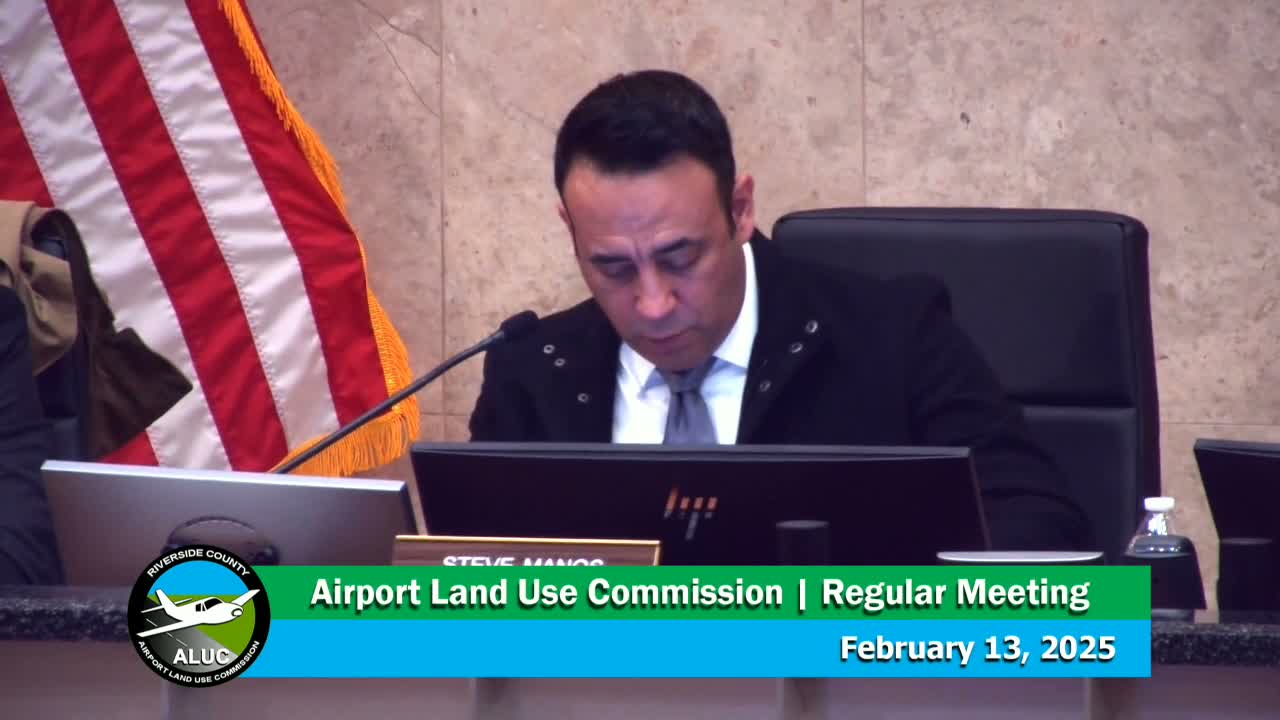
Commissioner Poole expressed acute concern about siting a 5G facility so close to a runway used for both civilian and military operations, saying he was "very uncomfortable having this facility this close to our military runway." Other commissioners asked whether testing or modeling would be performed before construction; staff said the Air Force and FAA reviews and the FAA’s conditions are part of the mitigation framework but did not point to a pre‑construction field test specifically required by the commission.
When the commission voted on a motion to deny the application, the motion passed, with the chair recording a 4‑to‑2 vote (two commissioners, including Michael Geller, recorded as opposed). The commission’s decision found the proposed facility inconsistent with the March Air Reserve Base Airport Land Use Compatibility Plan and denied the conditional use permit.
The commission’s action does not change the FAA OES determination, which was described in staff materials as a conditional no‑hazard finding; instead the denial reflects the commission’s local compatibility determination and concerns raised about proximity and unresolved operational risks. The applicant, represented at the hearing by Butler America, and Verizon were notified on the record; staff recommended conditions of consistency earlier in the meeting only after receiving Air Force comments, but the body ultimately voted to deny the permit.
The denial is administrative and concerns consistency with local compatibility criteria; any further appeals or subsequent applications would need to address the commission’s findings and the technical mitigation and coordination requirements identified by the FAA, the Air Force and the compatibility study.