Get Full Government Meeting Transcripts, Videos, & Alerts Forever!
Get email alerts on the Energy Storage topic
No spam. Unsubscribe anytime.
Santa Barbara supervisors push for stronger local control, monitoring after Moss Landing briefing
Summary
After a detailed staff briefing and extensive public comment about the Moss Landing battery fire, the Board directed staff to support state bill AB303 restoring local permitting authority, to evaluate notice and siting rules, and to pursue air‑quality monitoring and on‑site staffing for battery storage projects.
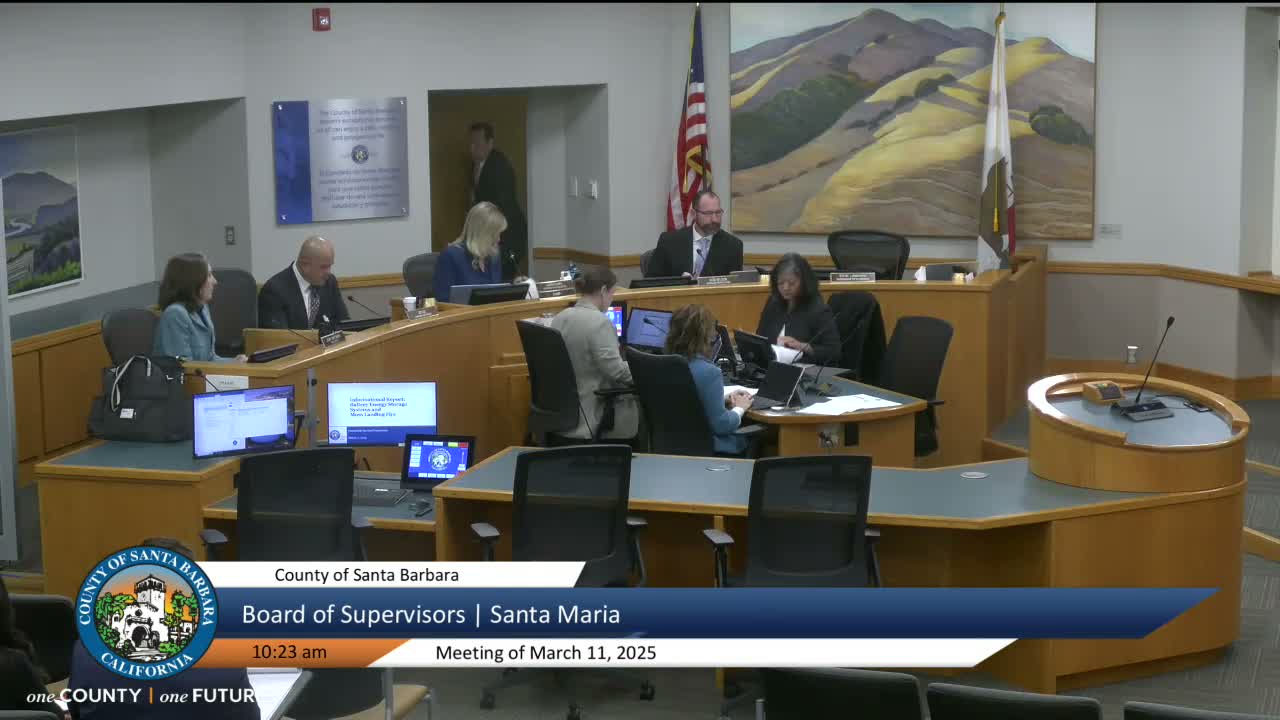
The Santa Barbara County Board of Supervisors on March 11 received a detailed briefing on battery energy storage systems and the Moss Landing fire, then directed county staff to seek stronger local controls and monitoring. The action, moved by Supervisor Joan Hartman, asks county staff to advocate for state legislation restoring local permitting authority, review notice and setback standards, explore air‑quality monitoring and on‑site staffing expectations, and develop proposals for placing battery systems on county sites.
The board held a lengthy technical presentation and public comment period about battery technology, safety standards and local projects. Robert Shaw, chief executive officer of Central Coast Community Energy, described the industry’s role and safety improvements, saying, “It has to be safe.” Fire Marshal Tan explained the technical differences between earlier indoor, nickel‑manganese‑cobalt systems and newer outdoor containerized lithium‑iron‑phosphate (LFP) installations, noting newer standards, UL testing and 24‑hour monitoring systems used on recent projects.
Why it matters: County supervisors and residents said the Moss Landing incident raised questions about siting, contractor stability, evacuation planning and long‑term liability. Multiple speakers urged local permitting and stricter conditions so that projects built near homes and farmland are easier for the county to evaluate and, if needed, respond to. Opponents also urged tougher environmental review and public notice, citing the Nipomo installation and concerns about plume impacts.
Details: County planning staff and the fire marshal explained current pathways. Small, customer‑sited units are permitted via building and safety; utility‑scale systems that connect to the grid typically require a conditional use permit, environmental review and planning‑commission review. For very large projects an applicant can elect a state “opt in” (Assembly Bill 205 pathway) in which the California Energy Commission — not the county — reviews and approves the project; AB303, now proposed in Sacramento, would eliminate that opt‑in and restore more local permitting authority.
Public comment spanned assurance and alarm: proponents argued that new chemistries, outdoor containerized design and updated codes have materially reduced incident rates, while opponents warned that toxic plumes, proximity to residences and inadequate public notice remain real threats. A number of speakers from Nipomo and surrounding areas said they were surprised by local permitting that proceeded without broad community awareness.
Board action and next steps: The Board voted to: (a) direct staff to advocate for AB303 (restoring local permitting authority and codified setbacks), (b) evaluate and recommend changes to public notice and setback distances for siting, (c) consider requirements for air‑quality monitoring and an on‑site presence or rapid response arrangements for large facilities, and (d) proceed with proposals for battery projects on two county sites previously reviewed by staff. The motion carried. Staff will return with options and regulatory language for Board direction.
What’s next: County staff flagged that the California Public Utilities Commission and the state legislature are moving on emergency operating, inspection and maintenance standards, and the Board asked staff to coordinate with those processes and report back with specific permit language, notification radius options and feasible monitoring requirements.