Get Full Government Meeting Transcripts, Videos, & Alerts Forever!
Get email alerts on the Procurement Equity topic
No spam. Unsubscribe anytime.
Hillsborough outlines supplier-diversity progress: business directory, outreach and examples from recent projects
Summary
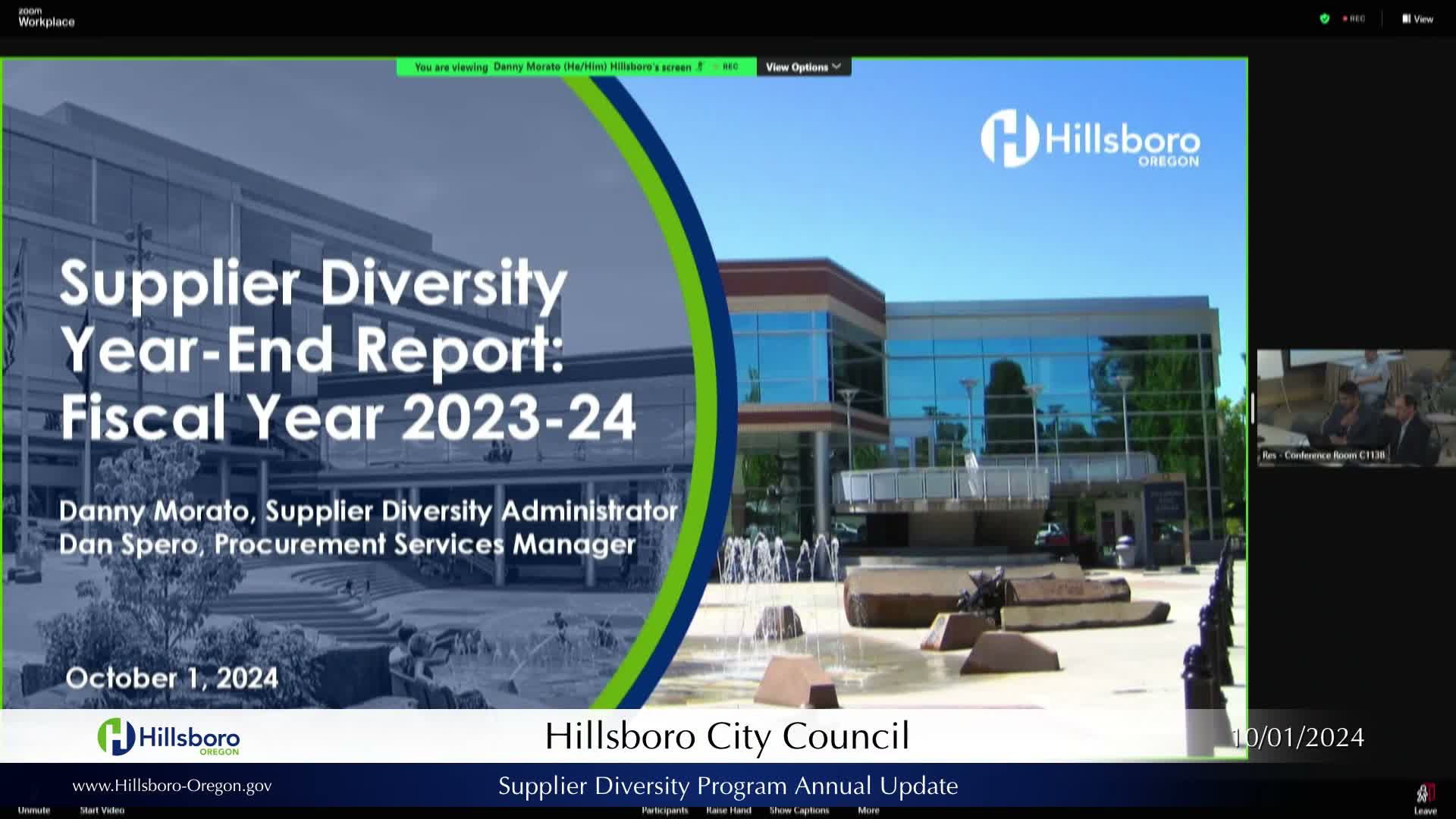
City procurement staff described a three-year supplier-diversity program that has launched a business directory, hosted outreach events including a Westside Open House, tracked diverse-supplier spend on pilot projects (Novo/Nuevo Esperanza) and plans to scale tracking and policy refinements while balancing administrative load.
City procurement and supply-diversity staff briefed the council on progress and next steps for the supplier-diversity program, framing the work as relationship-building designed to connect local minority-, women- and veteran-owned businesses to city contracting opportunities.
Danny Murado, the city’s supply diversity program administrator, said the program’s aims are to create a visible supplier database for internal staff, reduce reliance on a small number of vendors, and expand opportunities for historically disadvantaged firms. He described outreach at trade shows, tabling at regional events and a Westside Open House that attracted exhibitors and workshops addressing insurance, bonding, and onboarding for public contracts.
Staff launched a minority/women/veteran business directory for city staff use, focused on small-dollar purchases (staff cited a common practical range under $10,000 and noted direct-award thresholds up to $25,000 depending on procurement rules). The directory’s criteria require businesses to be headquartered in Washington County and self-identify; 31 businesses were listed at the time of the presentation with six pending review.
Procurement presented two pilot project case studies. Novo/Nuevo Esperanza, a $38.8 million affordable-housing project, reported roughly $13 million in spending with diverse businesses (about $7 million with minority-owned firms, $4.6 million with women-owned firms, and $1.4 million with emerging small businesses), exceeding a contractor-set diversity goal. A separate park project (Hidden Creek Park West) provided learning about the limits of credit for purchases of specialized equipment that rarely qualify as COVID-certified vendor spend.
Councilors raised questions about union status, prevailing wages and administrative burden. Staff said public-works projects contracted by or for the city are subject to Oregon prevailing-wage rules (Davis–Bacon / Oregon BOLI frameworks), so subcontractors on public works must be paid prevailing wages regardless of union status. Staff also acknowledged that tracking subcontractor payments and validating diverse-supplier participation is administratively intensive—Novo Esperanza, for example, involved tracking 32 subcontractors—and said they are calibrating requirements to balance oversight with cost and complexity.
The program’s near-term goals include growing the business directory, refining supplier-diversity policy language, setting citywide diverse-spend goals, and exploring whether to track broader spend categories (including P-card and other daily expenditures). Staff asked council members to attend upcoming outreach events to help connect with local businesses.