Get Full Government Meeting Transcripts, Videos, & Alerts Forever!
Get email alerts on the Housing Production topic
No spam. Unsubscribe anytime.
Hillsboro council reviews final housing production strategy, schedules adoption vote for Dec. 3
Summary
Consultants presented a 21-action housing production strategy aimed at increasing housing supply and preserving affordability; council discussed zoning, middle-housing standards, SDC scaling and potential revenue tools and agreed to bring the final package back for adoption Dec. 3.
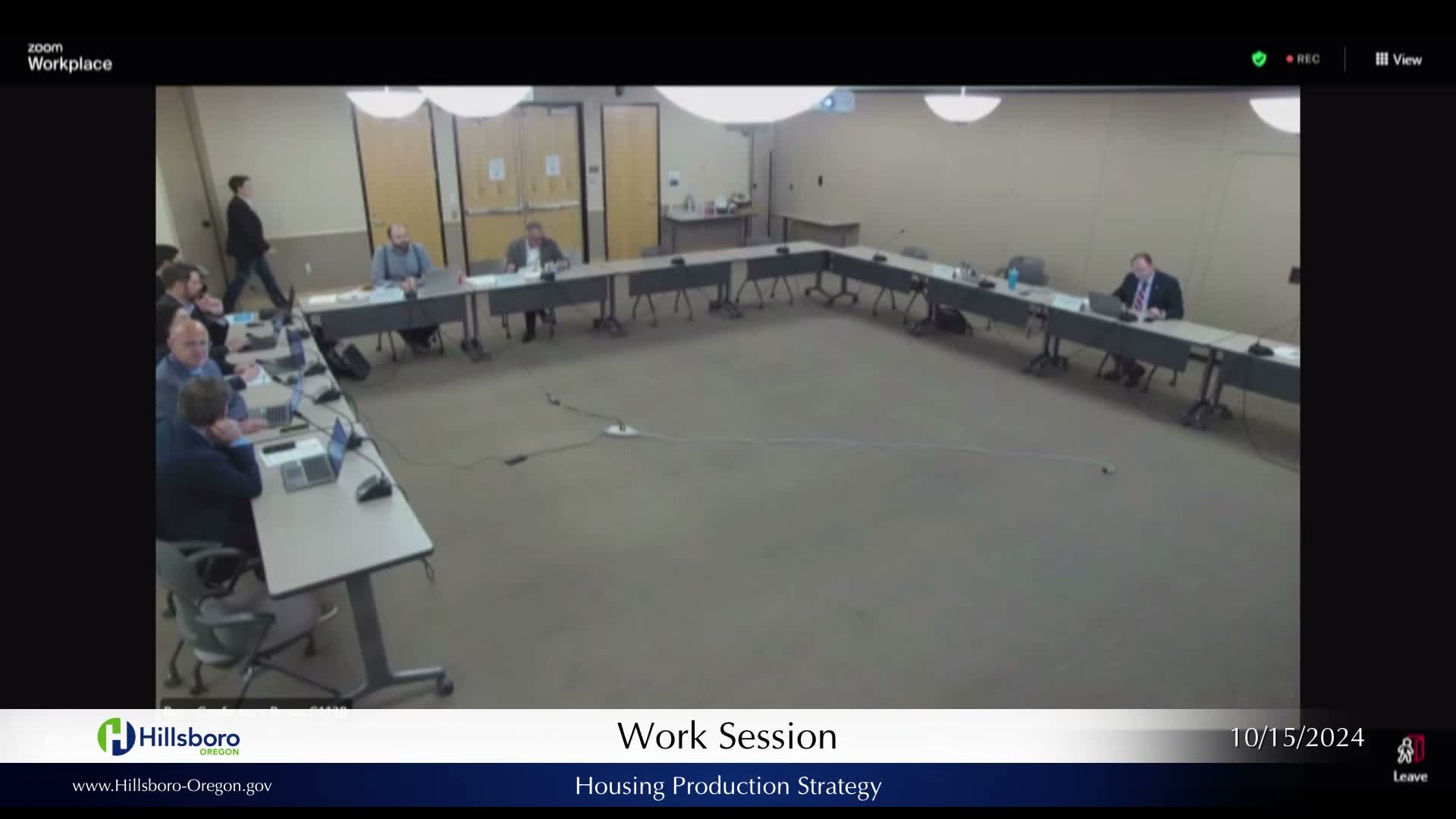
Councilors, city staff and the consultants from Cascadia Partners met in a third and final work session on the city—s housing production strategy to review a 21-item package of tools city leaders can use to increase housing supply and address affordability.
City Manager Robbie Hammond framed the meeting as the last step before the council will be asked to adopt a resolution in December. Becky, a city staff presenter, told the council the public draft will go out in October with a two-week comment period and reminded members that "these are, again, the final package of tools that we as a city can now use moving forward." The package groups actions under regulations, partnerships, investments, incentives and land strategies.
The consultants tied that set of actions to the city—s Housing Needs Analysis and recent production trends. Dan Diaz summarized recent delivery figures: "we as a community have delivered over 2,500 single dwelling units" since 2014 and nearly "just north of 4,900" multi-dwelling units in the same period, stressing that land availability in places such as South Hillsboro and Amber Glen drove production spikes.
The strategy lists regulatory moves that staff said could have medium-to-high impact depending on scope, including evaluating zoning map updates to add multiunit capacity, increasing allowable housing in multi-dwelling/commercial/mixed-use zones, refining middle-housing development standards, streamlining design and permit processes, and creating preapproved housing plans to speed small projects. Consultants emphasized pairing regulatory changes with targeted incentives and implementation capacity.
Council members asked clarifying questions about affordability and homeownership. Councilor O—Kare asked whether the strategy targets an affordable first-time home price of $300,000, a figure cited to the council earlier by an outside housing provider; staff said the production strategy does not set price caps but includes actions that could expand middle-income ownership opportunities. Councilors also probed modular construction—s role; staff said modular units are allowed in residential zones and could be expedited with preapproved plans.
The presentation also covered potential fee and tax tools: consultants described exploring selective permit fee waivers and scaling system development charges (SDCs) by unit size, evaluating multi-unit property tax exemptions and other abatements, and studying revenue options (including a construction excise tax) to fund deeper affordability or supportive housing.
Consultants and staff repeatedly flagged displacement risk and the need to pair production with anti-displacement measures. They described the equitable development strategy as an important companion to production-focused actions and noted that some actions will require more detailed implementation steps or state-level changes to be effective.
The council did not vote on the strategy at the session. Instead staff said adoption of the full package and the formal resolution is scheduled for a Dec. 3 public hearing; multiple implementation steps (code amendments, SDC/fee studies and targeted incentive programs) will follow and are expected to span multiple council terms and years. A consultant noted the code audit will continue into early 2025 and will produce draft code updates for future ordinances.
The council closed the work session and adjourned to executive session; staff will release the public draft in October and return with the final resolution for a December vote.