Get Full Government Meeting Transcripts, Videos, & Alerts Forever!
Get email alerts on the Eric Membership And Privacy topic
No spam. Unsubscribe anytime.
Presenter at county meeting urges Utah to leave ERIC, alleges data‑sharing and legal problems
Summary
At a public meeting, an unnamed presenter accused the Electronic Registration Information Center (ERIC) of building voter profiles, outsourcing maintenance to partisan nonprofits, and violating federal and state statutes; the speaker urged Utah lawmakers and county officials to end participation and increase transparency.
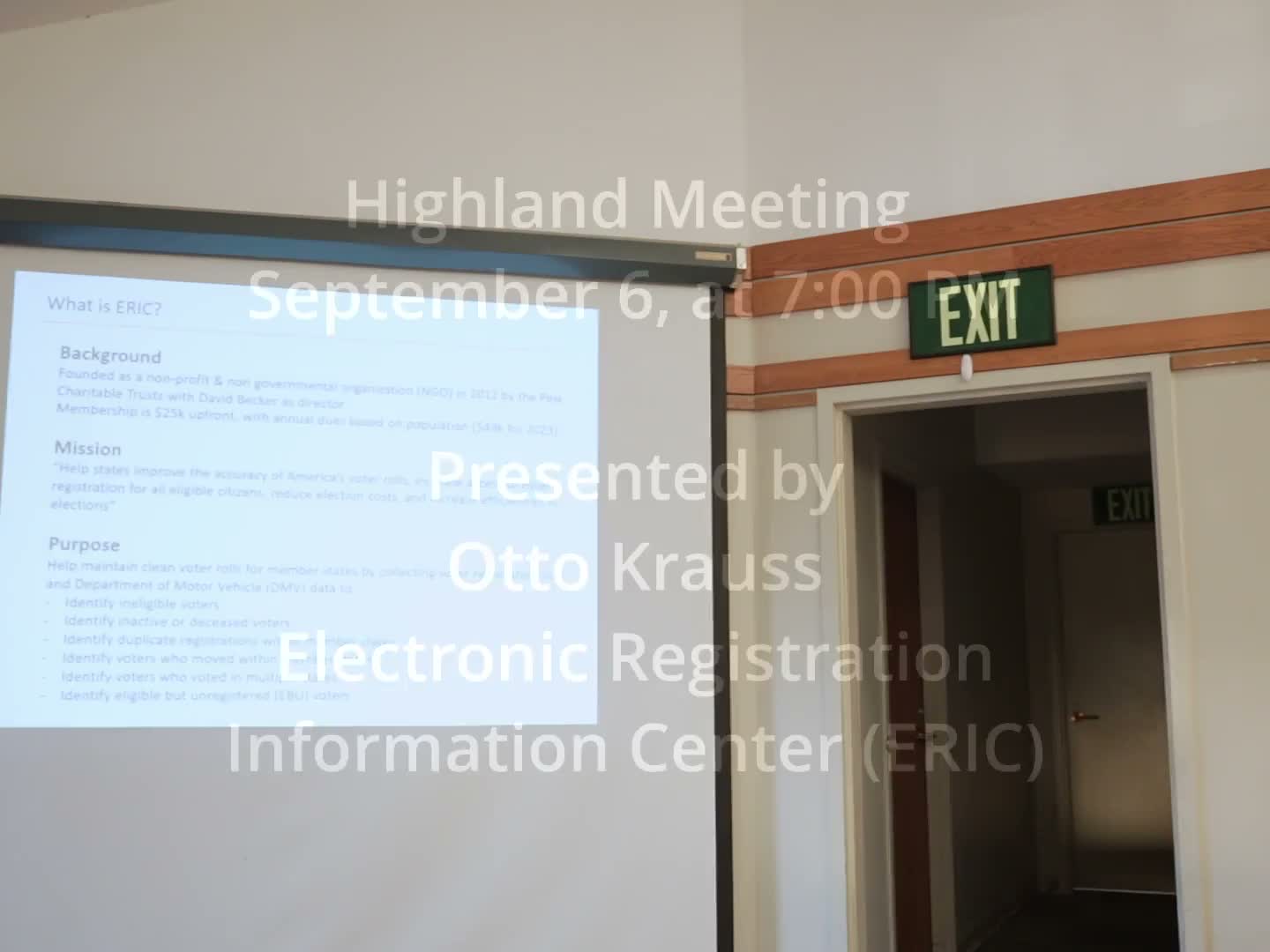
An unidentified presenter at a county civic meeting on election administration urged Utah officials to leave the Electronic Registration Information Center (ERIC), saying the interstate data‑sharing system creates privacy and legal risks and has been used to target voter outreach.
The presenter, credited in the transcript as Speaker 1, described ERIC as a nonprofit that matches states' voter‑registration rolls with DMV and other databases, and said Utah — a founding member — pays an initial $25,000 fee and population‑based annual dues (the presenter cited roughly $49,000 for Utah in the most recent year). "It is a nonprofit and nongovernmental agency," the presenter said, and "they want to build a profile of each voter in every state." The speaker added that Utah sends hashed driver and Social Security numbers to ERIC and that ERIC uses third‑party matching software to compare records across member states.
The presentation emphasized two types of concern. First, the speaker alleged procedural and legal problems: that ERIC's bylaws require member states only to "initiate contact" with certain flagged voters within 90 days rather than to perform roll cleaning; that ERIC prohibits public inspection of maintenance records; and that outsourcing list maintenance to an outside NGO could conflict with federal laws the presenter cited — the National Voter Registration Act (NVRA) and the Drivers Privacy Protection Act (DPPA). The presenter said these provisions "rub me the wrong way" and argued they leave incomplete public accountability for roll changes.
Second, the speaker raised questions about downstream data use and partisan effects. The presenter said ERIC shares data with the Center for Election Innovation and Research (CEIR) for outreach work, and highlighted a large private grant in 2020 that, the presenter claimed, funded voter‑education and turnout programs concentrated in Democratic‑leaning jurisdictions. "They take the registration and DMV data, and they are the ones that put together the EBU reports," the presenter said, referring to ERIC's "eligible but unregistered" lists.
The presenter cited media investigations and litigation elsewhere in the country, and described examples the speaker said showed data and maintenance problems in some states (including a claim about extensive duplicate registrations in Wisconsin). The talk also summarized local activity: volunteers who canvassed several Utah counties reported sample findings the speaker said included 200 "lost votes" out of roughly 6,600 canvassed and an error rate of about 18 percent in a different county sample. The presenter said four Utah counties had passed resolutions to cut ties with ERIC and urged attendees to contact legislators and the attorney general.
The presentation included direct recommendations: stop sharing voter data with nonprofits, increase transparency so county clerks and the public can inspect maintenance records, and pursue state‑led data‑sharing agreements with other government agencies (for example, using the National Change of Address database and memoranda of understanding with other states).
The presenter framed many statements as findings from independent reporting and canvasses; multiple audience members asked whether laws already on the books could be enforced, and the presenter noted lawsuits and court rulings pending in other states. The transcript records audience questions and some clarifying comments but does not record a formal vote or official action by the meeting itself.
The most recent procedural step the presenter described was local: county central committees and five county resolutions discussed in spring, four of which the presenter said succeeded, and a call that participants press the legislature or private litigants to act. The presenter also said Utah's election officials had obtained an exemption from ERIC's EBU reporting requirement late in the prior year, a point the speaker used to question the lieutenant governor's office's public statements about ERIC's operations.
The speaker repeatedly framed contested points as allegations backed by media stories, volunteer canvass results and litigation elsewhere rather than as confirmed findings by Utah officials. The Lieutenant Governor's Office, which the presenter said has produced explanatory materials defending participation in ERIC and noting bylaw changes in 2022–23, is not recorded in the transcript as responding to this presentation during the meeting.
The presentation concluded with a public‑action appeal: contact representatives and the attorney general, consider county resolutions, and press for open access to maintenance data.
Next steps described by the presenter included legislative outreach, canvass follow‑up, and potential litigation; the transcript does not record any formal, immediate policy decision at the meeting.