
Speaker Chris, a former Utah legislator, urges military aid for Ukraine and warns against conspiracy-driven narratives
Get AI-powered insights, summaries, and transcripts
Subscribe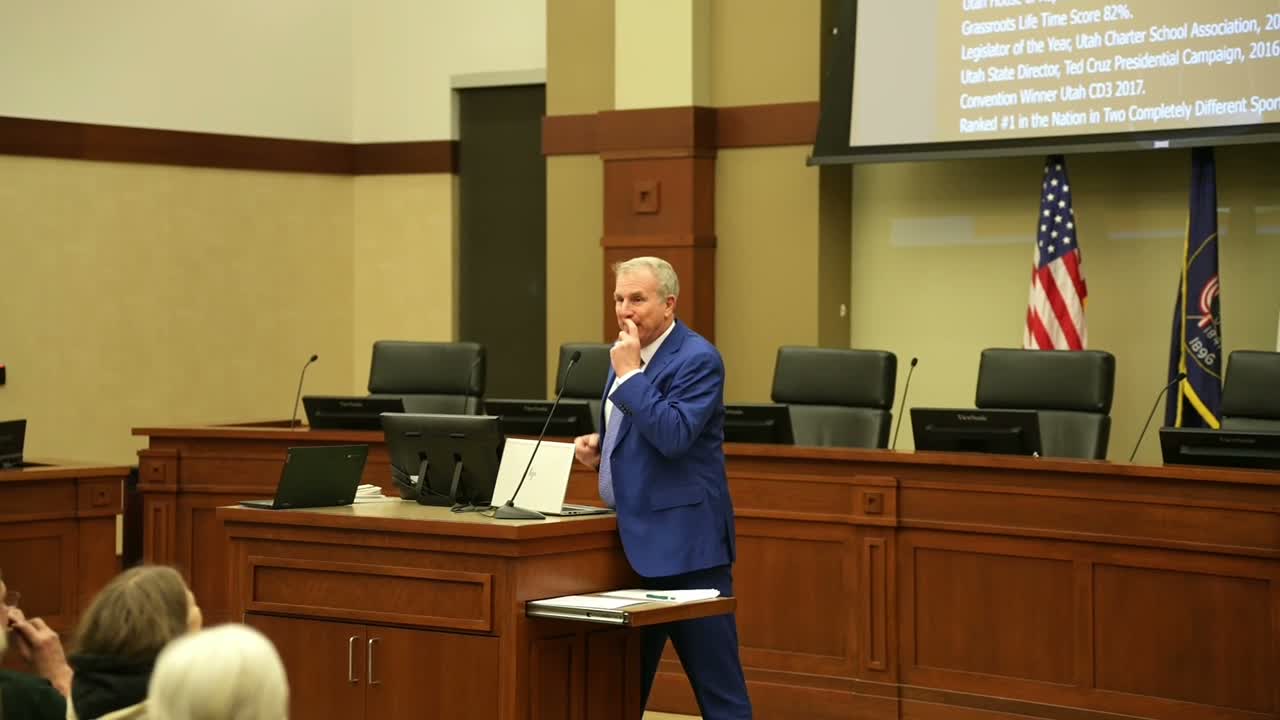
Summary
At a public forum, Chris (identified only by first name in the transcript) said U.S. military aid to Ukraine is strategically valuable, criticized misinformation spreading among some conservative media outlets, and urged audiences to verify sources and read original studies before repeating claims.
Chris, identified only by his first name in the transcript and described during the talk as a former Utah legislator, argued at a public forum that the United States should continue supplying military aid to Ukraine while being cautious about humanitarian spending and unverified claims circulating in political media.
"When I'm calling my mother, I can hear the bombs in the background," Chris said as he described direct contact with people in Ukraine and why he rejects simplistic narratives that dismiss the war as "fake news." He framed his position around cost‑benefit analysis and national interest, saying military aid yields intelligence and battlefield advantages while some humanitarian funding risks corruption and is better shouldered by European partners.
Chris addressed popular talking points he said have spread through conservative outlets. He disputed broad labels such as the claim that "Ukraine is full of Nazis," noting Ukraine has a sizable Jewish population and calling that kind of label propaganda that mixes partial truths with falsehoods. He also cautioned against repeating unverified stories—he called the "biolabs" narrative an example of a claim that circulated widely on social media and conservative channels but that should be investigated rather than amplified.
On historical context, Chris raised the Holodomor—the 1932–33 famine—as shaping Ukrainian attitudes. He cited different casualty estimates while warning listeners that historical grievances matter when assessing Ukrainian resolve. He also summarized the 1994 Budapest Memorandum, saying Ukraine gave up Soviet-era nuclear weapons under security assurances and noting the memorandum was not ratified by the U.S. Senate (a point he used to explore legal versus moral responsibility).
Chris criticized aspects of conservative media he said go beyond useful skepticism. He named commentators by example and warned that treating every disagreement or error by institutions (including mistakes during COVID) as proof of a global conspiracy risks political isolation and strategic error.
During a question‑and‑answer period, audience members pushed back on particular social issues and source credibility. Chris repeated his central advice: "research, research, research," and encouraged people to consult multiple sources and follow footnotes to primary documents rather than rely on clips or single pundits.
The event closed with a moderator inviting attendees to sign an email list and pick up announcements for local meet‑and‑greet events.