Get Full Government Meeting Transcripts, Videos, & Alerts Forever!
Get email alerts on the Transportation Safety topic
No spam. Unsubscribe anytime.
Hillsboro staff urge keeping Vision 0 as citywide goal while updating Transportation Safety Action Plan
Summary
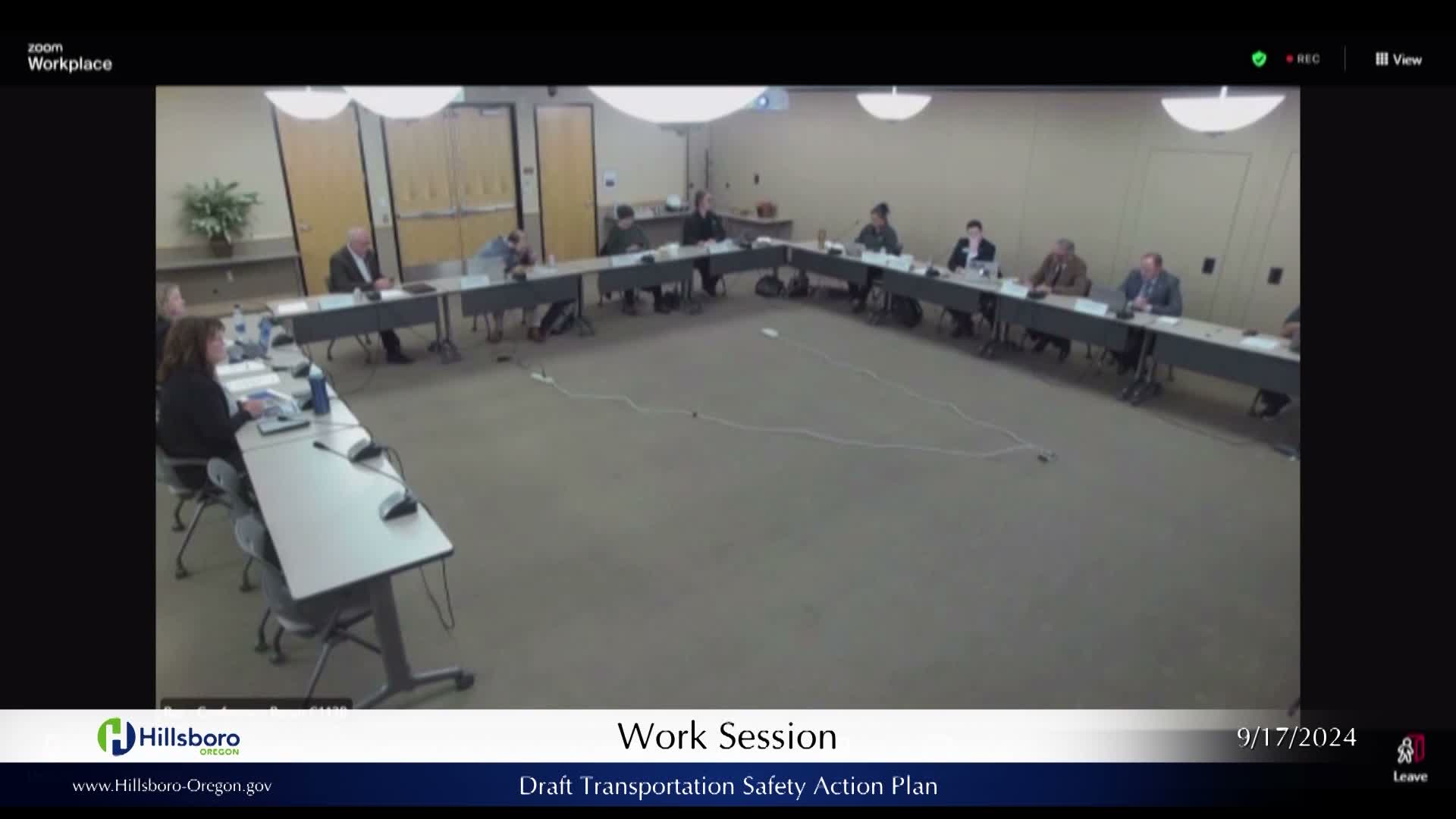
City staff presented an updated Transportation Safety Action Plan, showing total crashes down but serious injuries and fatalities up; staff recommended a safe-systems approach, prioritized five intersections and asked council to retain the Vision 0 goal through 2035.
City staff presented an update to Hillsboro’s Transportation Safety Action Plan (TSAP), asking council to retain the citywide Vision 0 goal of eliminating traffic fatalities and serious injuries by 2035 and to endorse a set of prioritized, low-cost safety improvements. The presentation described five years of vetted ODOT crash data and a mix of education, engineering and enforcement strategies to reduce serious outcomes.
"The total number of crashes has decreased but the crashes with serious injuries and fatalities has increased," said Susie Sims, who led the plan update, as she reviewed local crash trends and the plan’s safe-systems framework. Staff told council the ODOT five-year data and local analyses show roughly 15% of crashes involved pedestrians and bicyclists, 55% involved aggressive driving behaviors and 61% occurred at intersections.
Staff said the TSAP uses five focus areas — safer people, safer vehicles, safer speeds, safer roads and post-crash care — and couples citywide policy recommendations with intersection-level fixes. Examples of near-term, low-cost actions already underway include trimming trees to improve sight lines and changing signal heads or striping at priority intersections. Staff also highlighted school-safety investments: a nearly $300,000 education and outreach grant plus $50,000 from ODOT to expand Safe Routes programming and fund part-time staffing for outreach.
Councilors and staff discussed the limits of city authority where high-crash corridors are county or state facilities. "We can flag problems and help fund or influence design changes, but we cannot unilaterally implement projects on state or county corridors," staff said, urging continued collaboration with ODOT, county partners and TriMet. Several councilors pressed staff to pursue signal timing and operational changes and to consider a local matching strategy to advance county/state projects where they have highest impact.
Automated enforcement (camera-based red-light and speed enforcement) was flagged as a recommendation for evaluation. Staff noted prior local studies and jurisdictional experiences and said implementation would require operational analysis and likely additional staffing to administer citations.
Councilors voiced support for retaining Vision 0 citywide and for keeping the 2035 target to maintain pressure on regional partners. Staff said they will continue outreach, refine the top-5 intersection work plans and bring the TSAP back for formal adoption.
The work session informed the council’s priorities; staff will return with refined recommendations and grant strategies that could fund connected signal systems, pedestrian/bicycle toolkits and intersection improvements.