Get Full Government Meeting Transcripts, Videos, & Alerts Forever!
Get email alerts on the Water Infrastructure topic
No spam. Unsubscribe anytime.
Springville planning panel recommends water master plans and new impact-fee levels to City Council
Summary
After a detailed presentation from Public Works, the Springville Planning Commission voted unanimously to recommend the City Council adopt updated pressurized-irrigation and drinking-water master plans and attendant impact-fee analyses; commissioners pressed staff on water rights, well capacity and fee calculations.
The Springville Planning Commission heard a presentation from Public Works director Brad Stapley on proposed pressurized-irrigation and drinking-water master plans and related impact-fee analyses, then voted unanimously to recommend both plans to the City Council.
Stapley summarized the city's drinking-water assets (tanks, pipes, wells and springs), the hydraulic modeling used to identify system deficiencies and future capital projects, and how Utah law requires separating growth-related costs from existing system repairs. He told the commission the system currently produces roughly 17,000 gallons per minute against an existing demand near 13,000 gpm and described the city's "n minus 1" resilience (ability to lose one high-producing well and still meet peak-day demand).
"My name is Brad Stapley. I'm the public works director for Springville City," Stapley said at the start of his presentation. He cited a 1933 tank that was inspected and returned to service as an example of how the city extends asset life rather than immediately replacing aging infrastructure.
Staff also reviewed pressurized irrigation (PI) supply and storage. Bartholomew Pond was described as PI storage (about 32 acre-feet capacity with a six-foot operating fluctuation), and Stapley said the city can bring surface water from Strawberry Reservoir through the Century-Tow Water Conservancy District pipeline when needed.
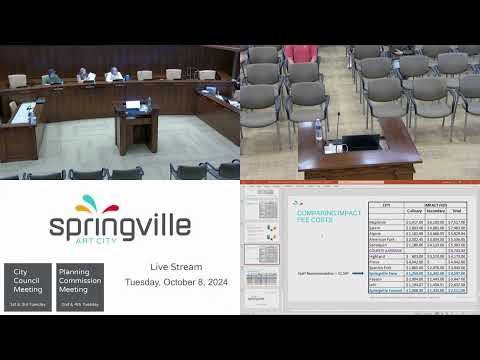
On impact fees, staff presented component figures shown on slides (an indoor-use component listed at $1,256 and an outdoor-use component listed at $2,772) and stated the "maximum allowable" combined fee from the impact-fee analysis as $3,597. Stapley said the proposed combined fee would remain below the county average and emphasized the statutory principle that "growth pays for itself." He asked the commission for a recommendation to the council on the full package of master plans and impact-fee analyses.
Commissioners asked where revenue from any future water leasing would go and whether a new well would be required. Stapley said the city currently does not sell water but holds nearly 5,000 acre-feet that could be leased or used in the future; he also said the master plan anticipates drilling a new well near the new high school within the next decade. He gave technical detail on existing wells: the 4 South complex wells produce about 3,000 and 4,000 gpm respectively and show relatively low drawdown compared with deeper wells in neighboring jurisdictions.
There were two legislative actions before the commission. After opening a public hearing on the pressurized-irrigation master plan and receiving no public comment, the commission moved, seconded and voted by roll call to recommend the 02/2024 pressurized-irrigation impact-fee facilities plan and impact-fee analysis to the City Council (all aye). The commission then opened and closed a public hearing on the drinking-water master plan (no public comment) and voted by roll call to recommend the 2024 drinking-water impact-fee facilities plan and impact-fee analysis to the City Council (all aye).
Votes at a glance: - Motion to recommend adoption of the 02/2024 pressurized-irrigation impact-fee facilities plan and impact-fee analysis: Passed by roll-call (Ralph Calder ' aye; Hunter Huffman ' aye; Anne Anderson ' aye; Genevieve Baker ' aye). - Motion to recommend adoption of the 2024 drinking-water impact-fee facilities plan and impact-fee analysis: Passed by roll-call (Ralph Calder ' aye; Hunter Huffman ' aye; Anne Anderson ' aye; Genevieve Baker ' aye).
The commission had no public comment on either hearing. The meeting adjourned after the votes; the recommendations will be transmitted to the City Council for final consideration.