
Planning commission backs Springville Public Works on sewer and wastewater impact-fee plans
Get AI-powered insights, summaries, and transcripts
Subscribe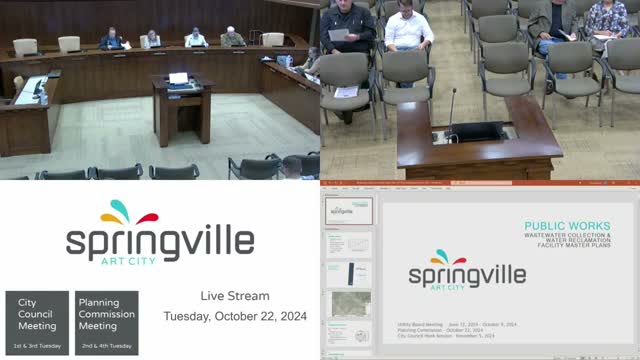
Summary
The Springville Planning Commission voted to recommend to the City Council adoption of two Public Works master-plan impact-fee packages — a Sewer Collection Master Plan and a Water Reclamation Facility (wastewater treatment) impact-fee analysis — endorsing the maximum allowable wastewater impact fee of $2,886 per ERU. Public comment was nil and staff said the analyses are defensible under state law.
The Springville Planning Commission on Tuesday recommended that the City Council adopt two Public Works master-plan packages that set capital projects and the growth-related share of costs for sewer collection and wastewater treatment.
Public Works staff presented both studies and the city’s impact-fee analysis, saying the work separates existing system deficiencies (to be paid by current ratepayers) from the portion of project costs that growth may lawfully be charged for under Utah impact-fee rules. The department’s presentation said the city’s wastewater system includes roughly 35 miles of gravity pipeline (4–36 inches), 12 lift stations, and about 2,700 manholes; flow studies show groundwater infiltration of roughly 400,000 gallons per day and storm-driven inflow spikes up to about 2,000,000 gpd.
“The model allows us to determine the proper size of pipelines, what size of lift stations we need, and also what the wastewater treatment plant is going to need to handle,” Public Works presenter (S5) said during the technical briefing. Staff said the treatment plant’s current average flow is about 3.5 million gallons per day, with design capacity around 6.6 million gpd and a peak-hour capability near 9.3 million gpd.
Phase 1 projects for the water reclamation facility, staff said, total about $7.1 million; roughly $1.5 million of that is already budgeted. Staff identified impact-fee-eligible components within those projects — for example, about $990,000 in headworks work and roughly $1.7 million in standby generator and sludge-dewatering upgrades that they recommend attributing to growth where appropriate.
Based on the consultant’s calculations and state guidance, the presentation recommended a maximum allowable wastewater impact fee of $2,886 per equivalent residential unit (ERU). “This is defensible,” the presenter said, adding the mayor has asked staff to review the master-plan and impact-fee documents annually because costs and construction pricing are changing rapidly.
The commission opened and closed a public hearing on the sewer collection plan after no members of the public stepped forward. Commissioners then made motions to recommend approval of the wastewater treatment plant master-plan impact-fee documents and the Sewer Collections Master Plan impact-fee documents to the City Council; both motions were seconded and approved by voice vote. The transcript records the decisions as passed by voice ‘Aye’ without a roll-call tally recorded in the meeting record.
What happens next: The commission’s recommendation will be forwarded to the City Council for final action. Staff told commissioners it will continue annual updates to the impact-fee assessment so the fee reflects revised project costs and capacity calculations.
Authorities and limits: Staff repeatedly cited Utah law on impact fees and the state’s evolving nutrient regulations (phosphorus and nitrogen) as constraints on future plant changes and funding responsibility. The commission’s action was procedural — a recommendation to the council — and not the final adoption of any fee schedule.