Get Full Government Meeting Transcripts, Videos, & Alerts Forever!
Get email alerts on the Housing Policy topic
No spam. Unsubscribe anytime.
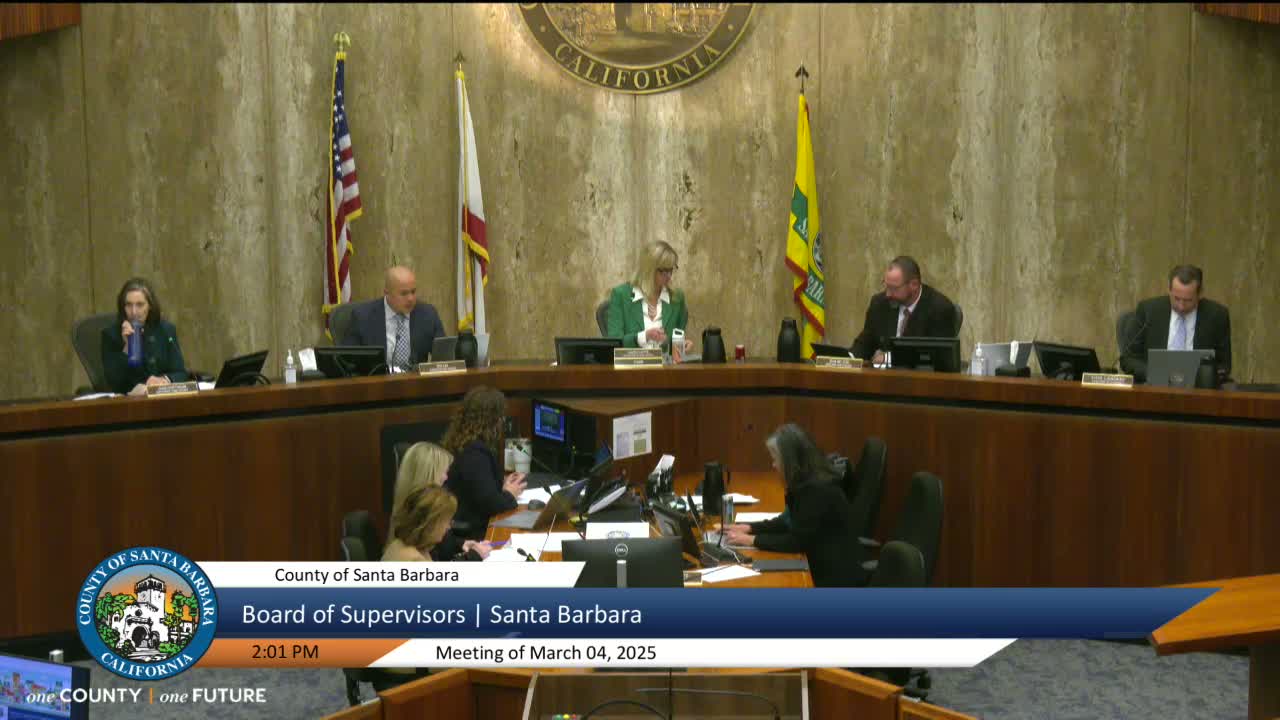
Board adopts changes to inclusionary housing ordinance, extends affordability to 90 years and applies rules to some rental projects
Summary
The Board amended County Code Chapter 46A to replace the "residential second unit" term with "ADU," extend deed-restriction terms to 90 years and allow the IHO to apply to 100% rental developments with waiver conditions tied to median rents by housing market area.
On March 4 the Santa Barbara County Board of Supervisors adopted amendments to the county—s Inclusionary Housing Ordinance (Chapter 46A) intended to strengthen long-term affordability and align local policy with current state law and the county—s updated housing element.
Community Services staff explained the package: (1) update terminology by replacing "residential second unit" with "accessory dwelling unit (ADU)" to reflect recent zoning changes; (2) lengthen the affordability term for deed-restricted ownership units from 45 to 90 years to preserve units for multiple generations; and (3) apply inclusionary requirements to 100% rental projects (with an annual waiver process for particular income categories where median rents in a housing market area are already affordable to that income tier).
Staff presented a pro forma feasibility analysis (Harrison Associates) for a prototype rental project in Santa Maria and reported the study found rental projects can remain financially feasible under the proposed inclusionary percentages. A lead consultant described the residual land value methodology used to test whether projects could support inclusionary units; the consultant said a substantial buffer exists for the Santa Maria prototype making the inclusionary obligation feasible in that instance.
During debate, Supervisor Nelson expressed concerns that adding inclusionary obligations could deter some projects—especially in parts of the county where land values and rents differ—and asked staff to be careful about local market effects and to rely on vetted market-data sources (the county will use Yardi matrix data for rent comparisons going forward). Several supervisors said the 90-year term preserves long-term affordability and aligns with other jurisdictions.
The board approved staff recommendations by roll-call vote, 4 to 1 (Supervisor Nelson opposed). Staff will implement the ordinance amendments and use the recommended market-data approach and waiver mechanics when assessing rental project applications.