
Public commenters urge limits on Xcel Energy’s PSPS authority and push undergrounding, microgrids as alternatives
Get AI-powered insights, summaries, and transcripts
Subscribe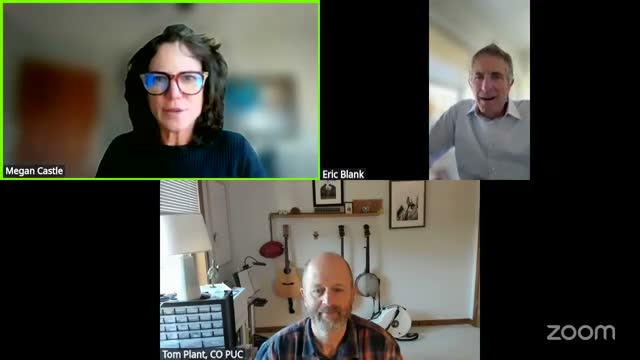
Summary
At a March 13 Public Utilities Commission hearing on docket 24A-0296E, residents, county officials and consultants praised detection tech but raised concerns about a proposed ~$1.9 billion wildfire-mitigation spending plan, potential rate impacts and utilities’ unilateral power-shutoff authority, and urged undergrounding and microgrids as longer-term solutions.
Public comment hearing on March 13, 2025: the Public Utilities Commission heard a range of testimony on Public Service Company of Colorado’s proposed 2025–2027 wildfire mitigation plan, its public safety power shutoff (PSPS) plan and a proposed wildfire mitigation cost-recovery rider filed in docket 24A-0296E.
The commissioners — chaired by Eric Blank — opened the record and instructed commenters that officials would listen without answering substantive questions during the hearing. PUC staff read the filing summary, noting the company projects about $1,900,000,000 in program costs and estimated that the proposed cost-recovery mechanism could increase residential bills by roughly $9 per month.
Why it matters: The proposed spending and the mechanism to recover those costs are intended to reduce utility-caused wildfire risk, but several speakers said the plan shifts disproportionate costs and risks to customers and urged alternative approaches that prioritize reliability and equity.
Several recurring themes emerged in public testimony. Mister Munchow, who identified himself as a consumer and retired wildland firefighter, said PSPS decisions appear driven by a utility’s exposure to liability and reputational risk and proposed checks on unilateral shutoffs, including economic disincentives such as disallowing charging customers for transmission during shutoffs or a second-review mechanism. “They’re gonna be focused on their economic liability,” he said, and urged the Commission to “circumscribe the utility’s power to shut down unilaterally.”
Summit County Commissioner Nina Waters praised Xcel Energy’s AI camera network for early detection, saying the cameras helped detect “over 6 wildfires just in the last summer of 2024,” and in some cases detected fires up to about 10 minutes before 911 calls. Waters urged better coordination and data-sharing between the utility and local emergency management, and raised equity concerns about funding: a roughly $2,000,000,000 program, she said, should not fall entirely on ratepayers; low-income households and medically vulnerable residents need simpler access to rebate programs and clearer PSPS notifications.
Technical and policy witnesses pressed for different mitigation priorities. Efrem Glass, a utility consultant with wildfire-mitigation experience, said many of Xcel’s proposed measures are sensible but warned that line hardening can reflect utility incentives and may not prevent all ignition types (he cited bird-caused ignitions). Glass recommended prioritizing undergrounding of distribution lines in high-risk areas and investing in microgrids and customer-sited resources as a cost-effective path to both reduce wildfire risk and improve reliability.
Leslie Glustrom, who said she lives in Boulder, criticized the financing approach, contending that much proposed capital spending would yield returns for shareholders while customers shoulder outage and reliability costs. “When we say to Xcel, we want you to do something, they just start drooling,” she said, urging the Commission to limit the utility’s ability to profit from wildfire-related capital spending and to consider system redesigns that emphasize local generation and storage.
What was not decided: This hearing was a public-comment session; commissioners did not deliberate or rule at the meeting. The PUC staff noted the matter is scheduled for evidentiary hearing in early May, with the Commission expecting to deliberate and issue a decision later in the summer.
Next steps: Commissioners encouraged written comments to supplement the record (via the Commission’s e-filing system or online comment form) and signaled additional public comment opportunities, including a hearing scheduled April 29 from 4–6 p.m. The record will be considered alongside evidentiary filings before the PUC decides.
Sources and attributions in this article come from the March 13, 2025 PUC public comment hearing (docket 24A-0296E).