Get Full Government Meeting Transcripts, Videos, & Alerts Forever!
Get email alerts on the Recall Petition topic
No spam. Unsubscribe anytime.
Danvers committee narrows citizen recall petition language, approves Section 2 and several provisions
Summary
The Town Meeting/Town Manager Acts Review Committee voted to accept amended language for the citizen recall petition (notably Section 2), resolved several section‑by‑section edits and authorized the chair to make clerical changes before forwarding the committee’s report to the select board.
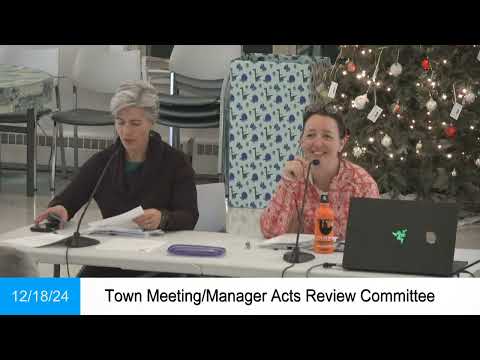
The Town Meeting/Town Manager Acts Review Committee on Dec. 18, 2024 adopted amended language for the citizen recall petition after extended debate over whether recall grounds should be limited to actions while in office.
The committee’s action centered on Section 2, a redline prepared by member John Almeida. Almeida proposed general (non‑enumerated) grounds reserved to voter judgment but with explicit language stating the expectation that the recall process “would only be used to address serious malfeasance or misconduct,” while leaving the final determination to voters. After an initial tie on a proposed amendment to remove the clause excluding prior acts, members caucused briefly and then approved the revised Section 2.
Why it matters: The text the committee approved defines the scope and threshold for recalls in the Town of Danvers. The choices the committee made—keeping broad wording on grounds while adding an explanatory sentence—seek to balance two risks the members debated: avoiding frivolous recalls and preserving voters’ ability to respond to serious past misconduct.
What the committee did and did not do: The group voted section‑by‑section on the citizen petition. It rejected a proposal to change the filing‑window timing from the petition’s six‑month rule to 12 months, removed a parenthetical listing of covered offices from Section 1, accepted edits to Sections 3–6 (including clarifying business‑hours language and replacing a narrow Town Manager Act citation with 'consistent with applicable law'), and approved Sections 7–9. At one point the board was deadlocked on an amendment and took a five‑minute break before resuming. The committee also authorized the chair to make grammatical and clerical edits based on tonight’s discussion and agreed to report the committee’s work to the select board.
Quotes from the meeting: “The voters themselves shall individually determine whether the grounds listed in a petition for recall are sufficient,” the chair said while explaining the redrafted sentence the committee added to Section 2.
John Almeida, who drafted the redline, said, “I would make a motion to adopt the language as provided in the document edited to provide general language on grounds for recall, leaving grounds to voters, but limited to actions conducted while in office,” and moved that language as the committee’s starting point for amendment.
A member arguing against restricting recall to in‑office acts warned the committee that limiting grounds could “close the door” on future cases of serious past misconduct and urged keeping the language broad while raising signature thresholds if members were concerned about frivolous filings.
Votes at a glance:
- Section 2 (redline by John Almeida as amended with explanatory sentence): adopted (committee recorded 6 members in favor at time of confirmation). - Section 1 (eligibility/timing, parenthetical removed; six‑month rule retained): adopted. - Sections 3–6: accepted with minor edits (business‑hours wording; vacancy/appointment language changed to ‘consistent with applicable law’). - Section 7: adopted (timing restriction on filing within 6 months of assumption of office). - Section 8 (post‑resignation appointment restriction): adopted as written. - Section 9 (effective date): adopted.
What’s next: The committee will forward its revised petition language and a report of tonight’s votes to the select board for consideration and likely return the matter to town meeting for final action. The committee set its next meeting for Jan. 15 to continue separate review of the Town Manager Act.
Context/clarifying details: The draft petition included an initial signature step of 350 names; members discussed both raising that number (for example to 600 or to a percentage) and other ways to discourage frivolous petitions. Committee members repeatedly emphasized they intended the language to let voters decide ultimate grounds while avoiding mechanical rules that preclude action in cases of serious misconduct.
Ending: The committee concluded its work on the recall petition sections and adjourned after authorizing the chair to finalize clerical edits. The group turned next to the Town Manager Act and scheduled further review for January.