Get Full Government Meeting Transcripts, Videos, & Alerts Forever!
Get email alerts on the Airport Noise Expansion topic
No spam. Unsubscribe anytime.
Danvers residents press Beverly Regional Airport officials on noise, runway work and new hangar plans
Summary
At a Dec. 17 Select Board meeting, Beverly Regional Airport manager Gabriel Hanifin gave a year-in-review and said the airport is tracking noise complaints (341 total this year, 64 from Danvers) and pursuing a runway reconstruction with environmental review; residents raised concerns about a proposed 40,000 sq. ft. hangar, PFAS contamination and whether local authorities can limit flights.
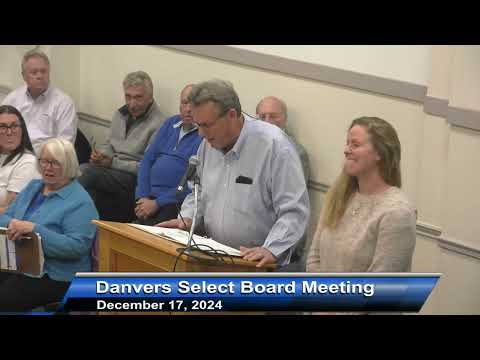
Gabriel "Gabe" Hanifin, Beverly Regional Airport manager, told the Town of Danvers Select Board on Dec. 17 that the airport has begun systematically tracking noise complaints and that operational and safety projects are underway, including a planned full reconstruction of the main runway targeted for fiscal 2027.
Hanifin said the airport started a formal complaint-tracking program Jan. 1 and has recorded 341 noise-related communications this year from 33 unique addresses, of which 64 complaints (from 19 unique addresses) originated in Danvers. "We started tracking each and every noise complaint we received," Hanifin said. He said month-to-month complaints have fallen since the program began, and that the airport follows up with complainants and with operators to reduce repeat problems.
The presentation and a lengthy public-comment period focused on two related concerns: whether runway and hangar projects will draw larger, noisier jets, and the local environmental impacts of airport operations. Hanifin said the runway work will include an aeronautical study and an environmental assessment before construction can begin. The project will add about 300 feet of paved safety area at each runway end; Hanifin said that pavement provides additional takeoff rollout but "it can't be used for direct landing," and that the FAA is directing the work to improve safety for aircraft already using Beverly rather than to attract larger planes.
Residents pressed for specifics. Ed Pino and other speakers asked for a written statement showing the airport's current critical aircraft category and the classes and maximum weights of aircraft currently using the field; Hanifin replied that the airport's current FAA "critical aircraft" classification is C‑2 (characteristic of midsize business jets such as a Cessna Citation) and that the master plan does not appear to change that categorization. "That doesn't mean a bigger aircraft might not show up here and there," Hanifin said, but he added that the designation is based on observed, regular operations.
Concern about a proposed 40,000-square-foot hangar drew repeated criticism. Several residents said a hangar that size would enable far more based jets and would increase noise and pollution. Hanifin said the private hangar proposal is intended primarily to house aircraft that already use Beverly—reducing empty repositioning flights to other airports—and that the facility would be for storage rather than maintenance.
Environmental questions included a 2009 firefighter-training discharge of foam that left PFAS readings on part of the airfield. Hanifin said the highest reading on the Danvers side of the airfield was about 66 parts per trillion and said mitigation and delineation work is ongoing; he stated the town of Danvers has not been found legally responsible for cleanup costs.
Residents pressed on local authority to regulate operations. Select Board members and airport officials repeatedly said the FAA controls the national airspace, including which aircraft land and when, and that airports are generally prohibited from restricting flights by time, frequency or aircraft type. Hanifin also explained the FAA's DNL (day-night average sound level) contour approach and said Beverly's 65 DNL contour remains inside airport property, which currently makes homes ineligible for FAA-funded soundproofing programs; he warned that larger aircraft could expand the contour.
Hanifin and the airport commission chair, Kyle Retallik, invited residents to continue to submit complaints via the airport website and to attend monthly airport commission meetings. The board asked the manager to obtain additional data requested by the Select Board—annual gallons of fuel pumped on the Danvers side, details of on-site safety and hazmat equipment, and visual diagrams of noise contours—and Hanifin agreed to return with more detail in the fall.
The Select Board discussed next steps, including whether the town should pursue a resolution opposing certain expansion actions; no formal resolution or vote on that topic was recorded at the meeting.