Get Full Government Meeting Transcripts, Videos, & Alerts Forever!
Get email alerts on the Biomass Project topic
No spam. Unsubscribe anytime.
Residents, health professionals press Tuolumne supervisors to reject Golden State Natural Resources pellet plant
Summary
Multiple residents and a registered nurse told the Tuolumne County Board of Supervisors the GSNR wood‑pellet project poses health and climate risks, citing the DEIR's air‑pollution analysis, alleged cancer‑risk exceedances and a DEIR estimate of 1,900,000 metric tons CO2 over 20 years; proponents argued biomass can aid forest health.
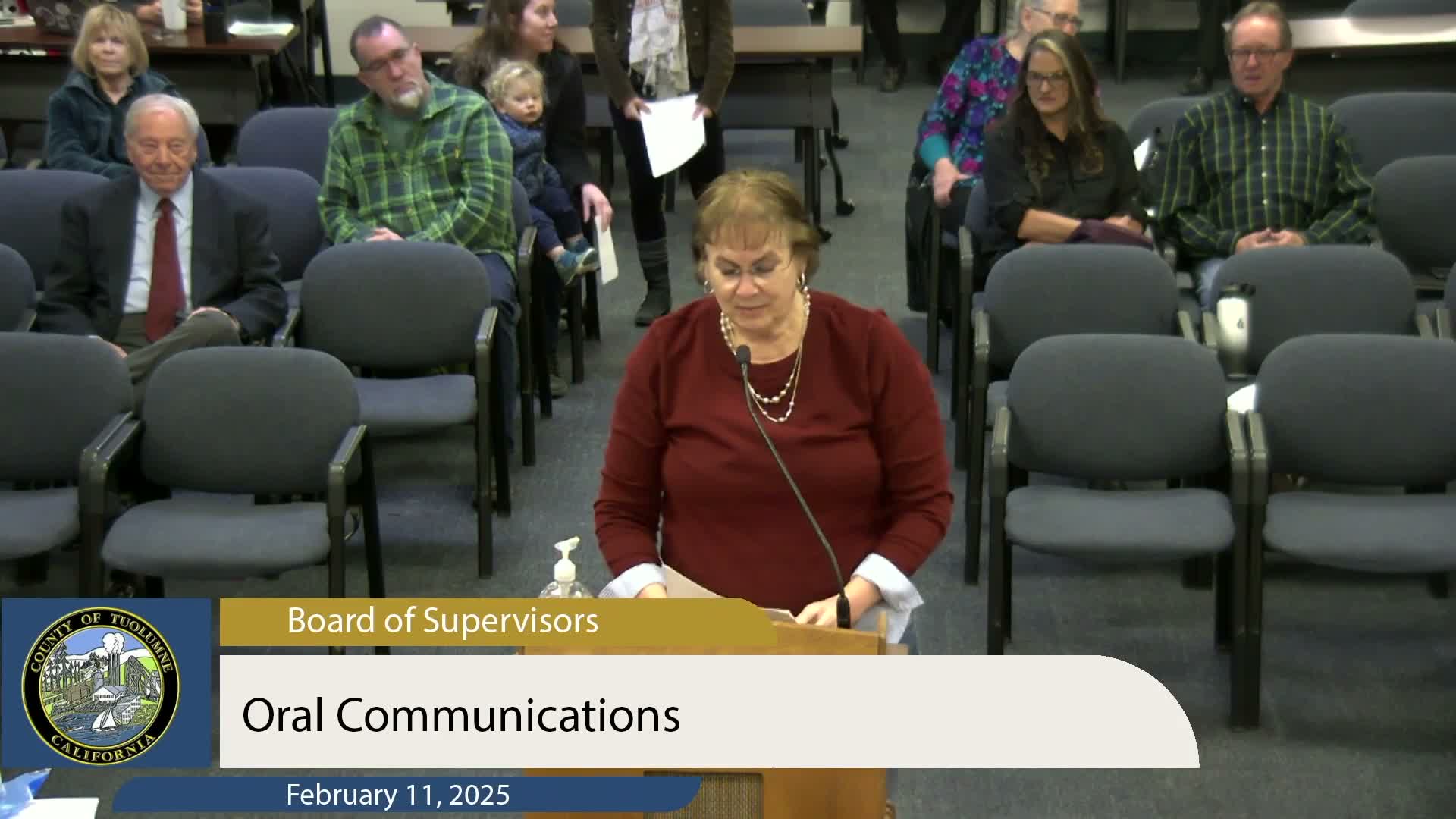
Elaine Hagan, a registered nurse, urged the Tuolumne County Board of Supervisors to oppose the Golden State Natural Resources (GSNR) wood‑pellet/biomass project, saying the draft environmental impact report (DEIR) devotes roughly 300 pages to air pollution and predicts operations would exceed cancer‑risk thresholds "approximately 3 to 6 times," even after mitigation.
"This project is all risk and no reward," Hagan said during public comment, urging the board to reject the proposal on public‑health grounds.
Other speakers backed Hagan's concerns. An unidentified commenter told the board that industrial pellet standards require non‑rotting, whole logs rather than slash piles, and cited the DEIR language that the project could cut trees up to 40 inches in diameter. The speaker warned that the project would not resolve existing slash‑pile problems and urged enforceable, independently verifiable commitments from GSNR.
Karen Johnson, a Twain Harte resident, framed her objections around climate accounting. She said the DEIR "discloses that it will generate 1,900,000 metric tons of CO2 equivalent over its 20 year lifespan," and warned that the global market for wood pellets is shifting as countries reconsider subsidies. "If the global market for wood pellets collapses, Tuolumne County could be left with a massive, unusable pellet plant and the bill for cleaning it up," she said.
Several other residents expressed opposition, pointing to international examples. One commenter cited Smithers, British Columbia, saying a local plant there resulted in whole‑tree harvesting rather than resolving slash‑pile burning and that public commitments were not honored.
Not all public comment opposed the concept. A timber faller and firefighter said removing ladder fuels and thinning live trees are critical to forest health and public safety and urged support for biomass operations that pay enough to remove fuels. He cited a separate project, Yosemite Clean Energy, as an example of a local initiative that could provide benefits.
Jonathan, a Sonora business owner, asked the board whether it is the final authority on the project and urged supervisors to take a leadership position rather than remaining neutral as the review proceeds. County staff clarified that environmental approvals and RCRC/GSNR steps precede potential land‑use entitlements, and that any land‑use permits would later come before the board in a quasi‑judicial capacity.
The board did not take action on the project during this meeting. Public comments were recorded for the administrative record; staff reiterated that the planning and entitlement processes remain ongoing and that the board's future role would address land‑use approvals should formal permit applications come before it.
What happens next: The DEIR process and subsequent land‑use entitlement steps will determine whether and how proposed mitigation is required, and the board indicated staff will provide process clarifications when those items move forward.