Get Full Government Meeting Transcripts, Videos, & Alerts Forever!
Get email alerts on the Sewer Enforcement topic
No spam. Unsubscribe anytime.
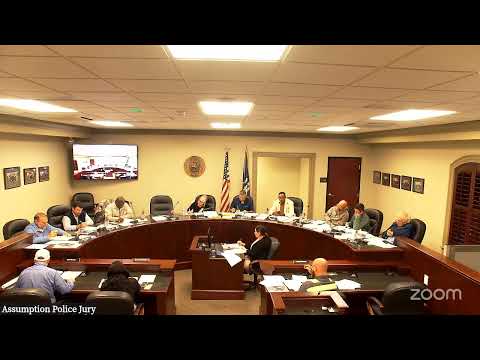
Assumption Parish jury votes to require connections, start enforcement for consolidated sewer district
Summary
After lengthy debate, the parish police jury ordered staff to identify parcels inside consolidated sewer boundaries and begin enforcement so properties feasible to connect will be required to tie in and be billed; commissioners and staff outlined coordination with the Waterworks and the state sanitarian and a 30‑day notice process.
The Assumption Parish Police Jury voted Wednesday to identify parcels within consolidated sewer‑district boundaries and require residences that can be served to connect and begin being charged, moving the parish toward enforcement of long‑unresolved sewer billing gaps.
The motion, made by Mr. Blanchard and seconded by Mr. Diaz, passed in committee and in open session after extended discussion of maps, billing records and enforcement logistics. Staff said they will produce a parcel/address list for the Waterworks and the parish sanitarian to determine feasibility and to trigger the state’s 30‑day notice to connect where applicable.
Why it matters: Commissioners said the action aims to correct historic underbilling and bring more properties into the system in accordance with state sanitation rules. Several jurors emphasized the need to coordinate the timing with the water billing cycle, to provide clear notice to residents and to avoid overwhelming local plumbers or the permitting office with simultaneous tie‑in requests.
Staff and legal context: Paul (parish staff) reviewed proposed district maps and previous minutes; the sanitarian told the jury the state sanitation code authorizes issuing 30‑day notices to properties the sanitarian determines are feasibly serviceable. Commissioners asked who would pay for tie‑in plumbing work and how the parish would handle private systems and exceptions; staff said typical practice is that homeowners pay installation costs while the parish handles any work in parish right‑of‑way.
Next steps: The jury directed staff to compile a complete address list and maps, coordinate with Waterworks and the sanitarian, and return with timing recommendations and estimated enforcement dates so the jury can set an effective date for billing. Several jurors asked staff to prioritize public outreach so residents receive clear instructions about whether they must connect and how billing will begin.
The jury did not adopt a specific effective date for charges at the meeting; that will follow once the Waterworks and the sanitarian confirm feasibility lists and enforcement logistics.