Get Full Government Meeting Transcripts, Videos, & Alerts Forever!
Get email alerts on the Land Use Solar topic
No spam. Unsubscribe anytime.
Board upholds Planning Commission and denies Sunfish/BayWa solar permit after intense community opposition
Summary
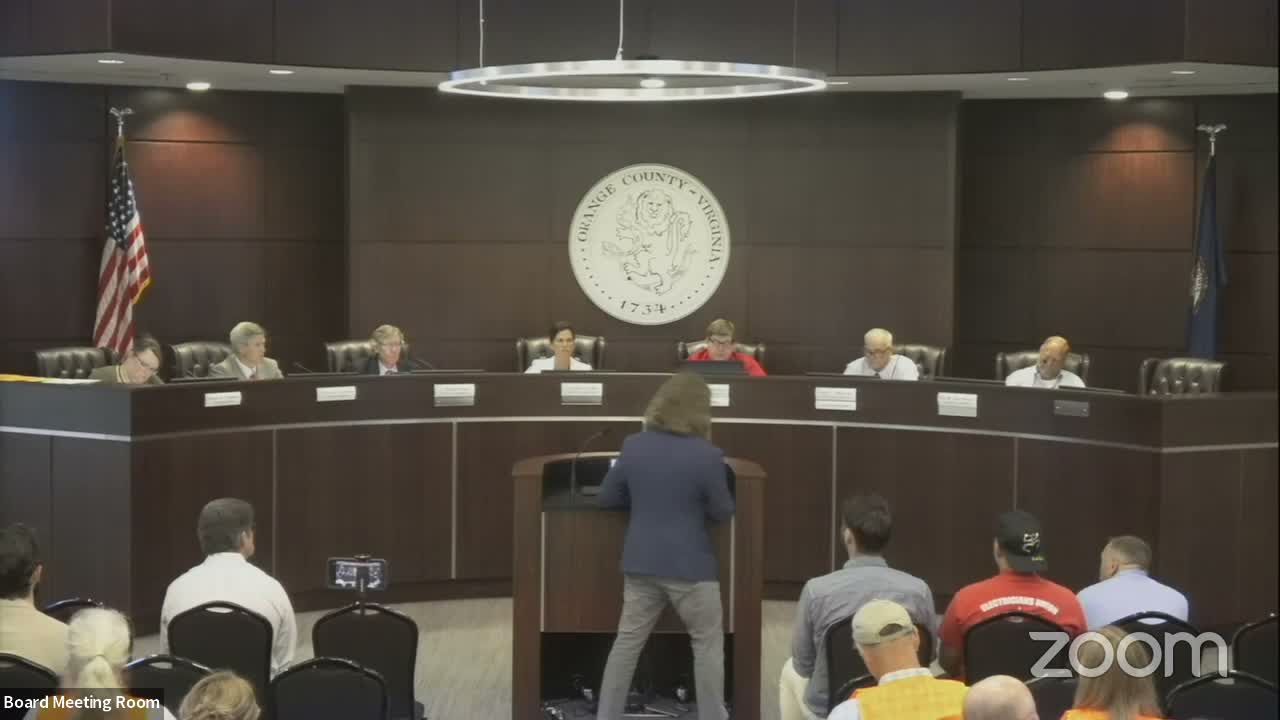
After lengthy presentations and 22 additional public speakers, Orange County supervisors upheld the Planning Commission’s finding that the Sunfish/BayWa 80 MW solar project was not in substantial accord with the comprehensive plan and then denied the special-use permit by a 5-0 vote.
Orange County’s Board of Supervisors on Aug. 13 upheld the Planning Commission’s determination that the proposed Sunfish Solar project was not in substantial accord with the county comprehensive plan, and followed by voting 5‑0 to deny the special‑use permit (SUP 23‑10) requested by BayWa/Sunfish.
Staff framed the matter as an appeal of the Planning Commission’s substantial-accord finding (required for state‑regulated public utility facilities), explaining that the commission had concluded the project—originally proposed across options totaling 932 acres and subsequently narrowed—was too large and would adversely affect prime farmland and viewsheds. Planning & Zoning Services Manager Josh Frederick told the board the ordinance and comprehensive-plan review had raised concerns about viewshed impacts and potentially inadequate buffers.
Will Calloway and John Crosby, representing BayWa/Sunfish, argued the project met zoning standards, described revisions since the planning commission hearing (including removing 23 acres from a roadway-facing area and enlarging buffers), and proposed a decommissioning bond and a siting agreement that would provide the county up to $24,000,000 over the life of the project. "We will provide 80 megawatts," Calloway said, and described commitments to buffers, pollinator habitat and worker training; the applicant also emphasized road‑maintenance bonds and third‑party financial surety for decommissioning.
More than 50 members of the public spoke across the two hearings and public-comment sessions. Opponents warned the project would convert prime A2 agricultural land to an industrial energy use, harm historic and scenic resources, depress nearby property values and create stormwater and erosion risks during construction. Environmental and land‑use advocates urged reducing the footprint, stronger buffer and soil‑management commitments, and incentivizing agrivoltaic practices. Labor unions and some residents supported the project for construction jobs and projected local revenues. "This project is not a farm," a sixth‑generation farmer told the board, arguing that grazing sheep beneath panels does not equate to preserving agriculture.
In board deliberations supervisors referenced the comprehensive plan’s intent to preserve rural character and prime farmland; several said the scale and location of the proposal made it inconsistent with that vision. Supervisor (District 3) said the comprehensive plan’s purpose is to set the county’s long-term character and that "not once have I read through this plan that a thousand acres of prime farmland covered in solar panels was the vision." Another supervisor noted the difference between a by‑right small use and a large industrial operation and the county’s responsibility to weigh those differences.
After board members moved to uphold the Planning Commission and then deny the SUP, roll-call votes were unanimous (5-0) on both actions. Because the SUP was denied, the siting agreement item was rendered moot and was tabled by the board.
The denial ends the county’s consideration of SUP 23‑10 in its current form. The board did not adopt additional countywide solar rules at the meeting; supervisors and members of the public suggested the county revisit ordinance updates to address decommissioning, erosion controls and maximum project sizes for future applications.