Get Full Government Meeting Transcripts, Videos, & Alerts Forever!
Get email alerts on the Water Quality topic
No spam. Unsubscribe anytime.
Orange County ratifies and closes local emergency after widespread water contamination; residents press for answers
Summary
The Board of Supervisors unanimously ratified a local emergency and its closure after a multi-agency response to a water contamination episode that left thousands briefly without usable potable water. Residents called for transparent investigation, health guidance and a public town hall.
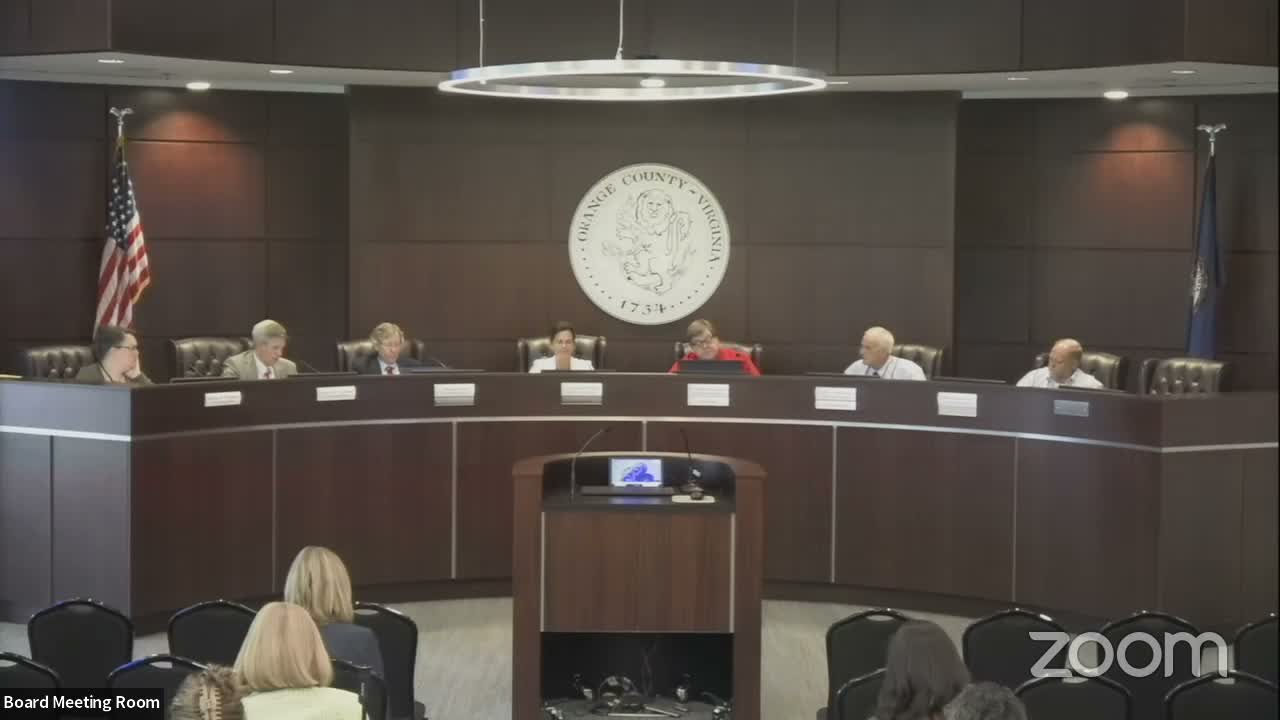
Orange County’s Board of Supervisors on Aug. 13 formally ratified a local emergency that county staff had declared in the days after a widespread water contamination episode, and voted to close that emergency at the meeting.
County Administrator Ted Voorhees described the standard procedure for emergency declarations and said staff consulted the chairman and other leaders before issuing the verbal declaration and later reducing it to writing for ratification. “This is a local emergency, and I want to give a shout out to our emergency management team,” Voorhees said, thanking County of Orange Fire & EMS, the sheriff’s office, social services, school staff and dozens of volunteers who helped distribute water and stand up temporary services.
The board voted 5-0 to ratify and close the emergency. Supervisors used the floor to thank first responders, volunteer groups including the Lake of the Woods Lions and Rappahannock-Rapidan Medical Reserve Corps, and private donors. Supervisor (District 4) said the declaration and response were “swift” and appropriate for the community’s needs.
During the meeting’s public-comment period, multiple residents — representing neighborhoods including Locust Grove, Somerset Farm and Lake of the Woods — described ongoing problems in their homes: a persistent metallic or diesel-like odor and taste, discolored water after flushing, and health concerns. “Our water smells like diesel and WD‑40,” Kathleen Stevens told the board, asking why the problem was not reported sooner and whether the county would pursue legal relief or reimbursement for cleaning and elevated bills.
Other speakers urged clearer, faster public notification from the water authority (RSA) and more aggressive local follow-up. Several residents asked for a formal independent investigation, regular public updates and a future town hall to address outstanding questions about the cause and the potential for chronic health effects. A resident called on the board to consider a permanent ‘neighborhood water watch’ committee to increase oversight.
Board members agreed that further local engagement is needed: several supervisors endorsed an after-action report and analysis of the county’s emergency response, and Supervisor Hale asked the board to host a town hall for community questions. The board did not announce a timeline for a follow-up town hall during the meeting but said staff would return with details.
Next steps identified during the meeting include an after-action review, continued coordination with state agencies and a promise of more public engagement to explain what is known and what remains under investigation. No new technical cause was announced at the meeting; multiple residents emphasized that the source remains unresolved and demanded more transparency and testing results.