Get Full Government Meeting Transcripts, Videos, & Alerts Forever!
Get email alerts on the Court Funding topic
No spam. Unsubscribe anytime.
Panel advances bill to shift judge salaries to state, reset court fee split and cap installment fees
Summary
The Senate Judiciary Committee advanced a bill stemming from a two‑year task force that would move district judges’ salaries onto the state payroll, standardize a 50/50 split of court costs and fees between courts and the state, and reduce installment-processing charges to $7.50 with a $90 per-defendant cap and a temporary sunset for review.
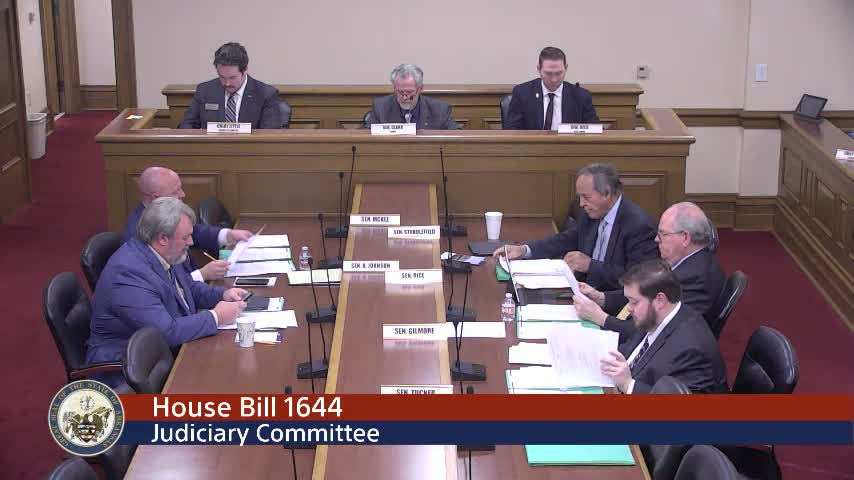
Representative Carol Dolby presented a comprehensive judiciary reform bill that the Judiciary Committee moved forward Wednesday, saying the measure implements recommendations from a two‑year task force on district courts.
Dolby told the committee the bill takes three principal steps: it directs that all district court judges’ salaries be paid from the state constitutional officers’ fund so cities and counties are no longer required to contribute to judges’ pay; it standardizes retained shares so district courts remit 50% of court costs and fees to the state and retain 50%; and it lowers an installment-processing fee used to fund court automation from $10 to $7.50, limits the maximum any defendant could be charged to $90 and includes a sunset to allow the Legislature to reassess the fee.
Dolby said stakeholders — including the Administrative Office of the Courts, the Municipal League, the County Association and district judges — participated in drafting the bill. She told senators the change should relieve counties and cities of an obligation that for some jurisdictions had become a substantial local burden after Amendment 80 reorganized court structures 25 years ago.
Committee members asked how the changes would be implemented and whether shifting fees and priorities would create winners and losers among local courts. Dolby acknowledged disparities but said eliminating local salary obligations should moderate the net effect over time. Senator Tucker raised technical questions about the statutory language for fee distribution and the mechanics of the sunset; Dolby and AOC staff offered to refine statutory citations before floor action.
Dolby also framed the installment‑fee adjustment as a partial measure: removing the $2.50 difference would avoid an immediate $14 million hole in court‑automation funding, she said, while capping individual liability and sunsetting the change to evaluate longer‑term reforms.
The committee recorded a do‑pass motion and advanced the bill by voice vote. The measure will be available for further amendment and floor consideration.