Get Full Government Meeting Transcripts, Videos, & Alerts Forever!
Get email alerts on the Zoning Ordinance Update topic
No spam. Unsubscribe anytime.
Orange County Board reviews Berkeley Group diagnostic, consultant urges full update and public engagement
Summary
The Berkeley Group presented a diagnostic of Orange County’s zoning and subdivision ordinances, reporting that most mandatory Code of Virginia provisions are met but recommending a unified development ordinance, targeted updates (including solar decommissioning bonding), and broad public engagement; the board asked staff to circulate a scope of work and return in January.
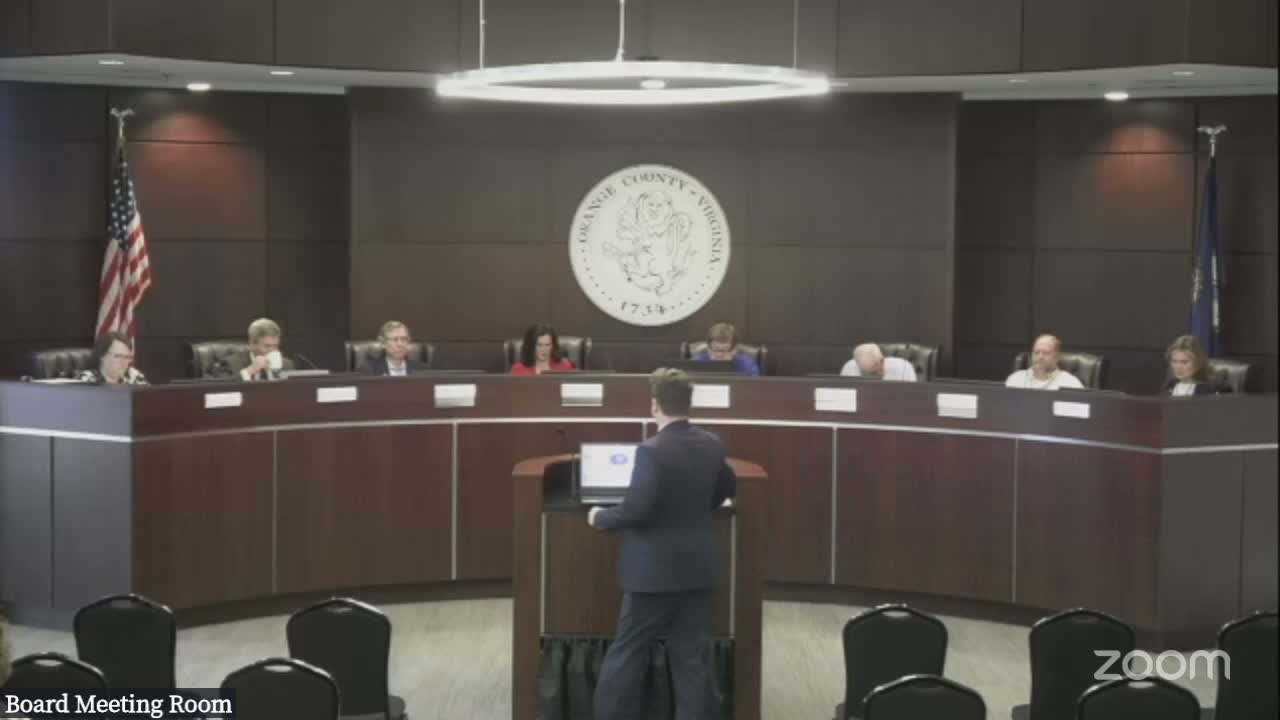
The Orange County Board of Supervisors heard a diagnostic presentation from the Berkeley Group during a work session, detailing how the county’s zoning and subdivision ordinances align with the Code of Virginia and recommending a program of updates and public engagement.
The Berkeley Group consultant told the board that the county is “mostly in compliance with the Code of Virginia” but flagged specific gaps and modernization needs. The report—provided to board members and organized with diagnostic appendices—identifies where mandatory and optional state provisions are included, partially included or missing and recommends reorganizing the ordinances into a single unified development ordinance to improve clarity.
The consultant summarized the report’s key metrics: of 138 Code of Virginia sections related to zoning, 117 apply to Orange County; of those, 77 are mandatory. The consultant said the county is fully compliant with 61 mandatory items, partially compliant with nine, and has seven mandatory provisions that were not addressed. Of 40 optional provisions, the consultant reported 15 are included in the county’s zoning ordinance.
Among the consultant’s specific recommendations were: ensuring all mandatory Code of Virginia sections are addressed; restructuring the ordinance so related regulations live together; creating a consolidated use matrix; modernizing use and design standards (lighting, signs, parking, landscaping); clarifying broad catch-all uses such as agritourism; and adding graphics and tables to improve public comprehension. On subdivisions, the consultant said the subdivision ordinance is generally well organized but noted four sections of noncompliance and suggested optional additions such as solar facility decommissioning and bonding and mechanisms for infrastructure reimbursement.
“The key takeaway from our analysis of your zoning ordinance is that you’re mostly in compliance with the Code of Virginia,” the Berkeley Group consultant said. The consultant also said, “We do recommend kind of a full update to the zoning ordinance, and our work order reflects that at this moment,” and urged the board to undertake robust public engagement before adopting major changes.
Board members thanked the consultant and said they would need time to read the new report. One board member said the work should preserve the county’s character while reorganizing and updating regulations. Staff told members they would circulate the consultant’s scope-of-work/change order and recommended that the board compile comments and, if appropriate, forward them and the scope to the planning commission for further review.
As a next step, staff said they would distribute the scope-of-work change order to the board, accept questions, and place the matter back on the agenda at the board’s first meeting in January to consider priorities and any activation of the consultant’s work order.