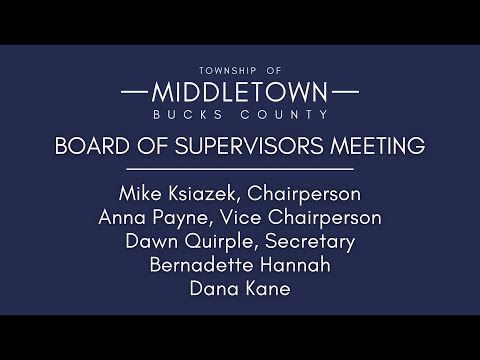
Middletown supervisors approve RDA grants, adopt updated fee schedule and authorize fire-services plan
Summary
At its Jan. 18 meeting, the Middletown Township Board of Supervisors unanimously approved three Redevelopment Authority grants totaling $416,197, adopted an updated municipal fee schedule including a new false-alarm charge, accepted multiple resignations and appointments, and authorized a $15,385 contract for a fire services strategic plan.
The Middletown Township Board of Supervisors on Jan. 18 approved a series of routine and policy items, including three grants from the Redevelopment Authority of Bucks County, adoption of an updated fee schedule, several personnel appointments, and a contract to develop a fire services strategic plan.
The board approved three RDA grant resolutions: Resolution 22-1 accepts $128,536 for police vehicles; Resolution 22-02 accepts $240,076 for public works vehicles; and Resolution 22-03 accepts $47,585 for a William Penn Fire Company chiefs vehicle. During public comment resident Andy Warren asked whether the grants must be repaid; the board’s response said the awards are not repayable and identified the funding source as casino revenue from Bensalem Township. The RDA resolutions passed by voice vote, 5-0.
The board also adopted a revised municipal fee schedule under Resolution 22-04 to update fees last reviewed in 2019. Township staff said the update reflects costs borne by the township and adds line items for recently adopted regulations (including a massage-parlor permitting fee) and a false-alarm charge aimed at chronic commercial repeat offenders. Interim director Don Harris participated in the presentation. A resident who uses a personal medical alert service raised concerns about sensitivity of systems; staff said the proposed false-alarm fee targets commercial sites with many dispatches and that staff will work with individual residents if their systems cause unnecessary responses. The fee resolution was adopted, 5-0.
On personnel matters, the board accepted resignations from Christy Ann Morris (Board of Auditors), Roberta Laney (Zoning Hearing Board) and Bernadette Hannah (Human Relations Commission). It reappointed John Allen, Mark Shubin and Anthony Spesato (transcript also shows spelling variants) to the Historical Preservation Commission for two-year terms through Dec. 31, 2023 and appointed James McCafferty to a Zoning Hearing Board vacancy through Dec. 31, 2024. All motions passed by unanimous voice vote.
The board authorized a contract with Dynamics Consulting to develop a fire services strategic plan. Township staff explained the firm was contracted in 2021 to perform a fire services study and will now be reengaged to create a strategic plan that implements prior recommendations; the plan will include resident engagement, confidential member surveys for local fire-company personnel and a one-day on-site workshop. The consultant and staff estimated the overall strategic plan would span three to five years in implementation, with some actions completed during the calendar year. The contract was amended on the floor to specify a not-to-exceed amount of $15,385 (budgeted in the 2022 budget) and was approved, 5-0.
The board approved a consent agenda that included payment of the bills list of $759,259.65, approval of January meeting minutes and authorization to advertise a cleaning-services bid.
An ordinance hearing for Ordinance 21-09, an age-qualified overlay related to the Stone Farm matter, was opened and continued to the Feb. 22 Board meeting to allow additional information and discussion. The board also noted it had met in executive session before the meeting to discuss litigation matters.
Procedural votes were taken by voice and recorded in the meeting as unanimous where noted; individual vote-by-name tallies were not read into the record. The board adjourned at the conclusion of regular business.
AI generated
The text on this page is AI generated. Summaries, highlights, analysis, and video transcripts are all produced from the original source material.
AI can make mistakes, so if you spot one, and we will fix it for everyone.
Note: the source content is unaltered by us. Any content source we link to, be it a video, an audio recording, or a document, is presented exactly as its publisher released it. That publisher is usually a government body, sometimes an individual official or another organisation.