Get Full Government Meeting Transcripts, Videos, & Alerts Forever!
Get email alerts on the Health And Wellness topic
No spam. Unsubscribe anytime.
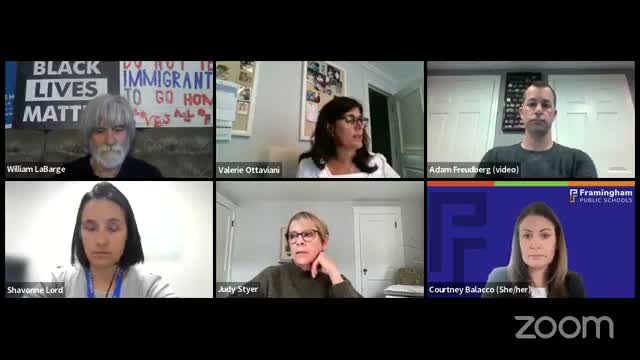
Framingham subcommittee approves health and wellness goals; district outlines K–4 rollout and e-hall pass expansion
Summary
The Framingham Public Schools Health & Wellness subcommittee approved its Feb. 2024 goals 4–0, endorsing use of recently purchased curriculum (bought with lawsuit-related funds), a districtwide e-hall pass rollout (except pre-K), continued expansion to full-time K–4 health teachers and targeted tracking of health-related absenteeism.
Framingham Public Schools' Health & Wellness subcommittee met and approved its subcommittee goals for February 2024 by a 4–0 roll-call vote, moving the goals on to the full committee.
The subcommittee's agenda focused on prevention education, staffing for K–4 health and wellness, attendance, and tools to manage student movement. Chair opened the meeting by noting the district used funds from a lawsuit “against Jewel” to purchase a new health curriculum aimed at educating students about the hazards of smoking, vaping, alcohol and other substance use. The new curriculum is being reviewed for how it will be scheduled and deployed across grades.
Members discussed the district’s recent rollout of an e-hall pass system. Unidentified staff reported the system is active in all schools in the district except prekindergarten and said anecdotal observations show improved hallway traffic. “I noticed a substantial, improvement in terms of, like, foot traffic in the hallways,” the staff member said, adding that stricter cell-phone expectations have also reduced hallway congestion and allowed staff to manage movement for students on safety plans.
On curriculum and staffing, district staff said the district has reallocated existing full-time equivalent positions to create more K–4 health teaching roles. The result is five elementary schools now have full-time K–4 health teachers, while four schools continue to be served by an itinerant (rotating) teacher. Staff described prior use of a rotating teacher model and said the district is working to make lesson delivery consistent across schools using the newly purchased curriculum and existing Social-Emotional Learning lessons (Second Step).
Members raised equity and scheduling questions. One member asked whether 55 minutes is an appropriate block for the new special; staff said most lessons run 30–50 minutes and that movement and SEL activities are used to keep lessons active. Second Step bullying lessons, staff said, typically run 20–25 minutes and can supplement the health lessons.
The subcommittee agreed to track absenteeism tied specifically to health and wellness, while avoiding duplication with the Teaching & Learning subcommittee’s work on broader chronic absenteeism metrics. Chair noted school nurses are actively working with families ahead of the Nov. 1 exclusion date for students who have not received recommended vaccinations.
Staff also described home/hospital instruction rules: the district must provide instruction when students are out for 14 or more days with physician affirmation (medical or mental-health hospitalization). Staff offered to provide data on how many students require home/hospital instruction each year, estimating at the elementary level “anywhere from, like, 2 to 5 students” in shorter windows.
On formal business, Adam moved to approve the Health & Wellness subcommittee goals and send them to the full committee; the motion was seconded and passed by roll call (District 4: yes; District 5: yes; District 6: yes; District 9: yes). The committee also approved the October minutes during the meeting and then adjourned at 3:28 p.m.
The next steps recorded were that staff will: gather data on e-hall pass effectiveness and home/hospital counts for the next meeting, report MetroWest adolescent survey results when available, and continue to evaluate staffing needs as attrition creates opportunities to convert positions into more K–4 health teachers.