Get Full Government Meeting Transcripts, Videos, & Alerts Forever!
Get email alerts on the Mbta Housing topic
No spam. Unsubscribe anytime.
Framingham school committee urges planning board and council to weigh school impacts of MBTA Communities housing plan
Summary
After public comment and staff analysis, the Framingham School Committee unanimously authorized the chair to send the district's data and concerns to the planning board and city council, highlighting a district estimate of roughly 0.15 students per new housing unit—about 653 students if 4,355 units are built—and urging education review before zoning votes.
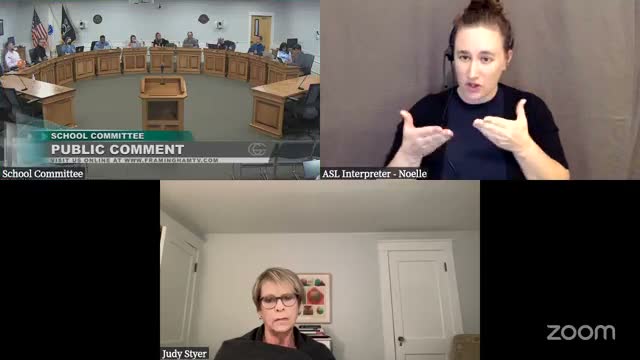
The Framingham School Committee voted unanimously to ask the planning board and city council to consider the district’s capacity and funding needs as the city plans to comply with the MBTA Communities Act.
At a discussion added to the agenda, Executive Director of Finance and Operations Lincoln Lynch summarized a memo and an enrollment formula the district uses that estimates about 0.15 students per housing unit. Applying that ratio to the 4,355 units cited in city materials yields roughly 653 additional students, Lynch said, though he stressed the units would be built over many years and the estimate should not be treated as a fixed projection.
"We see 0.15 students per unit," Lynch said. "So I think the number is 4,355 units at times 0.15 is 653 students." He added that the district budgets incrementally and will request resources when new students actually arrive.
In public comment, Herb Chasen cited a Framingham Public Schools analysis that he said projects about 658 new students and "almost $11,000,000" in added costs, and asked whether the district is prepared for classroom overcrowding, bus challenges and sidewalk and crosswalk needs. "Are the schools prepared and planning ahead?" he asked.
Superintendent Dr. Trembley and staff described how the district derived the 0.15 figure by comparing actual student yields from existing local apartment complexes to unit mixes and developer projections, and cautioned that tenant mix and timing make forecasting imprecise. "What we don't know is the number of kinds of units that will go in and how many will bring families there," Trembley said, adding that the formula is the best available estimator to date.
Multiple committee members said the district should be more actively involved in early planning. "We need to have a seat at the table now before the decisions are made," said Mr. Freidberg, who moved the formal authorization. The motion instructs the chair to communicate the committee’s concerns—early childhood education, potential need for a new elementary school, transportation implications, affordable housing for staff and the request that the district be included in planning discussions—to the planning board and city council.
Mr. Robles seconded the motion. The committee conducted a roll-call vote with all members recorded in the affirmative. Chair said she would send the packet "as soon as possible" and noted the city council has a public hearing scheduled.
Lincoln Lynch also noted he represents the district on the city's technical review team and that district staff raise questions at project-level reviews, but several members argued that the scope of the MBTA Communities zoning changes merits earlier and broader consideration by city decision-makers.
The board did not set any funding commitments at the meeting; Lynch emphasized the district will pursue resources through the regular budgeting process as student arrivals are confirmed. The chair said she will forward the committee’s packet and concerns to the planning board and city council ahead of upcoming hearings.