Get Full Government Meeting Transcripts, Videos, & Alerts Forever!
Get email alerts on the School Policies topic
No spam. Unsubscribe anytime.
Framingham subcommittee forwards package of student‑behavior and wellness policy changes after clarifying nutrition, bus and bullying language
Summary
A Framingham Public Schools policy subcommittee reviewed a bundle of revisions covering nutrition and wellness, competitive‑foods language, student conduct on buses, bullying prevention and athletics eligibility and voted 3–0 to send the recommended changes to the Teaching & Learning subcommittee for further review.
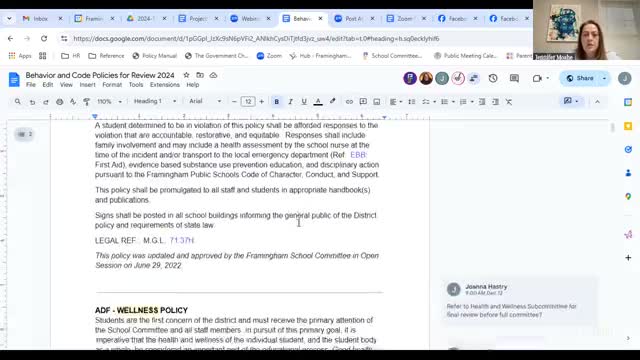
A Framingham Public Schools policy subcommittee on June 18 reviewed a package of changes to student conduct and wellness policies and voted to send the recommended edits to the district’s Teaching & Learning Subcommittee for review before a first reading by the full school committee.
The package covered multiple policies, including the wellness policy (ADF) and its nutrition guidelines, rules about competitive foods on campus, student conduct on buses (JICC), the district’s bullying prevention language and updates aligning athletics eligibility with MIAA standards. Unidentified Speaker 1, a subcommittee member who chaired the meeting, moved to approve the recommendations and send them to Teaching & Learning; the motion was seconded and approved in a 3–0 roll call vote.
Why it matters: the changes clarify when nutrition standards apply, how parents can access nutritional information, and how discipline and procedures around student conduct and bullying are organized. Those clarifications affect daily practice for students, school staff and parent volunteers and determine what rules apply during school hours versus after‑hours events.
Nutrition and wellness: statute citations and competitive foods Committee members pressed staff on whether to include the formal name of the Richard B. Russell National School Lunch Act in policy text or to reference the law more generally and put a specific citation in a references section. Tiffany (Speaker 2) said she was hesitant to include the statute name in the body because “that might change, at any point, and then we would have to revisit it” and suggested placing citations in a references section. Judy (Speaker 3) said the statute is commonly called the National School Lunch Act and has practical value as a reference.
The subcommittee also spent significant time on the competitive foods section, questioning wording such as the clause excluding “nonsweetened carbonated water.” Members sought clarity on whether bake sales, PTO events or booster concession stands fall under the policy during the school day. Miss Polacco (Speaker 4) said the phrasing was drawn from the DESE model policy and explained that the recent language clarified that plain seltzer/club soda is not treated as a competing beverage. Members asked staff to add clearer examples and to note the typical 30‑minute exemption that applies before and after the school day so readers understand when the rules apply.
Access to nutritional information Parents and committee members discussed how students will access nutritional information near the point of purchase. A committee member described the NutriSlice app and requested confirmation that kitchen staff have the same information and that a hard copy remain available in kitchens for students who need it for medical reasons (for example, carbohydrate counting). Staff said they would verify NutriSlice availability with the director of food services and confirm hard‑copy access.
Free meals and policy references A committee member noted the district currently provides free breakfast and lunch to all students and that the program is in place “until the end of the 2026 school year,” asking whether that operational fact should be referenced in policy or left to a separate policy/process. The subcommittee agreed to reference the separate free‑meal policy where appropriate rather than embedding operational program dates directly into the nutrition policy.
Student transportation and conduct on buses On JICC (student conduct on buses), members recommended strengthening enforcement language so it reads that transportation privileges may be revoked for students who abuse the privilege, and sought to clarify forfeiture language for paid busing versus routes provided without fee. The subcommittee discussed how details of progressive discipline and exact offense thresholds often belong in the code of conduct or living regulations rather than in policy text.
Bullying prevention and living documents Members debated removing detailed prevention/intervention plan text from the policy manual and instead linking to a living bullying prevention and intervention plan that can be updated as guidance evolves. Several members emphasized retaining a clear reporting section in the policy so parents know how to report incidents and what procedural steps to expect (investigation and student safety planning).
Athletics eligibility and other updates The committee discussed aligning co‑curricular eligibility requirements with Massachusetts Interscholastic Athletic Association (MIAA) standards and noted the district’s prior practice of higher local thresholds. Other minor updates include grammatical edits and cross‑references to the student code of conduct.
Actions taken The subcommittee voted 3–0 to approve the recommended changes and forward them to the Teaching & Learning Subcommittee for review ahead of a first reading by the full school committee. The subcommittee also approved three sets of minutes (Nov. 7, 2023; Mar. 27, 2024; Jun. 18, 2024) by unanimous roll call and adjourned at 5:11 p.m.
What’s next The Teaching & Learning Subcommittee will review the recommended edits; the package is expected to return to the full school committee for a first reading following that review.
Representative quotes from the meeting “I’m not sure if we wanna specifically put that in there because that might change, at any point, and then we would have to revisit it,” — Tiffany (Speaker 2), on naming the National School Lunch Act in policy.
“I believe, this language all comes from the model policy,” — Miss Polacco (Speaker 4), on competitive‑foods wording from DESE.
“So, I would like to make a, motion to approve the proposed changes and recommendations and send them to the Teaching and Learning Subcommittee for review,” — Unidentified Speaker 1, motion to forward the package.
The article is based on the subcommittee’s recorded discussion and roll‑call votes; procedural details, references to model policy and statutory citations were drawn from the meeting transcript and staff guidance provided during the session.