Get Full Government Meeting Transcripts, Videos, & Alerts Forever!
Get email alerts on the Student Discipline topic
No spam. Unsubscribe anytime.
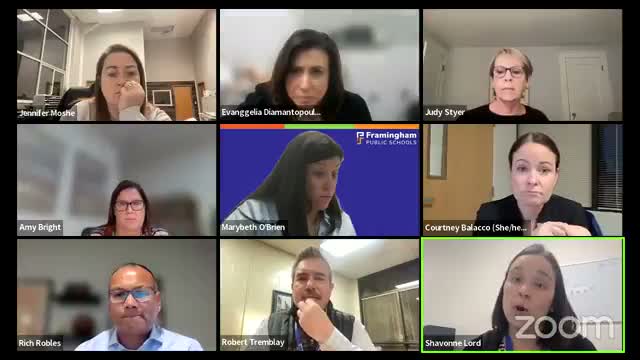
Framingham staff outline revisions to student code of conduct, add crisis protocol and phone expectations
Summary
District staff described targeted changes to the student code of conduct: a standardized crisis-response protocol, restored bus behavior matrix, clearer cell phone expectations, and a new administrators'action column for high-level incidents to align responses across schools.
District staff presented a set of targeted revisions to Framingham Public Schools'student code of conduct, saying the changes are designed to calibrate principals and other administrators in how they respond to disruptive or safety-related incidents.
The revisions include aligning the code with a standardized crisis-response protocol for behavior and mental-health emergencies, restoring a bus-behavior matrix, separating skipping/leaving-school incidents from public-space disruptions, and adding a protocol column that prompts administrators to assess a student's mental health when, for example, a student makes a threat. "The goal again there was to make sure that our administrators are calibrated as they're using the code," the presenter said.
Staff also added a new administrators'action column for level 4 and 5 behaviors, which the presenter described as "behaviors that are the most disruptive and impactful on a school community," and said the column lists who to call and which steps to take to ensure a consistent district response.
On cell phones, staff said the district has clarified expectations rather than changed them: visible or audible phones are taken and held for the day and returned at dismissal. The high school uses classroom pouches for phones, and staff said consistency across adults is the primary implementation challenge. "If it's seen or heard during the day, then it is gonna be taken and picked up, and you can get it at the end of the day," a presenter said.
Committee members asked for a comparison document showing proposed changes against the prior version. Miss Moshe said she wanted to "see the changes and the original versus the proposed" and staff agreed to prepare a comparison and share the Version 5 materials referenced in the meeting packet. Staff also described district supports tied to the code: attendance success plans, restorative circles, and check-in/check-out interventions, with training led by district staff and coaches to ensure consistent implementation.
The presentation concluded with staff noting that the intervention and protocol pieces are being integrated into MTSS (Multi-Tiered System of Supports) and that training across schools is ongoing so that students receive equitable supports districtwide.