Get Full Government Meeting Transcripts, Videos, & Alerts Forever!
Get email alerts on the Transportation topic
No spam. Unsubscribe anytime.
Framingham outlines plan to bring student busing in‑house, proposes $35/hr for drivers
Summary
District leaders presented a plan to operate student transportation in‑house starting July 1, citing improved oversight, safety, recruitment and potential cost savings; staff proposed $35/hour for drivers, $22/hour for monitors, paid training, retention bonuses and a January job posting timeline.
Framingham Public Schools staff outlined a plan on Nov. 20 to bring student transportation operations in‑house beginning July 1, citing improved control, safety and recruitment as primary reasons for the change.
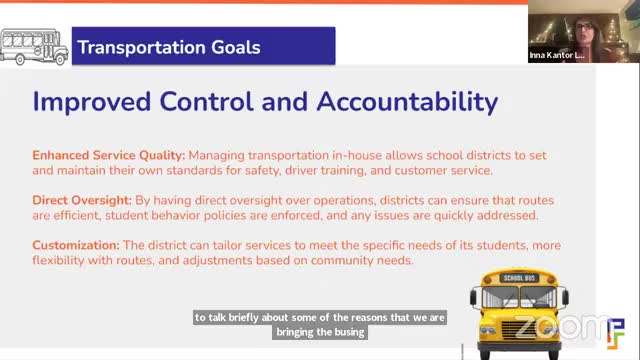
"We will be bringing the busing in house to maintain our own standards for safety, our own driver training, and we can really focus on customer service to our students and families," Transportation lead Ina London said during a slide presentation that described anticipated benefits including GPS tracking, real‑time communication with parents, rigorous background checks, and in‑house driver training.
Executive Director Lincoln Lynch said the district aims to be competitive in wages and benefits to attract drivers in a tight labor market. "We are looking for a very competitive pay of $35 an hour for our drivers and $22 per hour for our monitors," London said, adding that drivers would be eligible for city retirement and other city benefits if they meet eligibility requirements.
Committee members pressed for operational specifics. On weekly hours, Lynch said the district would offer a flexible spectrum of shifts — from roughly 2.5–3 hours for limited runs up to full‑time home‑to‑school schedules and additional athletic and field trip hours — to attract part‑time and full‑time applicants. On training, staff estimated approximately three months for an applicant without a commercial license to become fully certified; staff set a goal to post finalized job descriptions by January to allow six months for recruitment and training before the July start.
Members advocated for paid training and signing/referral bonuses to boost recruitment and retention. "Paid professional development is absolutely necessary," London said, and Lynch noted other districts’ success with attendance payouts and summer retention incentives. Staff also said they have met with MassHire and other districts to learn best practices and have drafted job descriptions and compensation packages.
The district outlined steps already completed: cross‑departmental planning meetings, consultation with the city and district attorney on labor questions, draft job descriptions translated into multiple languages, and coordination with MassHire for recruitment and training.
Committee members encouraged an aggressive communications plan, including internal referral incentives and a public ask for applicants. Staff said they will return with a posting and finalized compensation details and will report back on recruitment progress and training timelines.