Get Full Government Meeting Transcripts, Videos, & Alerts Forever!
Get email alerts on the Student Survey topic
No spam. Unsubscribe anytime.
Framingham High students report broad implementation of new phone and e‑hall‑pass procedures in 1,374‑response survey
Summary
Student Advisory Council presented results from multilingual surveys showing majority student reports that e‑hall passes and bathroom safety procedures are widely used and that the cell‑phone policy is implemented in most classes; students flagged a missing question on the Spanish survey and low adoption of the InCaseOfCrisis app.
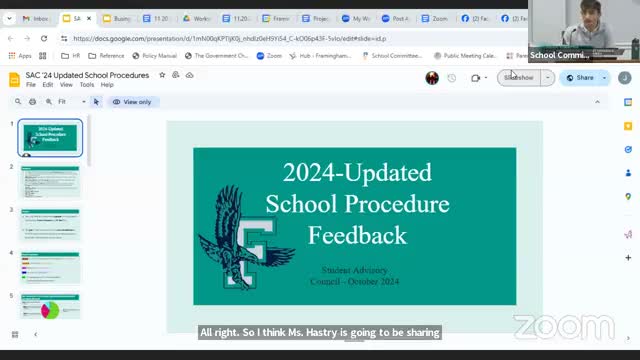
Framingham High School’s Student Advisory Council told the school committee on Nov. 20 that a student survey sent during extended advisory blocks drew 1,374 responses — about 56% of the student body — and showed widespread implementation of several updated school procedures.
“More than half of the students across the English and Portuguese surveys responded that the cell phone procedure has been implemented in their classes,” Student Advisory Council Chair Jordan Cohen said, adding that the Portuguese responses were higher on some items. The council reported roughly 55% of English‑survey respondents and about 71% of Portuguese respondents said the phone rule was being enforced in their classes.
The students said the e‑hall pass system — an electronic check‑in where teachers approve hall passes on a computer — was “implemented by their teachers in their classes” in a majority of responses across languages. On updated bathroom safety routines, the presentation reported 56% of English respondents said the routines had been completely implemented; the Spanish and Portuguese results trended higher in the same questions.
The SAC identified two key gaps. First, most students had not downloaded the InCaseOfCrisis app the district seeks to use for emergency check‑ins: “the vast majority had said no,” a student presenter said. Second, the students acknowledged a translation error: Cohen said a question about phone procedures was accidentally omitted from the Spanish survey. “We missed putting this question on the Spanish survey,” he said, and the council recommended correcting that in future distributions.
Students also described how they get school information: email, Parent/Student Square and advisory were the top channels in English and Portuguese, while Spanish respondents favored Parent/Student Square translations and the district website. The presenters said some translations on Parent/Student Square are currently inaccurate and that administration is working with the vendor to fix them.
Administration and committee members asked how Aspen and Canvas are used for grades and reports. A student representative said Canvas carries most up‑to‑date assignments and grades while Aspen provides final progress reports, report cards and transcript access.
The SAC recommended next steps including sharing the full results with staff, adding InCaseOfCrisis reminders to upcoming safety trainings, re‑issuing missing survey items in Spanish, and targeting additional students with opportunities to complete the survey. “While the majority of these procedures are being adhered to by students and staff, it is clear that there is some room for improvement,” Cohen said.
The committee commended the student presenters for turnout and data quality and asked staff to follow up on translation fixes and app adoption. The school committee accepted the presentation and directed administration to distribute corrected materials and the survey findings to staff.