Get Full Government Meeting Transcripts, Videos, & Alerts Forever!
Get email alerts on the Solar topic
No spam. Unsubscribe anytime.
Presenters tell Westmoreland supervisors solar is cheaper, manageable locally with ordinances and revenue deals
Summary
Energy Right briefed the Board and Planning Commission on utility-scale solar economics, stormwater and decommissioning rules, and recommended local ordinance elements (setbacks, buffers, bonding) and revenue-share or siting agreements to capture local payments.
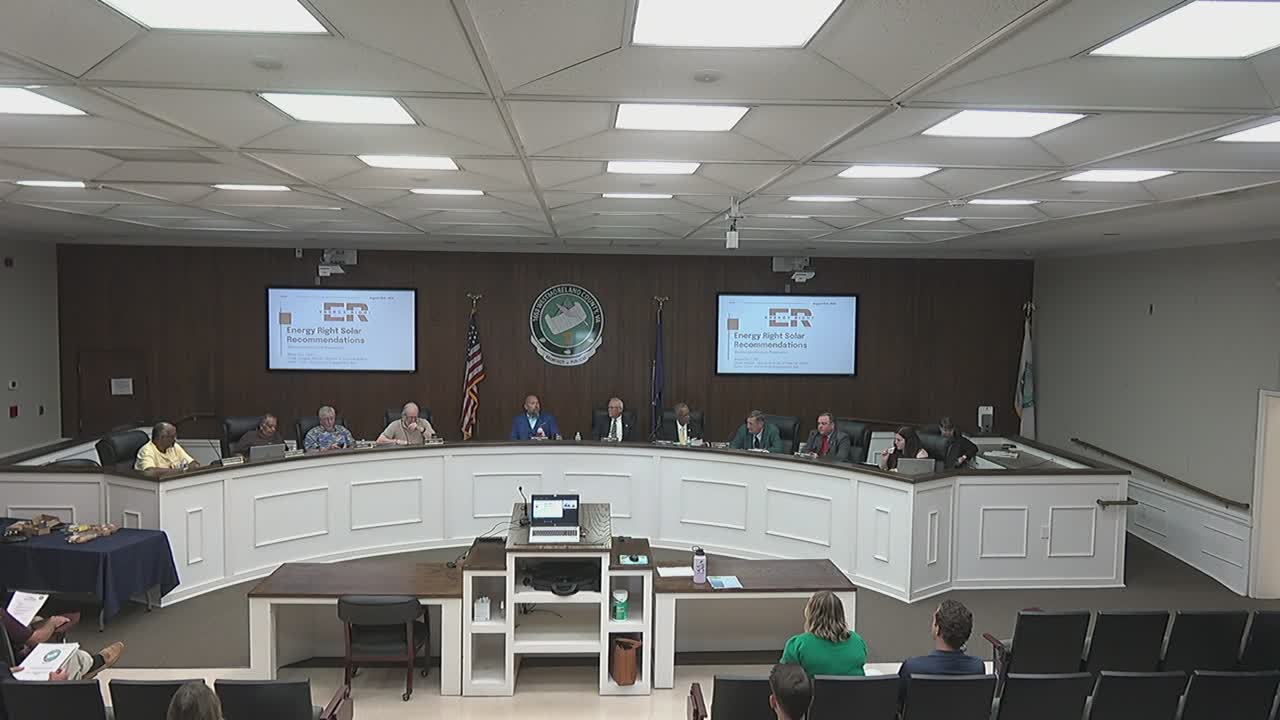
Energy Right, a Virginia organization that says it brings a ‘‘conservative, rural’’ perspective to clean-energy planning, presented a briefing to the Westmoreland County Board of Supervisors and Planning Commission on utility-scale solar development and policy options.
Skyler, a founder of Energy Right, told the joint meeting that the levelized cost of utility-scale solar has fallen sharply over the last decade and that utility-scale projects can now produce power far more cheaply than many other resources. He said larger projects require high-voltage transmission connections while smaller projects can use local distribution lines. ‘‘Over the past 10 or so years, costs have come down 80 to 90%,’’ Skyler said in the presentation slides and discussion.
Dylan and Chloe, Energy Right staff, addressed technical and community concerns. Dylan said Virginia Tech testing and field measurements do not show the soil contamination, heat-island effects, or EMF hazards that residents sometimes fear. ‘‘Solar panels produce non-ionizing radiation, which means that it's not cancer causing,’’ Dylan said.
Chloe reviewed state regulatory changes and local tools. She described a 2022 DEQ memo that changed how stormwater is calculated for panels and summarized HB 206 (passed in 2022) aimed at balancing agricultural land and solar siting. Chloe emphasized that state code requires land to be returned to ‘‘the same state or better’’ when panels are decommissioned and urged local ordinances to require decommissioning bonds and topsoil protection. She recommended standard setbacks (50–100 feet from property lines, 100–250 feet from homes) and vegetative buffers that can be tailored to county preferences.
Energy Right also described local revenue options: a revenue-share tax assessed per megawatt and negotiated siting agreements. The presenters gave a commonly used negotiation benchmark of about $25,000 in a siting agreement per megawatt and noted a statutory revenue-share example of roughly $1,400 per megawatt per year, rising by 10% every five years in the example shown.
Board members asked about how much energy produced in-county is used locally versus exported; Energy Right said large projects can be tracked on the PJM interconnection, while smaller co-op or Dominion interconnections require provider data. Planning commissioners asked for the slide deck and resources; Energy Right agreed to provide them.
The presentation closed with Energy Right urging strong community engagement and transparent public meetings if Westmoreland crafts or updates a solar ordinance. The presenters provided an ordinance template and offered follow-up assistance to staff and commissioners.
The board did not take any formal action on an ordinance at the meeting; presenters left materials for staff and commissioners to review.